Argia agrioides
California Dancer
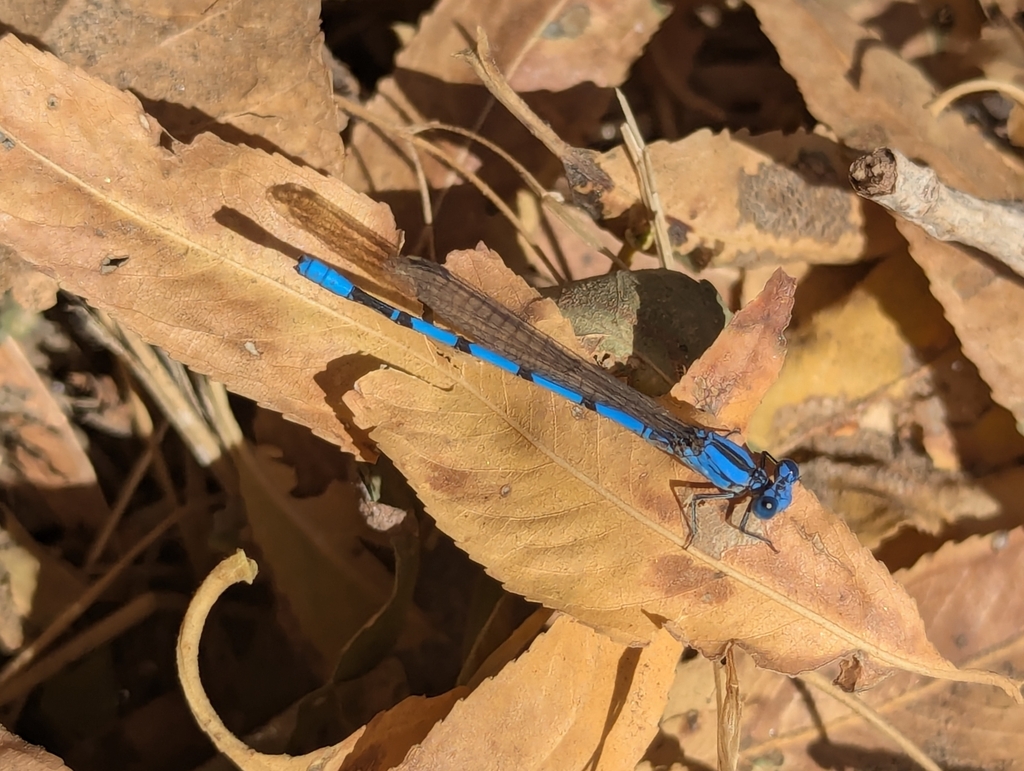
(c) Rachel Stringham, some rights reserved (CC BY) · licence
Family: Coenagrionidae · Class: Insecta · Order: Odonata
Argia agrioides (California Dancer) is a California animal in the Coenagrionidae family.
The California Dancer is a medium-sized damselfly belonging to the narrow-winged damselfly family Coenagrionidae. Adult males typically measure 35-40 mm (1.4-1.6 inches) in total length with a wingspan of approximately 50 mm (2.0 inches). Males display bright blue coloration on the thorax and anterior abdominal segments, with black markings creating distinctive patterns. The posterior abdominal segments often show purple or violet hues. Females are generally more subdued in coloration, with brown to tan bodies and similar black markings. Both sexes possess the characteristic narrow, clear wings held vertically above the body when at rest, typical of damselflies. Argia agrioides occurs primarily in the western United States, with its range extending from southern Oregon through California and into Baja California, Mexico. In California, the species is distributed throughout much of the state, from coastal regions to inland valleys and foothills. The species shows particular abundance in central and southern California, where suitable aquatic habitats are present. According to NatureServe, the species maintains a Global Status of G4, indicating it is apparently secure globally (NatureServe Explorer). California Dancers inhabit areas near flowing water, including streams, creeks, and small rivers. Unlike some Argia species that prefer slower-moving waters, A. agrioides shows a preference for faster-flowing streams with rocky substrates (BugGuide). The species occurs from sea level to moderate elevations in the foothills and mountains. Adults are commonly found perching on rocks, fallen logs, or vegetation along streambanks, often in partially shaded areas where riparian vegetation provides cover. Adult California Dancers are active fliers that hunt for small flying insects including mosquitoes, midges, and other soft-bodied prey. Males establish territories along suitable stretches of stream, defending prime perching and mating sites from other males. Mating occurs during the warmer months, typically from late spring through early fall, with peak activity in summer. Females deposit eggs in aquatic vegetation or directly into the water. The aquatic nymphs develop over one to two years, depending on water temperature and food availability, feeding on aquatic invertebrates and small crustaceans before emerging as adults. Currently, Argia agrioides does not hold any federal or state conservation listing status. The species appears to maintain stable populations throughout most of its range, though like many aquatic insects, it faces potential threats from habitat modification, water diversions, and pollution. Urban development and agricultural practices that alter stream flow patterns or water quality could impact local populations. Climate change may also affect the species through altered precipitation patterns and increased temperatures that could stress aquatic habitats. Despite these potential concerns, the species' apparently secure global status suggests populations remain viable across its geographic range.
Classification
Class: Insecta · Order: Odonata · Family: Coenagrionidae
Frequently asked questions
How is Argia agrioides classified?
Argia agrioides belongs to class Insecta, order Odonata, family Coenagrionidae.
What family does Argia agrioides belong to?
Argia agrioides is in the Coenagrionidae family.
What is Argia agrioides?
The California Dancer is a medium-sized damselfly belonging to the narrow-winged damselfly family Coenagrionidae.
Is Argia agrioides found in California?
Yes. Argia agrioides is recorded in California in The California Species Project's catalogue.
Related species
Other California species in the same genus, family, or bioregion.
Data from The California Species Project — 14,000+ California species with verified data from CNPS, CDFW, USFWS, and more.