Argia lugens
Sooty Dancer
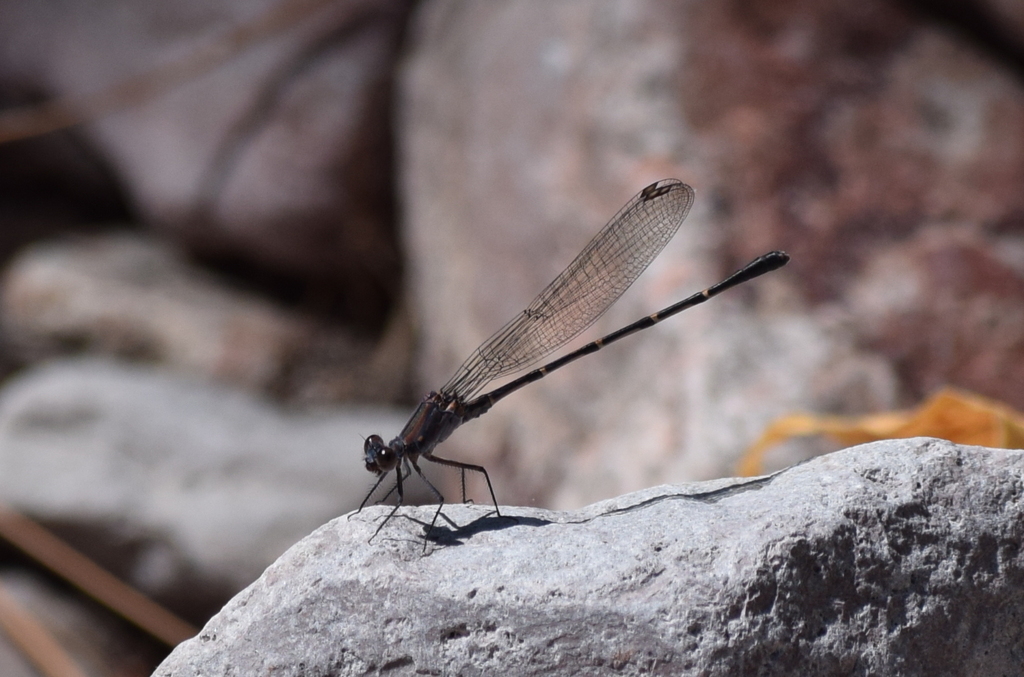
(c) William Harmon, some rights reserved (CC BY) · licence
Family: Coenagrionidae · Class: Insecta · Order: Odonata
Argia lugens (Sooty Dancer) is a California animal in the Coenagrionidae family.
The Sooty Dancer is a medium-sized damselfly in the family Coenagrionidae, characterized by its predominantly dark coloration. Males typically display a sooty black or dark metallic blue-black thorax and abdomen, while females are generally brownish with darker markings. Like other members of the genus Argia, this species exhibits sexual dimorphism in coloration and shows the characteristic slender build and delicate flight pattern typical of narrow-winged damselflies. Adults measure approximately 35-45 mm in total length with a wingspan of 45-55 mm. The Sooty Dancer occurs in western North America, with documented populations in California, Oregon, and other western states. In California, the species has been recorded from various counties including Butte County, where observations have been made at Upper Bidwell Park in Chico (BugGuide 2011). The species appears to have a patchy distribution throughout its range, often associated with specific aquatic habitat requirements. This damselfly inhabits areas near streams, seeps, and other flowing water bodies. The species shows a preference for rocky stream environments with moderate to fast-flowing water, distinguishing it from some closely related species that favor slower-moving or still water habitats. Adults are typically found along riparian corridors where they perch on vegetation near water sources. The association with flowing water systems suggests specific water quality and habitat structure requirements. Sooty Dancers are predatory insects throughout their lifecycle. Adults capture small flying insects including gnats, mosquitoes, and other soft-bodied prey using their strong mandibles and excellent vision. Mating typically occurs during warmer months, with males establishing territories along suitable water bodies. After mating, females deposit eggs in or near water on aquatic vegetation or submerged substrates. The aquatic nymphs are also predatory, feeding on various aquatic invertebrates including mosquito larvae, small crustaceans, and other aquatic insects. Development from egg to adult typically requires one to two years, with nymphs overwintering in aquatic habitats. The conservation status of the Sooty Dancer has not been formally assessed at federal or state levels, and the species does not appear on current threatened or endangered species lists. However, like many aquatic insects, populations may be vulnerable to habitat degradation, water quality changes, and stream modification. Climate change impacts on precipitation patterns and stream flow regimes could affect suitable habitat availability. The species' apparent preference for specific stream conditions makes it potentially sensitive to watershed-level changes including urbanization, agriculture, and water diversions. Monitoring of population trends and habitat conditions would be valuable for assessing long-term conservation needs. The patchy distribution pattern observed in some regions may reflect natural habitat limitations or could indicate population fragmentation due to human activities affecting riparian and aquatic ecosystems.
Classification
Class: Insecta · Order: Odonata · Family: Coenagrionidae
Frequently asked questions
How is Argia lugens classified?
Argia lugens belongs to class Insecta, order Odonata, family Coenagrionidae.
What family does Argia lugens belong to?
Argia lugens is in the Coenagrionidae family.
What is Argia lugens?
The Sooty Dancer is a medium-sized damselfly in the family Coenagrionidae, characterized by its predominantly dark coloration.
Is Argia lugens found in California?
Yes. Argia lugens is recorded in California in The California Species Project's catalogue.
Related species
Other California species in the same genus, family, or bioregion.
Data from The California Species Project — 14,000+ California species with verified data from CNPS, CDFW, USFWS, and more.