Argiope argentata
Silver Garden Orbweaver
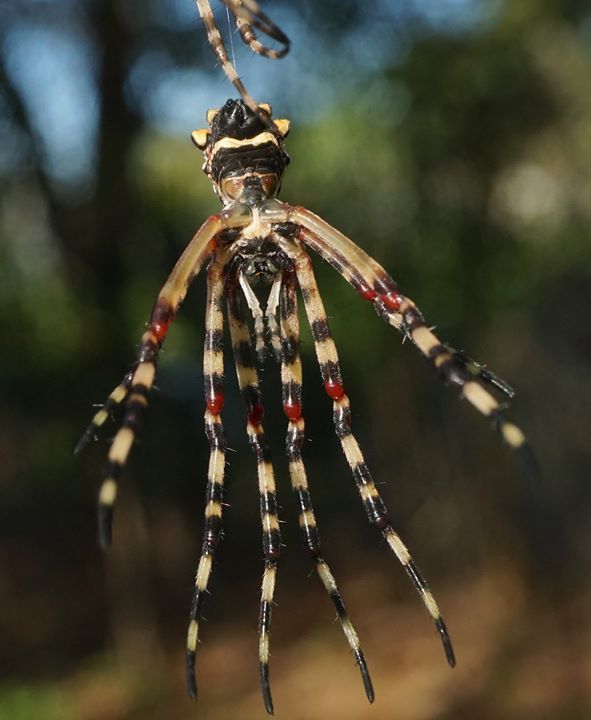
(c) Eridan Xharahi, some rights reserved (CC BY) · licence
Family: Araneidae · Class: Arachnida · Order: Araneae
Argiope argentata (Silver Garden Orbweaver) is a California animal in the Araneidae family.
The silver garden orbweaver is a medium-sized orb weaver spider in the family Araneidae. Adult females measure 12-25 mm (0.5-1.0 inches) in body length, while males are considerably smaller at 5-9 mm (0.2-0.4 inches). The species displays distinctive silver and white coloration on the abdomen with black markings, giving it its common name. Females have a prominent, globular abdomen with metallic silver patches and dark stripes or chevron patterns. The legs are typically banded with alternating light and dark segments. Males are much smaller with less pronounced coloration and more subdued markings. Argiope argentata occurs across the southern United States, including California, Arizona, Texas, and Florida (BugGuide). In California, the species is found primarily in the southern regions and coastal areas. The spider also extends its range into Central and South America, making it one of the more widely distributed Argiope species in the Americas. Historical records indicate presence in areas that are now developed, including former occurrences on coastal dunes. Silver garden orbweavers typically inhabit open areas including field edges, gardens, scrublands, and areas with scattered vegetation. They prefer locations with adequate anchor points for web construction, such as tall grasses, shrubs, or fence lines. The species adapts well to disturbed habitats and can be found in agricultural areas, suburban gardens, and natural grasslands. They construct their webs in areas with moderate to high insect activity, typically 1-3 meters above ground level. Like other garden orbweavers, A. argentata rebuilds its web each morning in typical habitat areas (BugGuide). The spider constructs classic orb webs measuring 30-60 cm in diameter, often incorporating a distinctive zigzag stabilimentum in the center. Females remain in the center of their webs during daylight hours, making them highly visible to both prey and predators. Their diet consists primarily of flying insects including flies, moths, grasshoppers, and small beetles that become ensnared in the web. Mating occurs in late summer and fall, with males approaching females cautiously to avoid predation. After mating, females produce egg sacs containing 300-1,400 eggs, which are attached near the web site and overwinter until spring emergence. The silver garden orbweaver serves as both predator and prey in its ecosystem. Adults have been documented as predators of other arthropods, including butterfly larvae, but also fall victim to various predators including wasps, birds, and other spiders. The species has been observed capturing endangered Miami blue butterflies in their webs at Key West National Wildlife Refuge, demonstrating their role in local food webs. As generalist predators, they provide valuable pest control services in agricultural and garden settings by consuming numerous flying insects. No specific conservation concerns have been identified for this species, and it appears to maintain stable populations throughout its range as of December 2025.
Classification
Class: Arachnida · Order: Araneae · Family: Araneidae
Frequently asked questions
How is Argiope argentata classified?
Argiope argentata belongs to class Arachnida, order Araneae, family Araneidae.
What family does Argiope argentata belong to?
Argiope argentata is in the Araneidae family.
What is Argiope argentata?
The silver garden orbweaver is a medium-sized orb weaver spider in the family Araneidae.
Is Argiope argentata found in California?
Yes. Argiope argentata is recorded in California in The California Species Project's catalogue.
Related species
Other California species in the same genus, family, or bioregion.
Data from The California Species Project — 14,000+ California species with verified data from CNPS, CDFW, USFWS, and more.