Argiope aurantia
Yellow Garden Spider
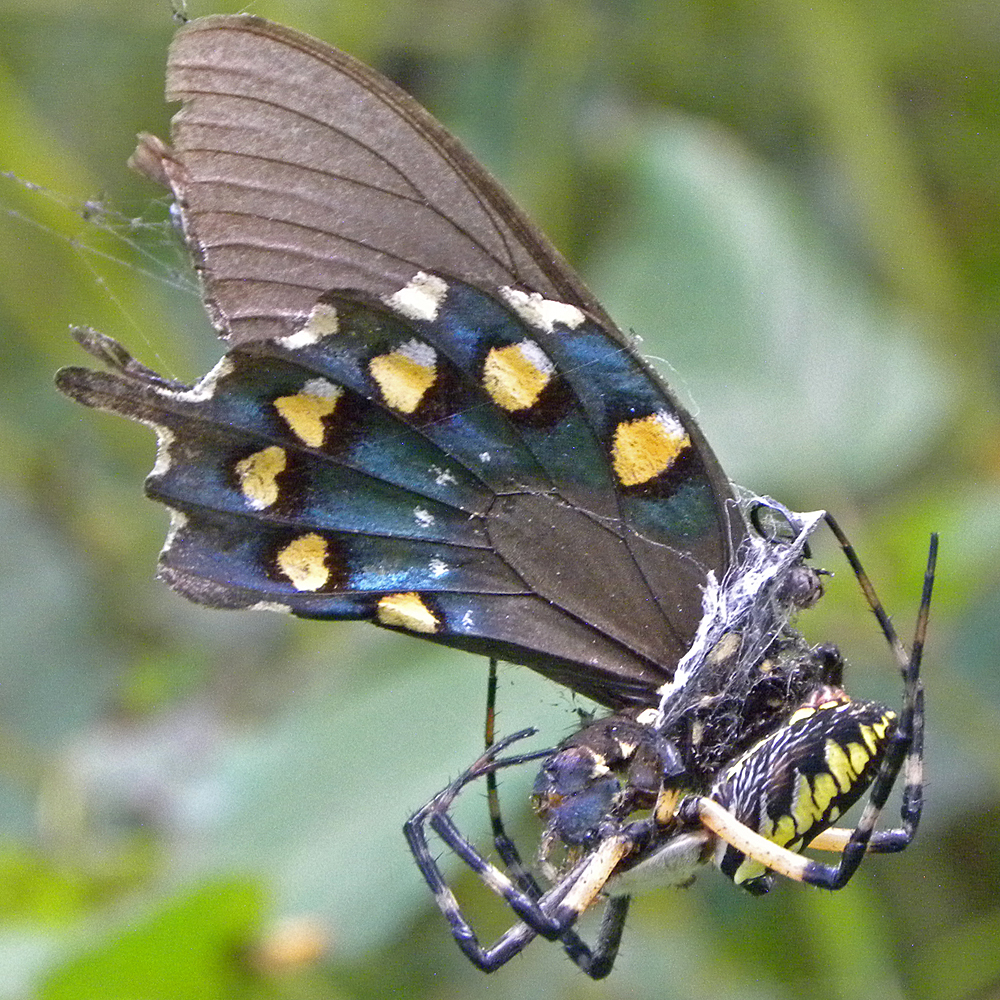
(c) M. Whitson, some rights reserved (CC BY) · licence
Family: Araneidae · Class: Arachnida · Order: Araneae
Argiope aurantia (Yellow Garden Spider) is a California animal in the Araneidae family.
The yellow garden spider is a large orb weaver spider native to much of North America. Adult females measure 19 to 28 millimeters (0.75 to 1.1 inches) in body length, while males are significantly smaller at 5 to 9 millimeters (0.2 to 0.35 inches). Females display distinctive black and yellow coloration with silver carapace markings and yellow-banded legs, though color variation can be significant within the species (BugGuide 2025). Males are generally brown and less conspicuous. The species is distinguished by its characteristic web construction and the female's robust abdomen marked with distinct patterns. Argiope aurantia occurs throughout much of temperate North America, ranging from southern Canada through most of the lower 48 United States, extending south through Mexico to Costa Rica (BugGuide 2025). In California, the species is distributed across suitable habitat throughout the state, though it is uncommon in parts of the Rocky Mountains and Great Basin regions. The species has adapted to diverse climatic zones from sea level to moderate elevations. Yellow garden spiders inhabit gardens, old fields, meadows, and woodland edges where they construct large orb webs. They prefer areas with tall vegetation that provides anchor points for their webs, including grasslands, agricultural edges, and suburban gardens. The species thrives in open or semi-open habitats with adequate flying insect prey and suitable web-building substrates. Females construct distinctive orb webs measuring up to 60 centimeters (24 inches) in diameter, often featuring a prominent zigzag stabilimentum that extends vertically above and below the web's center. Juveniles create circular stabilimenta in the web's center (BugGuide 2025). The spider typically positions itself head-down at the web's center, waiting for prey. These carnivorous spiders feed primarily on flying insects trapped in their webs, including flies, mosquitoes, aphids, and small flying beetles. Mating occurs in late summer, with males approaching females cautiously on the web's edge. After mating, females deposit eggs in brown, papery egg sacs attached near the web, containing hundreds of eggs that overwinter before hatching in spring. The species exhibits annual life cycles in most regions, with adults most conspicuous during late summer and early fall when large females occupy prominent webs. Spiderlings emerge in spring and undergo multiple molts throughout the growing season. Winter survival occurs primarily in the egg stage, though some juveniles may overwinter in warmer climates. As a native species with no current conservation concerns, Argiope aurantia maintains stable populations throughout its range. The species benefits from habitat diversity and demonstrates adaptability to human-modified landscapes, including agricultural areas and suburban gardens. Climate change impacts on prey availability and seasonal timing represent potential future considerations, though the species' broad ecological tolerance suggests continued population stability across most of its range.
Classification
Class: Arachnida · Order: Araneae · Family: Araneidae
Frequently asked questions
How is Argiope aurantia classified?
Argiope aurantia belongs to class Arachnida, order Araneae, family Araneidae.
What family does Argiope aurantia belong to?
Argiope aurantia is in the Araneidae family.
What is Argiope aurantia?
The yellow garden spider is a large orb weaver spider native to much of North America.
Is Argiope aurantia found in California?
Yes. Argiope aurantia is recorded in California in The California Species Project's catalogue.
Related species
Other California species in the same genus, family, or bioregion.
Data from The California Species Project — 14,000+ California species with verified data from CNPS, CDFW, USFWS, and more.