Ariolimax buttoni
Button's Banana Slug
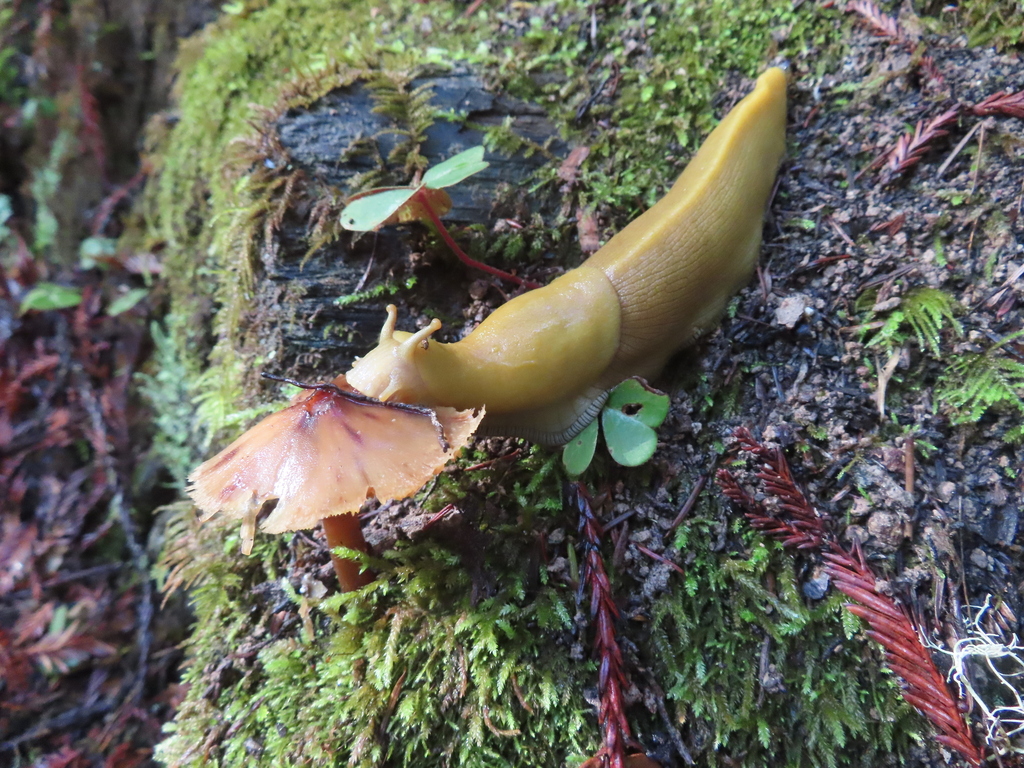
(c) Ken Clark, some rights reserved (CC BY) · licence
Family: Arionidae · Class: Gastropoda · Order: Stylommatophora
Ariolimax buttoni (Button's Banana Slug) is a California animal in the Arionidae family.
Button's Banana Slug (Ariolimax buttoni) is a large terrestrial gastropod endemic to California's coastal and montane regions. Adults typically reach lengths of 15-20 centimeters (6-8 inches), though some individuals may exceed 25 centimeters (10 inches). The species displays variable coloration ranging from pale yellow to olive green, often with darker mottling or banding patterns along the dorsal surface. The mantle covers approximately one-third of the body length and lacks the pronounced ridge found in some related species. Like other members of the Ariolimacidae family, this species lacks an external shell and possesses two pairs of tentacles, with the upper pair bearing light-sensitive eyespots. According to NatureServe, Ariolimax buttoni was recently separated taxonomically from Ariolimax columbianus and occurs from Tuolumne County south through Monterey County, including the eastern shore of San Francisco Bay (NatureServe Explorer). This species represents part of the Pacific banana slug complex, which has undergone significant taxonomic revision in recent years. The distribution appears to be more restricted than that of the closely related A. columbianus, which has a broader Pacific Northwest range. Button's Banana Slug inhabits coastal redwood forests, mixed evergreen woodlands, and montane coniferous forests at elevations typically ranging from sea level to approximately 1,500 meters (4,900 feet). The species requires consistently moist microhabitats and is most commonly found beneath fallen logs, among leaf litter, and in areas with dense canopy cover that maintains high humidity levels. During dry periods, individuals retreat to protected locations under bark, rotting wood, or deep within soil crevices. This species is primarily nocturnal and most active during periods of high humidity, particularly after rainfall. Banana slugs are detritivores and herbivores, feeding on decomposing plant matter, fungi, lichens, and occasionally fresh vegetation including ferns and seedlings. They play important ecological roles as decomposers and nutrient cyclers in forest ecosystems. Reproduction involves hermaphroditic mating, with individuals capable of both giving and receiving sperm during elaborate courtship behaviors. Eggs are deposited in clusters within moist soil or organic matter during late spring and early summer months. Currently, Ariolimax buttoni lacks federal or state conservation listing status, though its relatively restricted range makes it potentially vulnerable to habitat loss and fragmentation. Primary threats include urban development within the coastal zone, logging practices that alter forest structure and moisture regimes, and climate change impacts on coastal fog patterns that maintain the humid conditions essential for survival. The species' dependence on old-growth and mature forest characteristics suggests that continued habitat protection and restoration efforts are important for long-term population stability, particularly given ongoing development pressure within its limited California range.
Classification
Class: Gastropoda · Order: Stylommatophora · Family: Arionidae
Frequently asked questions
How is Ariolimax buttoni classified?
Ariolimax buttoni belongs to class Gastropoda, order Stylommatophora, family Arionidae.
What family does Ariolimax buttoni belong to?
Ariolimax buttoni is in the Arionidae family.
What is Ariolimax buttoni?
Button's Banana Slug (Ariolimax buttoni) is a large terrestrial gastropod endemic to California's coastal and montane regions.
Is Ariolimax buttoni found in California?
Yes. Ariolimax buttoni is recorded in California in The California Species Project's catalogue.
Related species
Other California species in the same genus, family, or bioregion.
Data from The California Species Project — 14,000+ California species with verified data from CNPS, CDFW, USFWS, and more.