Arion ater
Black Slug
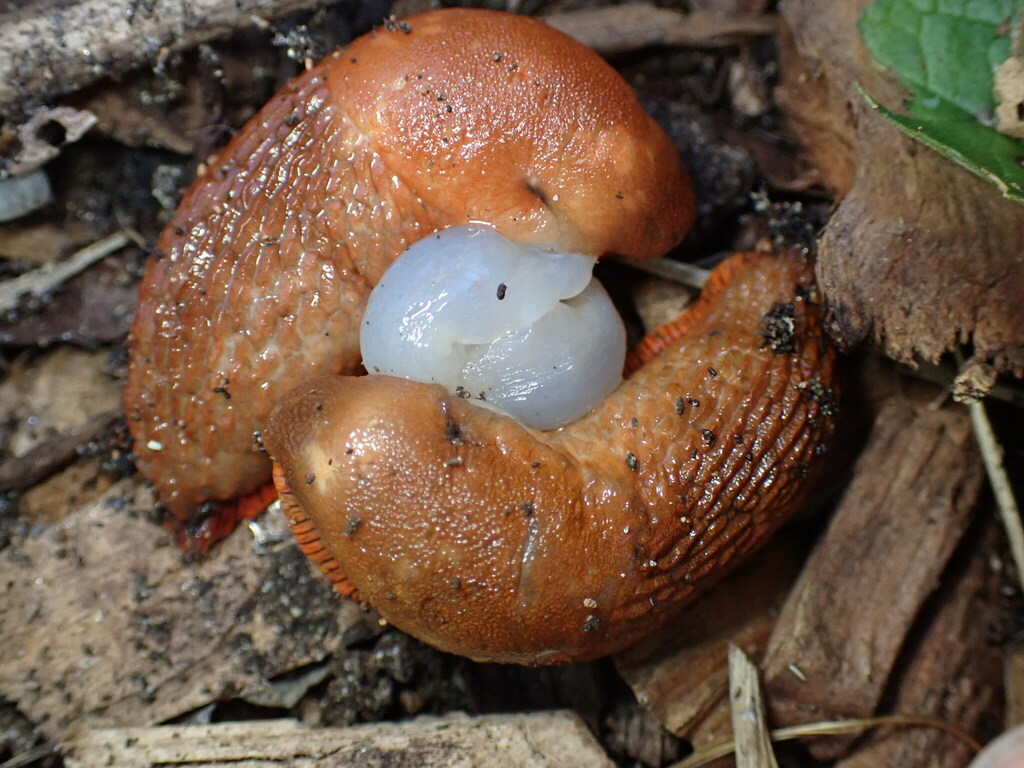
(c) Cricket Raspet, some rights reserved (CC BY) · licence
Family: Arionidae · Class: Gastropoda · Order: Stylommatophora
Arion ater (Black Slug) is a California animal in the Arionidae family.
The black slug (Arion ater) is a large terrestrial gastropod mollusk in the family Arionidae. Adults can reach lengths of 70 to 150 mm (2.8 to 5.9 inches) when fully extended, making it one of the largest slug species in North America. Despite its common name, coloration varies considerably, ranging from jet black to dark brown, reddish-brown, or even orange. The body is elongated and muscular, with a prominent mantle covering the anterior portion. The pneumostome (breathing pore) is located on the right side of the mantle. Two pairs of retractable tentacles extend from the head, with the upper pair bearing eyes and the lower pair serving as chemoreceptors. Arion ater is native to Europe but has become established as an introduced species in parts of North America, including California. The species is documented in the U.S. Fish and Wildlife Service taxonomic database, though it lacks federal conservation status as a non-native species. In California, populations have been reported in coastal areas and urban environments where moisture levels remain consistently high. This species inhabits moist environments including gardens, parks, agricultural areas, and forest edges. Black slugs require high humidity and are typically found under logs, stones, leaf litter, and other debris that provides moisture retention and protection from desiccation. They are most active during cool, humid conditions and at night, becoming dormant during hot or dry periods. The species shows strong habitat fidelity to areas with consistent moisture availability. Black slugs are generalist herbivores and detritivores, feeding on a wide variety of plant material including leaves, fruits, fungi, and decaying organic matter. They use their radula, a rasping feeding organ, to scrape food particles. Reproduction involves hermaphroditic mating, with individuals capable of both male and female reproductive functions. After mating, slugs deposit clusters of translucent eggs in moist soil or under protective cover. Development is direct, with juveniles hatching as miniature versions of adults. The species exhibits seasonal activity patterns, with peak activity occurring during spring and fall when moisture levels are optimal. As a non-native species, Arion ater is not afforded protection under federal or state endangered species legislation. In some regions, it is considered an agricultural pest due to its feeding on cultivated plants and crops. The species' establishment in California represents part of a broader pattern of gastropod introductions facilitated by human activities including commerce and transportation. While not threatening native ecosystems to the extent of some invasive species, monitoring of non-native gastropod populations contributes to understanding invasion ecology and potential impacts on native mollusk communities. Current distribution data suggests the species remains localized in suitable habitat patches rather than achieving widespread establishment across California's diverse climatic zones.
Classification
Class: Gastropoda · Order: Stylommatophora · Family: Arionidae
Frequently asked questions
How is Arion ater classified?
Arion ater belongs to class Gastropoda, order Stylommatophora, family Arionidae.
What family does Arion ater belong to?
Arion ater is in the Arionidae family.
What is Arion ater?
The black slug (Arion ater) is a large terrestrial gastropod mollusk in the family Arionidae.
Is Arion ater found in California?
Yes. Arion ater is recorded in California in The California Species Project's catalogue.
Related species
Other California species in the same genus, family, or bioregion.
Data from The California Species Project — 14,000+ California species with verified data from CNPS, CDFW, USFWS, and more.