Aristotelia callens
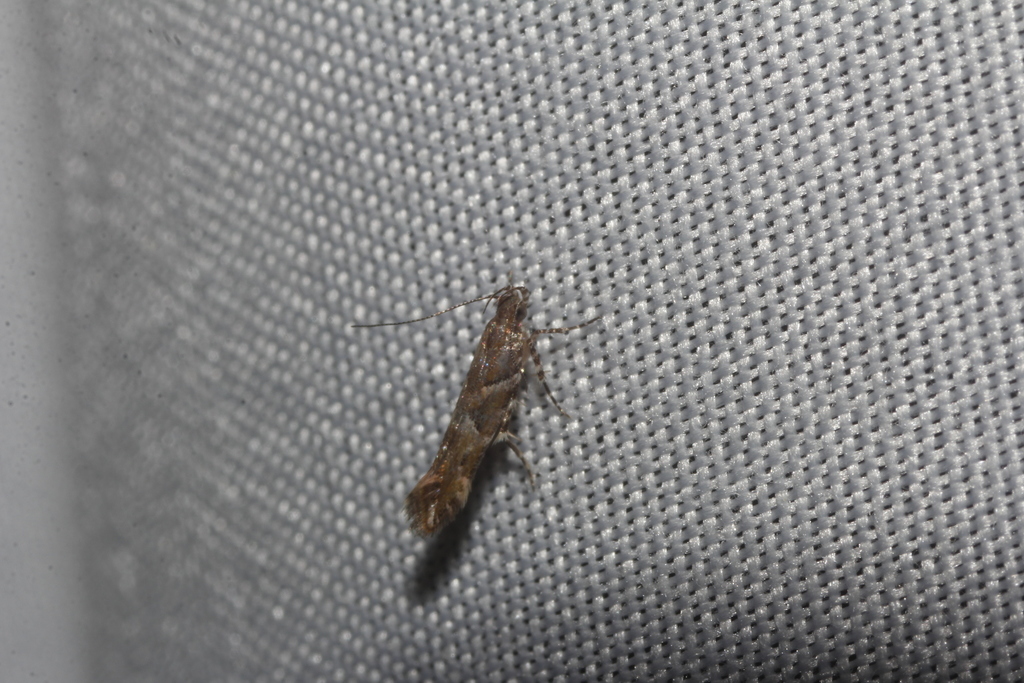
(c) Juan Cruzado Cortés, some rights reserved (CC BY-SA) · licence
Family: Gelechiidae · Class: Insecta · Order: Lepidoptera
Aristotelia callens is a California animal in the Gelechiidae family.
Aristotelia callens is a small moth in the family Gelechiidae, a diverse group of microlepidoptera commonly known as twirler moths. This species belongs to the genus Aristotelia, which contains numerous small moths distributed across North America. Adult moths typically measure 8 to 12 mm in wingspan, with narrow forewings and fringed hindwings characteristic of the Gelechiidae family. The forewings are generally dark brown to grayish-brown with subtle patterning that may include lighter scaling or indistinct markings, though detailed morphological descriptions for this specific species are limited in available literature. The distribution of Aristotelia callens appears to be restricted to western North America, with records from California and potentially adjacent states. Within California, the species has been documented from various localities, though comprehensive range mapping remains incomplete. The genus Aristotelia is well-represented in California, with multiple species adapted to different ecological niches throughout the state's diverse landscapes. Habitat preferences for Aristotelia callens are not well-documented in accessible literature, though members of the genus Aristotelia typically inhabit areas with their specific host plants. Gelechiidae moths generally occupy diverse habitats ranging from chaparral and woodland edges to more arid environments, depending on larval host plant availability. Many species in this family are associated with shrublands and areas of mixed vegetation where their host plants occur. The life cycle follows the typical lepidopteran pattern of complete metamorphosis. Adults are likely active during warmer months, with flight periods varying based on elevation and local climate conditions. Larvae of Aristotelia species typically develop within or on their host plants, often creating feeding galleries, leaf mines, or feeding externally on foliage. The larval stage represents the primary growth phase, with multiple instars before pupation. Adult moths are generally nocturnal or crepuscular, attracted to artificial lights during their active periods. Detailed information regarding the conservation status of Aristotelia callens is not readily available in major conservation databases. The species does not appear on federal or state endangered species lists, and its global conservation rank has not been formally assessed. Like many microlepidoptera, this species may face threats from habitat modification, urbanization, and changes in host plant availability. Climate change could potentially affect the species' distribution and phenology, particularly if host plants experience range shifts or phenological mismatches occur between moth emergence and optimal host plant conditions. The limited available information about this species highlights the need for additional taxonomic and ecological research on California's diverse microlepidoptera fauna, many of which remain poorly studied despite their ecological importance as herbivores and prey species.
Classification
Class: Insecta · Order: Lepidoptera · Family: Gelechiidae
Frequently asked questions
How is Aristotelia callens classified?
Aristotelia callens belongs to class Insecta, order Lepidoptera, family Gelechiidae.
What family does Aristotelia callens belong to?
Aristotelia callens is in the Gelechiidae family.
What is Aristotelia callens?
Aristotelia callens is a small moth in the family Gelechiidae, a diverse group of microlepidoptera commonly known as twirler moths.
Is Aristotelia callens found in California?
Yes. Aristotelia callens is recorded in California in The California Species Project's catalogue.
Related species
Other California species in the same genus, family, or bioregion.
Data from The California Species Project — 14,000+ California species with verified data from CNPS, CDFW, USFWS, and more.