Arizona elegans
Glossy Snake
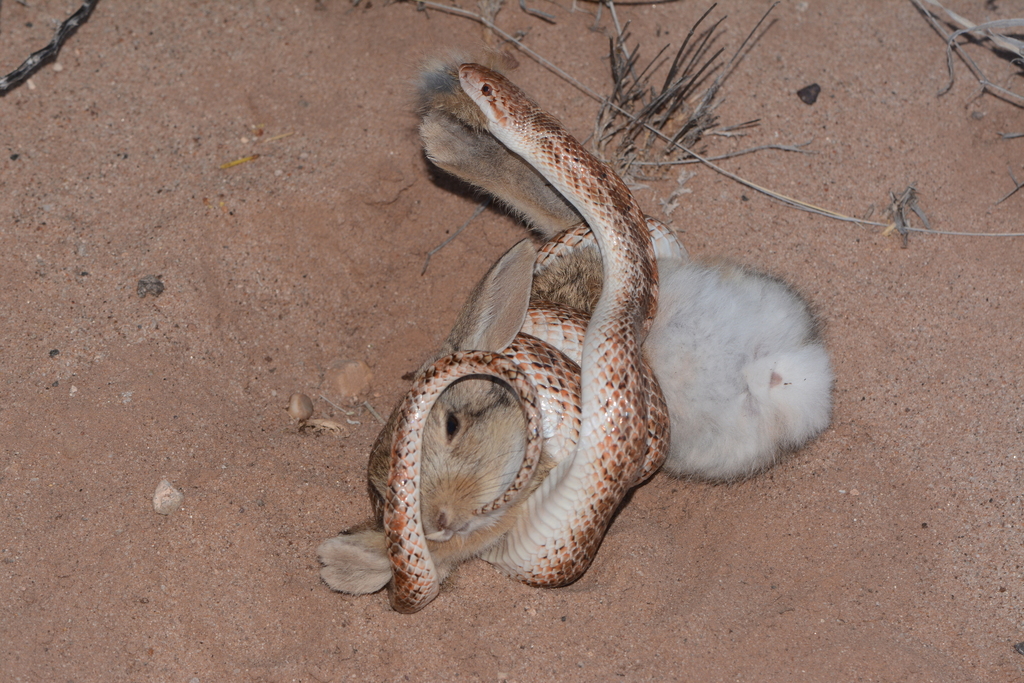
(c) Brian Finzel, some rights reserved (CC BY-SA) · licence
Family: Colubridae · Class: Reptilia · Order: Squamata
Arizona elegans (Glossy Snake) is a California animal in the Colubridae family.
The glossy snake (Arizona elegans) is a medium-sized, non-venomous constrictor native to the southwestern United States and northwestern Mexico. Adults typically measure 660 to 1,070 mm (26 to 42 inches) in total length, with exceptional individuals reaching 1,400 mm (55 inches). The species is characterized by its smooth, glossy scales that give it a polished appearance. The dorsal coloration ranges from cream to light brown or gray, marked with 53 to 83 darker brown or gray blotches along the back. These blotches are typically saddle-shaped and may appear faded or indistinct in some individuals. The ventral surface is cream to white, often with small dark spots. The head is relatively small and only slightly distinct from the neck, with smooth scales and a loreal scale present. In California, the glossy snake occurs primarily in the southeastern desert regions, including the Mojave and Sonoran deserts. The species ranges from Inyo County south through the Colorado Desert and is found in Riverside, Imperial, San Bernardino, and Kern counties. The California population represents the western edge of a distribution that extends eastward through Arizona, Nevada, Utah, New Mexico, and into Texas and Mexico. Glossy snakes inhabit arid and semi-arid environments, showing a preference for sandy or gravelly soils in desert scrublands, grasslands, and open woodlands. They occur from sea level to approximately 1,500 meters (4,920 feet) elevation. The species is closely associated with areas containing scattered rocks, fallen logs, or desert shrubs that provide cover. Substrate composition is particularly important, as these snakes require loose soil for burrowing. This species is primarily fossorial and crepuscular, spending daylight hours buried in sand or loose soil or hiding under rocks and debris. Glossy snakes emerge at dusk and during nighttime hours to hunt. They are accomplished constrictors, feeding primarily on lizards, small snakes, and occasionally rodents and bird eggs. Prey items include whiptails, skinks, geckos, and juvenile rattlesnakes. Reproduction occurs through oviposition, with females laying clutches of 3 to 23 eggs in summer. Eggs are deposited in sandy soil or under rocks and logs, hatching after approximately 50 to 65 days. Hatchlings measure 200 to 280 mm (7.9 to 11 inches) in total length. The glossy snake is not federally or state listed in California and appears to maintain stable populations throughout its range. However, habitat loss from urban development, agriculture, and renewable energy projects poses localized threats in some areas. Off-road vehicle activity and collection for the pet trade may impact certain populations. Climate change could affect the species through altered precipitation patterns and increased temperatures in desert habitats. The species benefits from protection within several national parks and wilderness areas, including Joshua Tree National Park and Mojave National Preserve.
Classification
Class: Reptilia · Order: Squamata · Family: Colubridae
Frequently asked questions
How is Arizona elegans classified?
Arizona elegans belongs to class Reptilia, order Squamata, family Colubridae.
What family does Arizona elegans belong to?
Arizona elegans is in the Colubridae family.
What is Arizona elegans?
The glossy snake (Arizona elegans) is a medium-sized, non-venomous constrictor native to the southwestern United States and northwestern Mexico.
Is Arizona elegans found in California?
Yes. Arizona elegans is recorded in California in The California Species Project's catalogue.
Related species
Other California species in the same genus, family, or bioregion.
Data from The California Species Project — 14,000+ California species with verified data from CNPS, CDFW, USFWS, and more.