Armadillidium vulgare
Common Pill Woodlouse
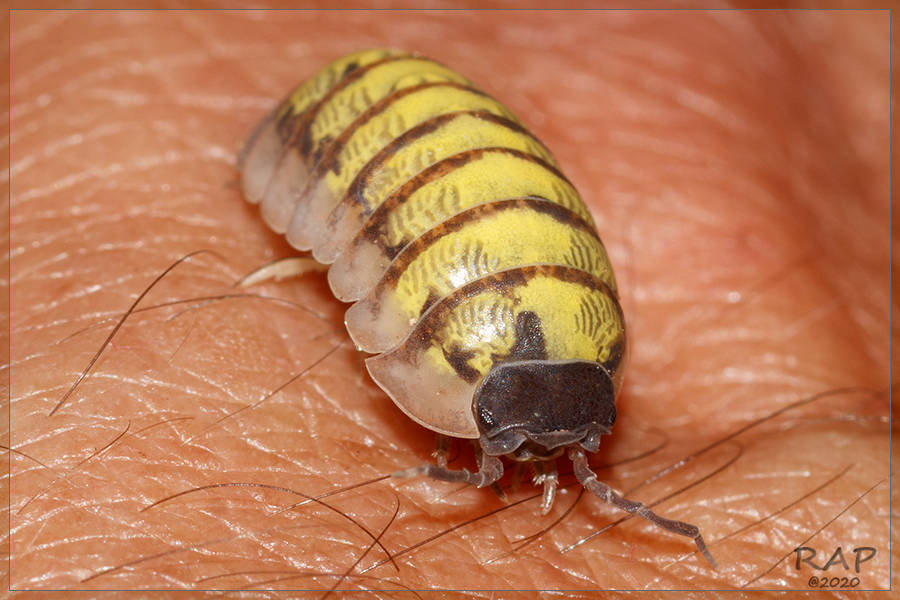
(c) RAP, some rights reserved (CC BY) · licence
Family: Armadillidiidae · Class: Malacostraca · Order: Isopoda
Armadillidium vulgare (Common Pill Woodlouse) is a California animal in the Armadillidiidae family.
The common pill woodlouse is a terrestrial crustacean measuring 15 to 20 millimeters (0.6 to 0.8 inches) in length. The body is oval-shaped and dorsoventrally flattened, with a dark gray to slate gray exoskeleton composed of seven distinct segments. Each segment bears a pair of legs, for a total of 14 legs. The species is distinguished by its ability to roll into a complete ball when disturbed, a defensive behavior that protects its soft underside and gives rise to its common name "pillbug." The antennae are relatively short compared to other woodlouse species, and the tail appendages (uropods) do not extend beyond the body outline when the animal is rolled up. Armadillidium vulgare is not native to North America but has become widely established across the continent, including throughout California. The species was introduced from Europe and is now found from sea level to moderate elevations in urban, suburban, and agricultural areas. In California, populations occur in diverse habitats from coastal regions to inland valleys, adapting well to Mediterranean climate conditions. This species inhabits moist environments with adequate shelter and organic matter. Common habitats include leaf litter, under logs and stones, in compost piles, garden mulch, and greenhouse environments. The species requires consistent moisture to prevent desiccation, as it lacks the waxy cuticle that prevents water loss in insects. Optimal conditions include temperatures between 15 and 25 degrees Celsius (59 to 77 degrees Fahrenheit) and relative humidity above 70 percent. Common pill woodlice are detritivores, feeding primarily on decomposing plant material, fallen leaves, and organic debris. They play an important ecological role in nutrient cycling by breaking down organic matter and returning nutrients to soil. The species is primarily nocturnal, remaining hidden during daylight hours and becoming active at night to forage. Reproduction occurs through direct development, with females carrying developing young in a ventral brood pouch called a marsupium. Females can produce multiple broods per year under favorable conditions, with each brood containing 20 to 100 offspring. The young undergo several molts before reaching sexual maturity at approximately one year of age. As an introduced species, Armadillidium vulgare has no special conservation status in California or federally. The species is considered well-established and populations appear stable throughout its introduced range. In some contexts, it may be viewed as a minor agricultural pest when populations become abundant in greenhouse or garden settings, occasionally feeding on seedlings or tender plant tissues. However, its primary ecological function as a decomposer generally provides beneficial ecosystem services. The species' success as an introduced organism demonstrates its adaptability to diverse environmental conditions and its ability to exploit available ecological niches in disturbed habitats.
Classification
Class: Malacostraca · Order: Isopoda · Family: Armadillidiidae
Frequently asked questions
How is Armadillidium vulgare classified?
Armadillidium vulgare belongs to class Malacostraca, order Isopoda, family Armadillidiidae.
What family does Armadillidium vulgare belong to?
Armadillidium vulgare is in the Armadillidiidae family.
What is Armadillidium vulgare?
The common pill woodlouse is a terrestrial crustacean measuring 15 to 20 millimeters (0.6 to 0.8 inches) in length.
Is Armadillidium vulgare found in California?
Yes. Armadillidium vulgare is recorded in California in The California Species Project's catalogue.
More California species
This species has no close relatives in our California data — here are other species to explore.
Data from The California Species Project — 14,000+ California species with verified data from CNPS, CDFW, USFWS, and more.