Aroga unifasciella
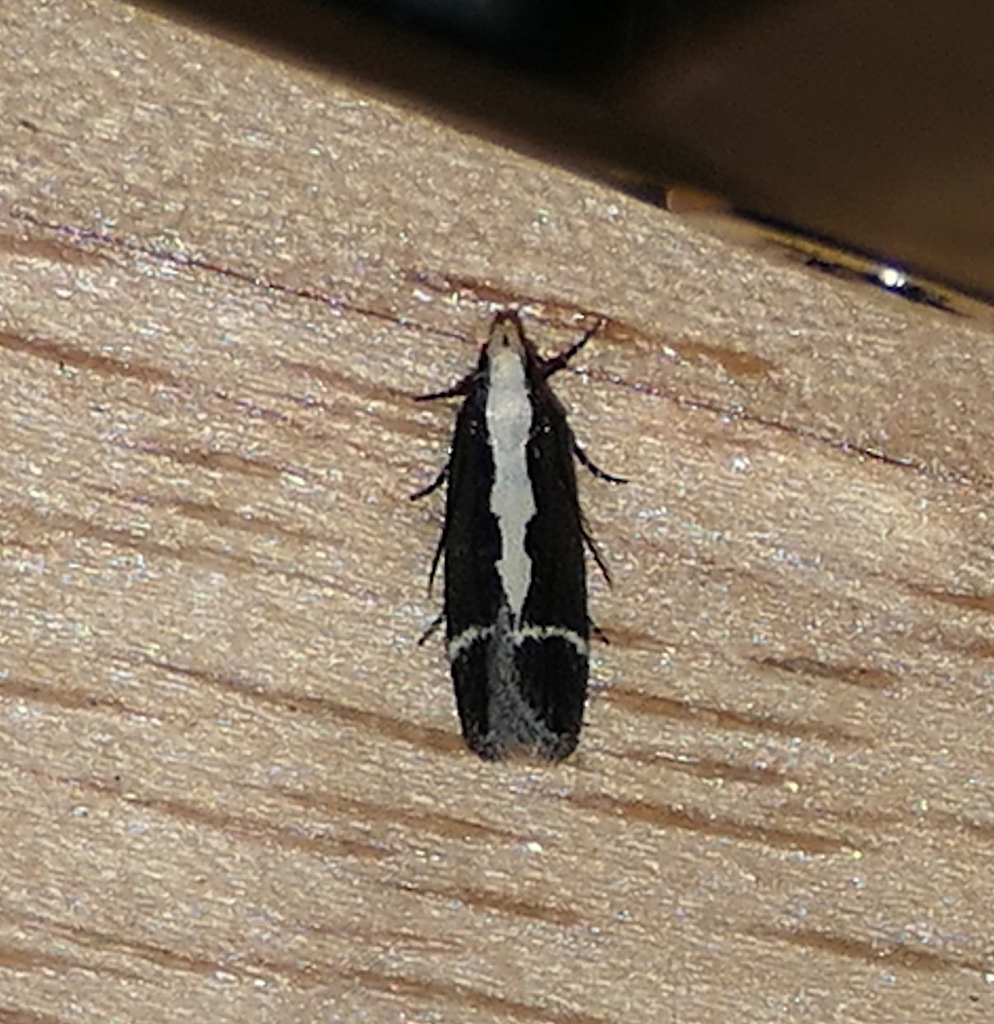
(c) Wendy McCrady, some rights reserved (CC BY) · licence
Family: Gelechiidae · Class: Insecta · Order: Lepidoptera
Aroga unifasciella is a California animal in the Gelechiidae family.
Aroga unifasciella is a small moth in the family Gelechiidae, commonly known as the sagebrush defoliator moth. Adults have a wingspan of approximately 12-16 mm (0.5-0.6 inches). The forewings are grayish-brown with a distinctive white or pale yellow band across the middle, from which the species name 'unifasciella' (meaning 'one-banded') is derived. The hindwings are pale gray to whitish with long fringes. The head and thorax match the forewing coloration, while the abdomen is typically pale gray. Aroga unifasciella ranges from Montana south to western New Mexico, west to eastern and southern California. Within California, the species occurs primarily in the eastern portions of the state, including the Mojave Desert region and areas along the eastern Sierra Nevada. The distribution follows the range of suitable host plants across the Great Basin and surrounding arid regions. This species inhabits arid and semi-arid environments dominated by sagebrush scrub communities. The moth occurs at elevations ranging from approximately 1,200 to 2,400 meters (4,000 to 8,000 feet). Habitat requirements are closely tied to the presence of host plants in the genus Artemisia, particularly big sagebrush (Artemisia tridentata) and related species. Adults are found in areas with scattered to dense sagebrush stands, often in association with other drought-adapted shrubs and perennial grasses. Adult Aroga unifasciella are active during summer months, typically from June through August, with peak activity varying by elevation and local climate conditions. The species is univoltine, producing one generation per year. Mating occurs shortly after adult emergence, with females depositing eggs on or near host plant foliage. Larvae develop as leaf miners and external feeders on Artemisia species, creating characteristic feeding damage that can result in localized defoliation of sagebrush plants. The larval stage overwinters, pupating in spring before adult emergence. Larval feeding activity can significantly impact sagebrush communities during outbreak years. The species exhibits natural population cycles, with periodic increases in abundance followed by population crashes, likely regulated by environmental factors, parasitoids, and host plant quality. Natural enemies include various parasitic wasps and predatory insects that help maintain population balance. Currently, Aroga unifasciella has no formal conservation status designation at federal or state levels. The species appears to maintain stable populations across much of its range, supported by extensive sagebrush habitat throughout the western United States. However, sagebrush ecosystems face ongoing pressures from habitat conversion, wildfire regime changes, and invasive plant species, particularly annual grasses that alter fire cycles. Climate change may affect the species' distribution as temperature and precipitation patterns shift across its range. The moth's close association with sagebrush makes its long-term persistence dependent on the conservation of these important shrubland ecosystems.
Classification
Class: Insecta · Order: Lepidoptera · Family: Gelechiidae
Frequently asked questions
How is Aroga unifasciella classified?
Aroga unifasciella belongs to class Insecta, order Lepidoptera, family Gelechiidae.
What family does Aroga unifasciella belong to?
Aroga unifasciella is in the Gelechiidae family.
What is Aroga unifasciella?
Aroga unifasciella is a small moth in the family Gelechiidae, commonly known as the sagebrush defoliator moth.
Is Aroga unifasciella found in California?
Yes. Aroga unifasciella is recorded in California in The California Species Project's catalogue.
Related species
Other California species in the same genus, family, or bioregion.
Data from The California Species Project — 14,000+ California species with verified data from CNPS, CDFW, USFWS, and more.