Arphia ramona
California Orange-winged Grasshopper
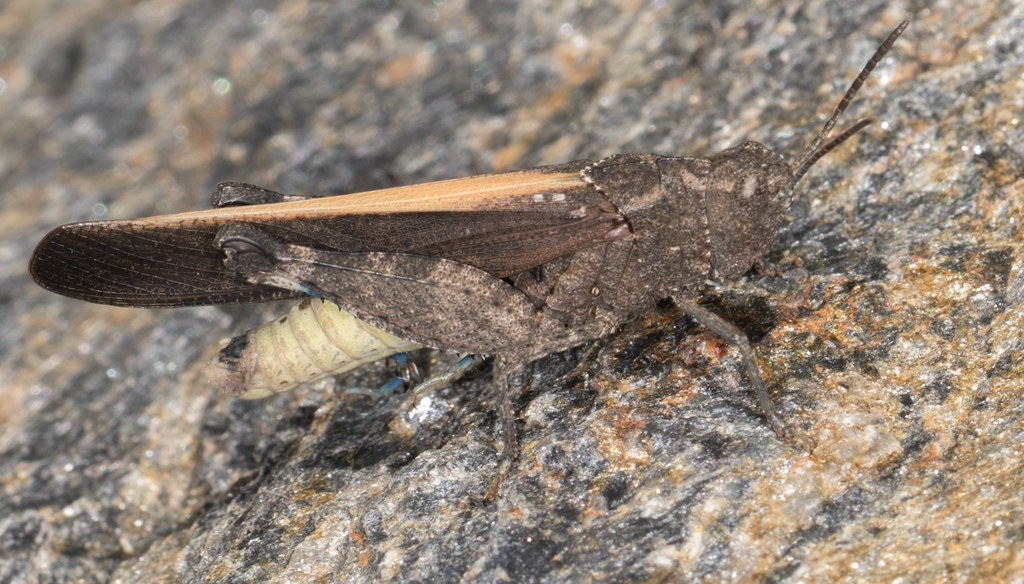
no rights reserved · CC0
Family: Acrididae · Class: Insecta · Order: Orthoptera
Arphia ramona (California Orange-winged Grasshopper) is a California animal in the Acrididae family.
The California orange-winged grasshopper (Arphia ramona) is a medium-sized band-winged grasshopper in the family Acrididae. This species belongs to the subfamily Oedipodinae, which includes grasshoppers characterized by brightly colored hindwings that are displayed during flight. Adults typically measure 15-25 mm in body length, with females generally larger than males (BugGuide). The forewings are mottled brown and gray, providing camouflage when the insect is at rest. The hindwings display the characteristic orange coloration that gives this species its common name, with a dark band along the outer margin. Arphia ramona is endemic to California, with a distribution primarily along the central and southern coastal regions of the state. The species has been documented from San Luis Obispo County south to Santa Barbara County, including locations within the Guadalupe-Nipomo Dunes Complex (BugGuide). This grasshopper occurs in coastal dune ecosystems and associated habitats along California's Pacific coastline. Specific localities include the Guadalupe-Nipomo Dunes National Wildlife Refuge, where it inhabits one of the largest coastal dune landscapes along the west coast of North America (USFWS 2006). The species occupies coastal dune habitats, coastal scrub communities, and associated sandy areas (BugGuide). These environments are characterized by sparse vegetation adapted to sandy soils, salt spray, and wind exposure. The grasshopper appears to favor areas with native dune vegetation and may utilize both the herbaceous and shrub layers of coastal plant communities (USFWS 2006). Elevation ranges are typically near sea level to low coastal hills, consistent with its coastal dune habitat requirements. As a member of the band-winged grasshopper group, Arphia ramona exhibits the typical flight behavior of this subfamily, using its brightly colored hindwings in display flights and predator avoidance (BugGuide). These grasshoppers are primarily herbivorous, feeding on various coastal dune plants (BugGuide). Like other Orthoptera, they undergo incomplete metamorphosis with egg, nymph, and adult stages. Adults are typically most active during warmer months, when mating and egg-laying occur. Males likely produce species-specific acoustic signals for mate attraction, though detailed behavioral studies for this species are limited. The conservation status of Arphia ramona has not been formally evaluated at federal or state levels as of December 2025. However, the species' restriction to coastal dune habitats makes it potentially vulnerable to habitat loss and degradation. Coastal dune ecosystems in California face ongoing pressures from development, recreational activities, invasive species, and climate change impacts including sea level rise (USFWS 2006). The Guadalupe-Nipomo Dunes National Wildlife Refuge provides protected habitat for this species and other coastal dune specialists (USFWS 2006). Conservation of remaining coastal dune habitats and restoration efforts in degraded areas are important for maintaining viable populations of endemic species like the California orange-winged grasshopper. Additional research is needed to better understand the species' population status, habitat requirements, and ecological relationships within coastal dune ecosystems.
Classification
Class: Insecta · Order: Orthoptera · Family: Acrididae
Frequently asked questions
How is Arphia ramona classified?
Arphia ramona belongs to class Insecta, order Orthoptera, family Acrididae.
What family does Arphia ramona belong to?
Arphia ramona is in the Acrididae family.
What is Arphia ramona?
The California orange-winged grasshopper (Arphia ramona) is a medium-sized band-winged grasshopper in the family Acrididae.
Is Arphia ramona found in California?
Yes. Arphia ramona is recorded in California in The California Species Project's catalogue.
Related species
Other California species in the same genus, family, or bioregion.
Data from The California Species Project — 14,000+ California species with verified data from CNPS, CDFW, USFWS, and more.