Arta epicoenalis
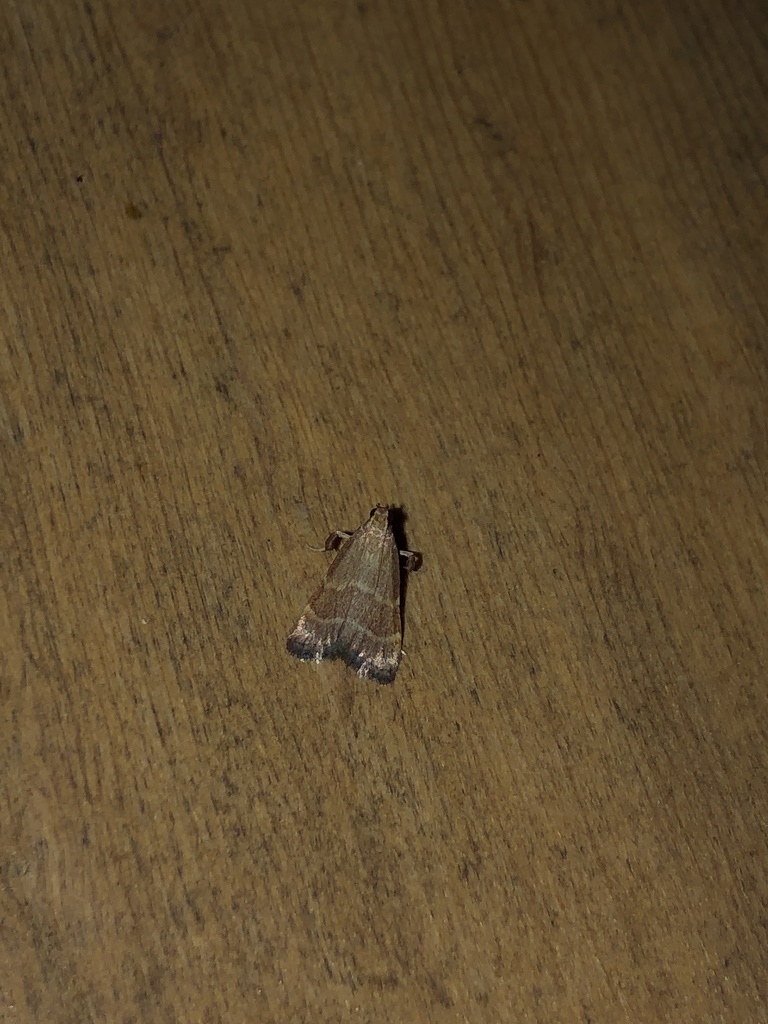
(c) emma reader-lee, some rights reserved (CC BY) · licence
Family: Pyralidae · Class: Insecta · Order: Lepidoptera
Arta epicoenalis is a California animal in the Pyralidae family.
Arta epicoenalis is a small pyralid moth in the subfamily Chrysauginae. Adults have a wingspan of approximately 17 mm, with forewings that are light reddish in coloration and marked by pale antemedial (AM) and postmedial (PM) lines that diverge slightly as they extend from the costa to the inner margin (Butterflies and Moths of North America). The hindwings are light gray, and the tibiae and tarsi lack the conspicuous scale tufts found in some related species. This species ranges from California eastward to Texas and Oklahoma. Within California, documented occurrences include San Benito County, where specimens have been collected near Aromas (BugGuide). Additional California records exist from Fresno and Madera counties, with specimens collected at locations including Coalinga and O'Neill (News of the Lepidopterists' Society 2005). The species appears to have a broad distribution across the southwestern and south-central United States. Specific habitat requirements for Arta epicoenalis have not been well documented in the scientific literature. Based on collection localities, the species appears to occur in areas of California's Central Valley and adjacent foothills. The Aromas locality in San Benito County represents coastal foothill habitat, while the Fresno and Madera county records suggest the species also inhabits interior valley and foothill environments. Elevation ranges and specific vegetation associations remain undocumented. Adult flight period appears to include late spring and early summer months, with California specimens collected in May and June. A specimen from Aromas was documented on June 23, 2011 (BugGuide). The larval biology, including host plants and developmental requirements, has not been described in available literature. Like other members of the Pyralidae, larvae likely feed on plant material, but specific feeding relationships remain unknown. Arta epicoenalis is not federally or state listed as threatened or endangered. No conservation assessments or population studies have been conducted for this species. The moth appears to be relatively uncommon in collections, with few documented specimens from California localities. As with many small moth species, limited survey effort and taxonomic expertise may contribute to sparse occurrence records rather than actual rarity. Scientific documentation for this species remains limited. The information presented here is based on available sources including BugGuide community observations and lepidopterological literature. Detailed ecological studies, comprehensive distribution surveys, and life history investigations are needed to better understand this species' biology and conservation status. We welcome contributions of verified scientific data, photographs, or field observations to enhance this species account.
Classification
Class: Insecta · Order: Lepidoptera · Family: Pyralidae
Frequently asked questions
How is Arta epicoenalis classified?
Arta epicoenalis belongs to class Insecta, order Lepidoptera, family Pyralidae.
What family does Arta epicoenalis belong to?
Arta epicoenalis is in the Pyralidae family.
What is Arta epicoenalis?
Arta epicoenalis is a small pyralid moth in the subfamily Chrysauginae.
Is Arta epicoenalis found in California?
Yes. Arta epicoenalis is recorded in California in The California Species Project's catalogue.
Related species
Other California species in the same genus, family, or bioregion.
Data from The California Species Project — 14,000+ California species with verified data from CNPS, CDFW, USFWS, and more.