Artema atlanta
Giant Daddy-long-legs Spider
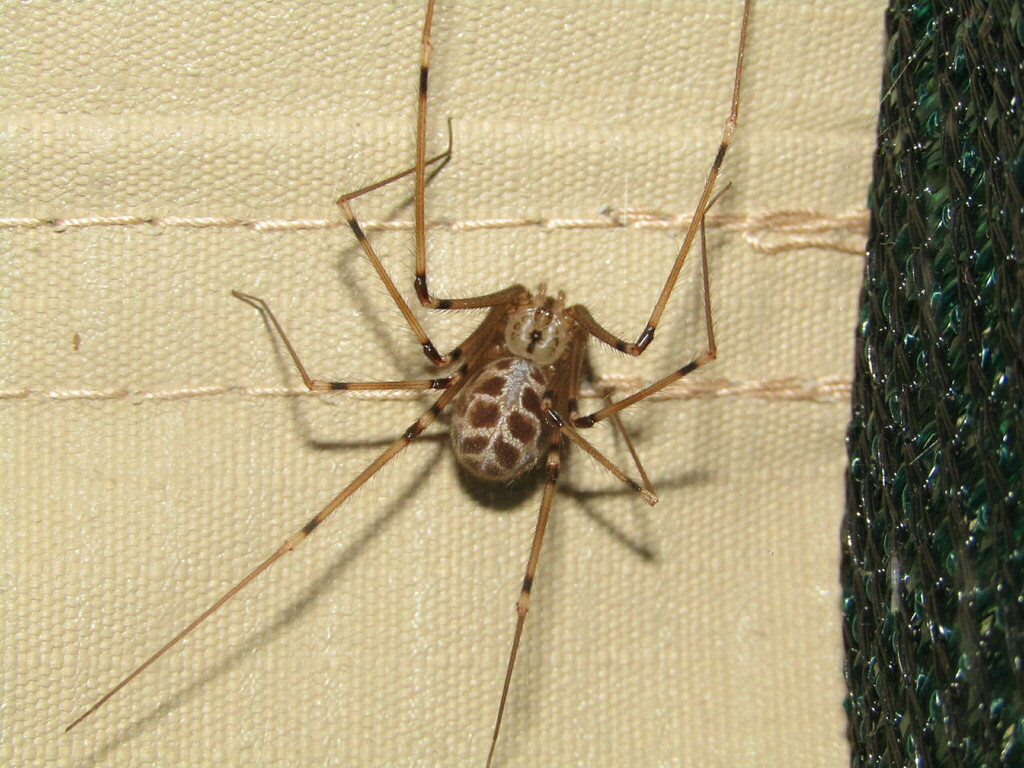
(c) Murphy Tladi, some rights reserved (CC BY) · licence
Family: Pholcidae · Class: Arachnida · Order: Araneae
Artema atlanta (Giant Daddy-long-legs Spider) is a California animal in the Pholcidae family.
The Giant Daddy-long-legs Spider is the largest member of the family Pholcidae worldwide, representing an introduced species that has established limited populations in North America. This arachnid exhibits the characteristic pholcid body plan with extremely long, thin legs equipped with flexible tarsi, distinguishing it from native cellar spiders by its substantial size. The species displays typical pholcid coloration patterns of whitish to gray tones, though specific morphometric data for North American populations remains undocumented. Artema atlanta has a pantropical distribution globally, but within the continental United States, established colonies are restricted to southern Arizona and southeastern California (BugGuide 2015). This limited North American range represents recent introductions rather than natural dispersal, as the species is not native to the region. The species' broader global distribution spans tropical and subtropical regions where it has become established through human-mediated transport. Specific habitat requirements for North American populations have not been thoroughly documented, though pholcids typically occupy structures, caves, and protected environments with stable temperature and humidity conditions. As an introduced species, A. atlanta likely exploits similar microhabitats to native pholcids, including building interiors, garages, and other anthropogenic structures that provide shelter and prey opportunities. Like other pholcids, A. atlanta presumably functions as a predator of small arthropods, though specific prey preferences and hunting behaviors for this species lack detailed documentation. Pholcids characteristically construct irregular webs and exhibit web-shaking behavior when disturbed, vibrating rapidly to confuse potential threats. Reproductive biology, including mating systems, egg production, and developmental timing, remains poorly studied for North American populations. The species likely follows general pholcid patterns of carrying egg sacs and exhibiting extended parental care behaviors. Artema atlanta currently holds no federal or state conservation listing status in the United States. As an introduced species with limited established populations, it does not receive protection under endangered species legislation. The species' conservation significance relates primarily to its status as a non-native organism rather than conservation concern. Population trends, potential ecological impacts on native spider communities, and long-term establishment success remain unassessed. The restricted distribution in only two southwestern states suggests either recent introduction or limited suitable habitat availability. Scientific documentation of this species' North American ecology remains sparse, reflecting the general lack of research attention given to introduced arachnids. Current knowledge derives primarily from taxonomic databases and amateur naturalist observations rather than comprehensive ecological studies. The species represents one of numerous arthropod introductions that have received minimal scientific scrutiny despite potential ecological implications for native arachnid communities.
Classification
Class: Arachnida · Order: Araneae · Family: Pholcidae
Frequently asked questions
How is Artema atlanta classified?
Artema atlanta belongs to class Arachnida, order Araneae, family Pholcidae.
What family does Artema atlanta belong to?
Artema atlanta is in the Pholcidae family.
What is Artema atlanta?
The Giant Daddy-long-legs Spider is the largest member of the family Pholcidae worldwide, representing an introduced species that has established limited populations in North America.
Is Artema atlanta found in California?
Yes. Artema atlanta is recorded in California in The California Species Project's catalogue.
Related species
Other California species in the same genus, family, or bioregion.
Data from The California Species Project — 14,000+ California species with verified data from CNPS, CDFW, USFWS, and more.