Artemisiospiza belli belli
Bell's Sparrow
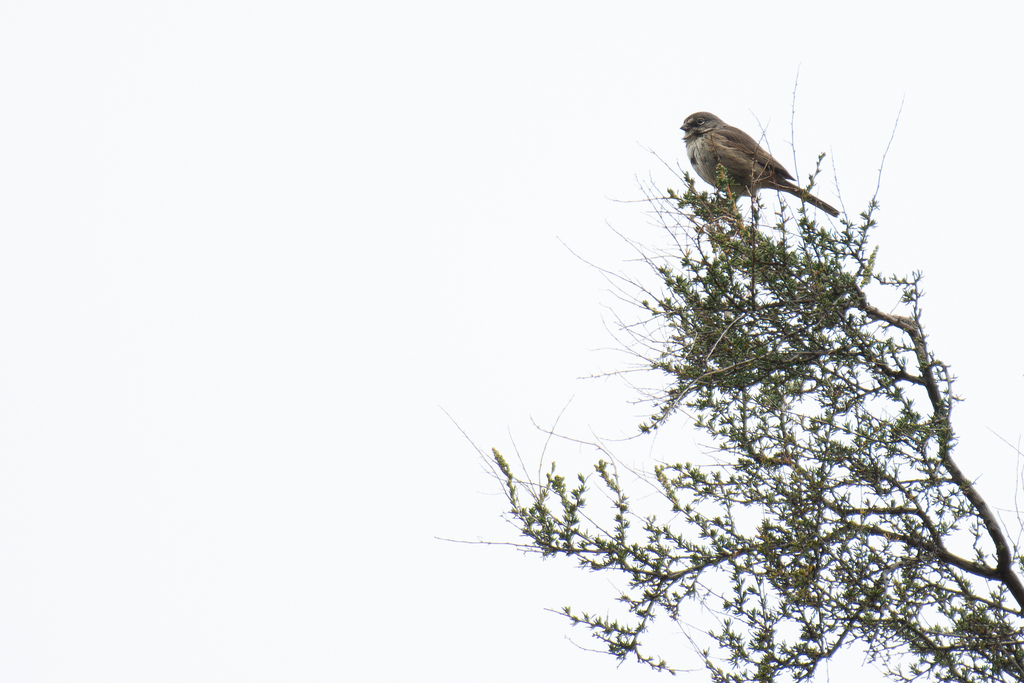
(c) Rajan Rao, some rights reserved (CC BY) · licence
Family: Passerellidae · Class: Aves · Order: Passeriformes
Conservation status: WL · G5T2T3 S3
Artemisiospiza belli belli (Bell's Sparrow) is a California animal in the Passerellidae family.
Bell's Sparrow (Artemisiospiza belli belli) is a medium-sized songbird measuring 12 to 15 cm (4.7 to 5.9 inches) in length and weighing approximately 14 grams (0.5 ounces). This subspecies displays brownish-gray plumage with a grayer head and darker brown back and wings. Distinctive field marks include a white eye ring, white spot in front of the eye, white streaks along the lower jaw, and sometimes a white streak across the forehead. The underparts are predominantly white, contrasting with a blackish-brown tail. The belli subspecies is notably darker than other Bell's Sparrow subspecies and lacks the pale coloration of interior forms. Bell's Sparrow belli occurs along coastal California and extends into Baja California, Mexico. This subspecies is restricted to a limited portion of the Pacific Coast region, distinguishing it from the more widespread interior subspecies. The range includes chaparral and coastal scrub habitats from the California-Oregon border south through the Baja Peninsula. NatureServe reports this subspecies as having a G5T2T3 conservation rank, reflecting its restricted distribution (NatureServe 2017). The subspecies inhabits dry chaparral and scrub-shrub communities characteristic of Mediterranean climates. Primary habitat consists of dense, low-growing shrublands dominated by species such as chamise, manzanita, and coastal sage scrub vegetation. Bell's Sparrows prefer areas with moderate shrub density that provide both foraging opportunities and nesting sites while maintaining open spaces for ground feeding. These birds are year-round residents, remaining within their territories throughout the breeding and non-breeding seasons. Bell's Sparrows are primarily ground foragers, using a distinctive running gait while searching for food among leaf litter and low vegetation. Their diet consists of insects, spiders, and seeds collected from the ground and shrub surfaces. During winter months, they supplement their diet with small fruits from native shrubs. Breeding occurs from March through July, with females constructing cup-shaped nests in dense shrubs typically 0.3 to 1.5 meters above ground. Clutch size ranges from 2 to 4 eggs, with incubation lasting 12 to 13 days. The species exhibits strong site fidelity, with pairs often returning to the same nesting territories across multiple breeding seasons. Bell's Sparrow belli faces significant conservation challenges despite not being federally listed. Primary threats include habitat loss and fragmentation due to urban development, agricultural conversion, and altered fire regimes in coastal California. Climate change poses additional risks through increased wildfire frequency and shifting precipitation patterns that affect chaparral ecosystems. The California Partners in Flight program has identified this subspecies as requiring focused conservation attention due to its restricted range and declining habitat quality (CalPIF 2004). Population monitoring is limited by the species' secretive nature and preference for dense shrubland habitats, making accurate population assessments challenging. Conservation efforts focus on protecting remaining chaparral habitat and implementing appropriate fire management strategies to maintain suitable breeding conditions.
Classification
Class: Aves · Order: Passeriformes · Family: Passerellidae
Conservation status
WL · G5T2T3 S3
Frequently asked questions
How is Artemisiospiza belli belli classified?
Artemisiospiza belli belli belongs to class Aves, order Passeriformes, family Passerellidae.
What family does Artemisiospiza belli belli belong to?
Artemisiospiza belli belli is in the Passerellidae family.
Is Artemisiospiza belli belli protected or of conservation concern?
Artemisiospiza belli belli carries the following status: WL · G5T2T3 S3.
What is Artemisiospiza belli belli?
Bell's Sparrow (Artemisiospiza belli belli) is a medium-sized songbird measuring 12 to 15 cm (4.7 to 5.9 inches) in length and weighing approximately 14 grams (0.5 ounces).
Is Artemisiospiza belli belli found in California?
Yes. Artemisiospiza belli belli is recorded in California in The California Species Project's catalogue.
Related species
Other California species in the same genus, family, or bioregion.
Data from The California Species Project — 14,000+ California species with verified data from CNPS, CDFW, USFWS, and more.