Artemisiospiza belli ssp. belli
Bell's sage sparrow
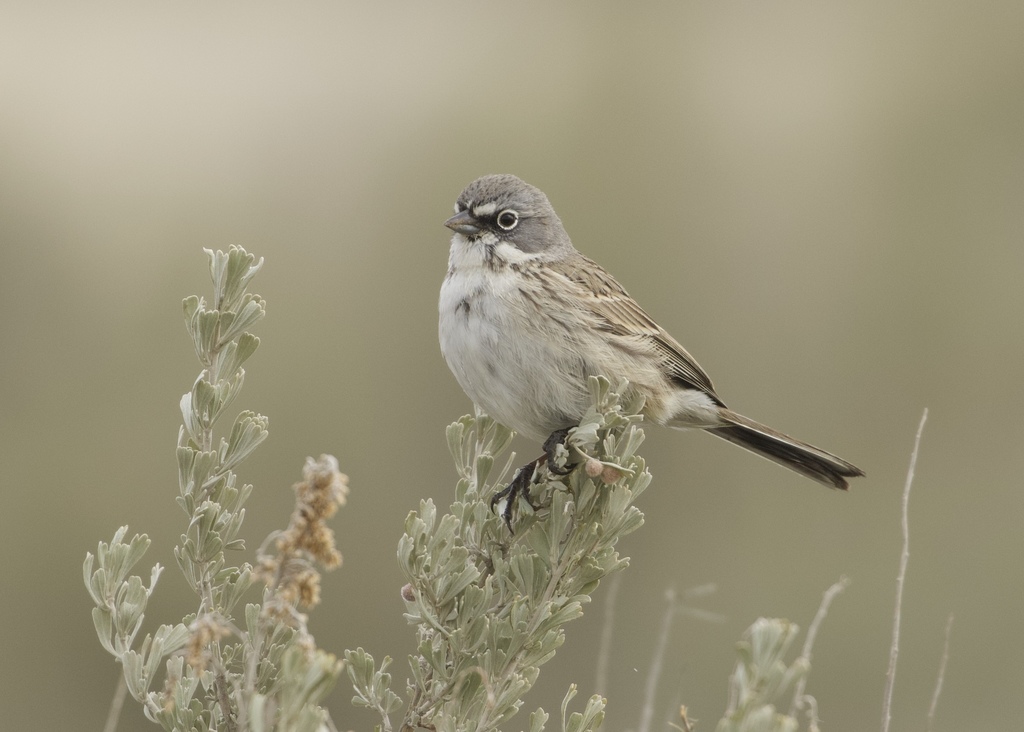
(c) RJ Baltierra, some rights reserved (CC BY) · licence
Family: Passerellidae · Class: Aves · Order: Passeriformes
Conservation status: WL · G5T2T3 S3
Artemisiospiza belli ssp. belli (Bell's sage sparrow) is a California animal in the Passerellidae family.
Bell's sage sparrow (Artemisiospiza belli belli) is a medium-sized songbird measuring 14-16 cm (5.5-6.3 inches) in length with a wingspan of approximately 20 cm (7.9 inches). Adults weigh 17-20 grams and display gray-brown upperparts with distinct dark streaking. The underparts are pale gray to whitish with a prominent dark central breast spot and fine streaking along the flanks. A distinctive white eyering contrasts with gray cheeks, and the tail is long and dark with white outer edges visible in flight. The bill is small and conical, adapted for seed consumption. This subspecies historically ranged throughout the coastal sage scrub and chaparral habitats of southern California, from Ventura County south to Baja California. The current range has contracted significantly, with populations now fragmented across isolated patches of suitable habitat in Los Angeles, Orange, Riverside, and San Bernardino counties. According to the California Department of Fish and Wildlife, the subspecies has experienced an estimated 80% range reduction since the early 1900s due to habitat loss. Bell's sage sparrow inhabits coastal sage scrub communities dominated by California sagebrush (Artemisia californica), white sage (Salvia apiana), and brittlebush (Encelia farinosa). The species requires dense, low-growing shrubs typically 0.5-2 meters in height for nesting and foraging. Optimal habitat occurs on slopes and mesas at elevations from sea level to 1,200 meters (3,937 feet), where shrub cover exceeds 50% and includes scattered open areas for ground foraging. Breeding occurs from March through July, with peak activity in April and May. Females construct cup-shaped nests 0.3-1.5 meters above ground in dense shrub branches, laying 2-4 pale blue eggs with brown spotting. Incubation lasts 11-13 days, and young fledge after 9-11 days. The species typically produces one brood per year, though double brooding may occur in favorable conditions. Bell's sage sparrow forages primarily on the ground beneath shrub cover, consuming small seeds from forbs and grasses. During breeding season, the diet includes insects, particularly lepidopteran larvae and beetles, which provide protein for developing young. The subspecies is designated as a California Department of Fish and Wildlife Watch List species with a state rank of S3 (vulnerable). The primary threat is habitat loss and fragmentation due to urban development, with an estimated 85-95% of historical coastal sage scrub habitat converted to other uses. Additional threats include invasive plant species that alter habitat structure, increased fire frequency, and edge effects from adjacent urban areas. Brown-headed cowbird parasitism affects reproductive success in some populations. Conservation efforts focus on habitat protection and restoration, with several populations occurring within protected areas including Crystal Cove State Park and Laguna Coast Wilderness Park. The California Gnatcatcher Multi-species Habitat Conservation Plan provides some protection for remaining coastal sage scrub habitats that support this subspecies.
Classification
Class: Aves · Order: Passeriformes · Family: Passerellidae
Conservation status
WL · G5T2T3 S3
Frequently asked questions
How is Artemisiospiza belli ssp. belli classified?
Artemisiospiza belli ssp. belli belongs to class Aves, order Passeriformes, family Passerellidae.
What family does Artemisiospiza belli ssp. belli belong to?
Artemisiospiza belli ssp. belli is in the Passerellidae family.
Is Artemisiospiza belli ssp. belli protected or of conservation concern?
Artemisiospiza belli ssp. belli carries the following status: WL · G5T2T3 S3.
What is Artemisiospiza belli ssp. belli?
Bell's sage sparrow (Artemisiospiza belli belli) is a medium-sized songbird measuring 14-16 cm (5.5-6.3 inches) in length with a wingspan of approximately 20 cm (7.9 inches).
Is Artemisiospiza belli ssp. belli found in California?
Yes. Artemisiospiza belli ssp. belli is recorded in California in The California Species Project's catalogue.
Related species
Other California species in the same genus, family, or bioregion.
Data from The California Species Project — 14,000+ California species with verified data from CNPS, CDFW, USFWS, and more.