Artemisiospiza belli ssp. clementeae
San Clemente sage sparrow
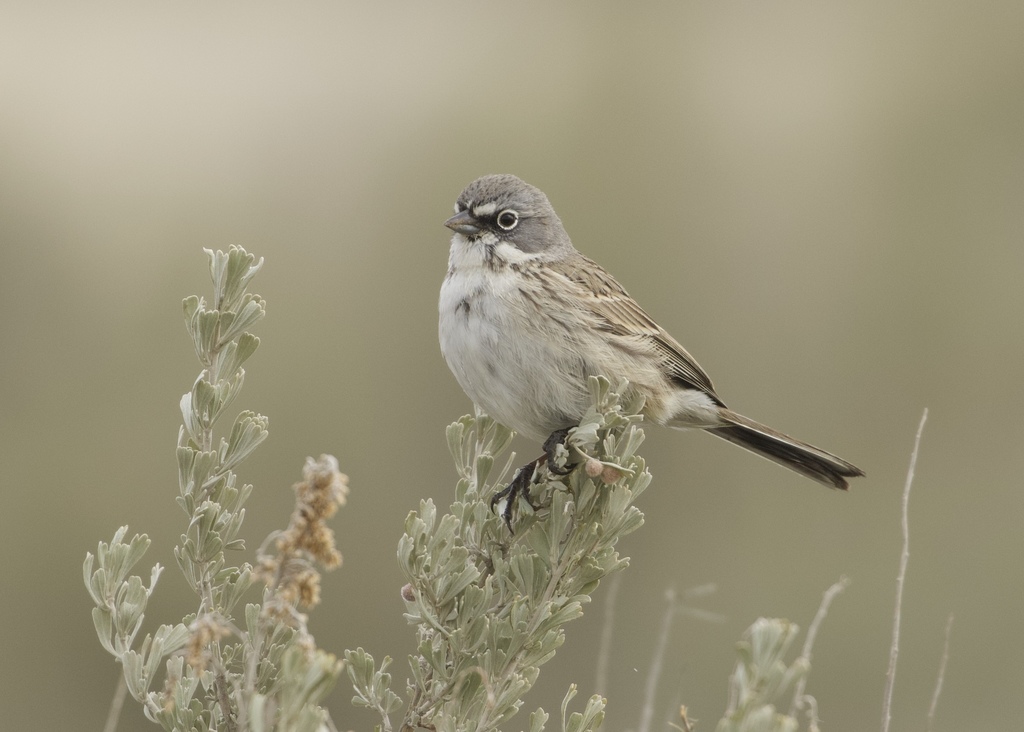
(c) RJ Baltierra, some rights reserved (CC BY) · licence
Family: Passerellidae · Class: Aves · Order: Passeriformes
Conservation status: Threatened · G5T1Q S1
Artemisiospiza belli ssp. clementeae (San Clemente sage sparrow) is a California animal in the Passerellidae family.
The San Clemente sage sparrow (Amphispiza belli clementeae) is a subspecies of bell's sparrow endemic to San Clemente Island, located approximately 68 kilometers (42 miles) west of San Diego, California. This small passerine measures 14 to 16 centimeters (5.5 to 6.3 inches) in length and weighs 17 to 20 grams. Adults display gray-brown upperparts with darker streaking, pale underparts with a distinctive dark central breast spot, and white outer tail feathers visible in flight. The subspecies is distinguished from mainland bell's sparrow populations by its darker overall coloration, longer tail, and more pronounced facial markings including a distinct white eyering and dark malar stripe. Historically, the San Clemente sage sparrow occupied shrubland habitats across San Clemente Island's 147 square kilometers (57 square miles). Current distribution is severely restricted to the island's central and northwestern portions, representing less than 25% of the subspecies' historical range. The population is concentrated in areas above 200 meters (656 feet) elevation where suitable habitat remains. The subspecies inhabits maritime desert scrub and coastal sage scrub communities dominated by native shrubs. Primary vegetation includes San Clemente Island bush mallow (Malacothamnus clementinus), boxthorn (Lycium hassei), and prickly pear cactus (Opuntia littoralis var. vaseyi). These birds require dense shrub cover with canopy heights of 1 to 2 meters for nesting and foraging. The subspecies has adapted to the island's arid conditions, obtaining most water requirements from food sources rather than free-standing water. San Clemente sage sparrows are primarily granivorous, feeding on small seeds from shrubs and herbaceous plants. During breeding season, adults supplement their diet with insects to provide protein for developing young. The species exhibits year-round territoriality, with males defending territories through song and aggressive displays. Breeding occurs from March through July, with peak nesting activity in April and May. Females construct cup-shaped nests in dense shrub foliage 0.5 to 1.5 meters above ground. Clutch size ranges from 2 to 4 eggs, with an incubation period of 12 to 14 days. Young fledge after 9 to 12 days but remain dependent on parents for several weeks. The U.S. Fish and Wildlife Service listed the San Clemente sage sparrow as threatened under the Endangered Species Act on August 11, 1977. Population surveys conducted by the U.S. Navy indicate the current population ranges from 1,500 to 2,500 individuals, representing a significant decline from historical levels. Primary threats include habitat degradation from introduced ungulates, particularly feral goats and pigs that were removed in the 1990s, and ongoing impacts from feral cats. Invasive plant species, including fennel and ice plant, continue to alter native shrubland communities. The U.S. Navy, which manages San Clemente Island, implements habitat restoration projects and invasive species control as part of recovery efforts. Climate change poses additional long-term threats through altered precipitation patterns and increased fire risk in the island's arid environment.
Classification
Class: Aves · Order: Passeriformes · Family: Passerellidae
Conservation status
Threatened · G5T1Q S1
Frequently asked questions
How is Artemisiospiza belli ssp. clementeae classified?
Artemisiospiza belli ssp. clementeae belongs to class Aves, order Passeriformes, family Passerellidae.
What family does Artemisiospiza belli ssp. clementeae belong to?
Artemisiospiza belli ssp. clementeae is in the Passerellidae family.
Is Artemisiospiza belli ssp. clementeae protected or of conservation concern?
Artemisiospiza belli ssp. clementeae carries the following status: Threatened · G5T1Q S1.
What is Artemisiospiza belli ssp. clementeae?
The San Clemente sage sparrow (Amphispiza belli clementeae) is a subspecies of bell's sparrow endemic to San Clemente Island, located approximately 68 kilometers (42 miles) west of San Diego, California.
Is Artemisiospiza belli ssp. clementeae found in California?
Yes. Artemisiospiza belli ssp. clementeae is recorded in California in The California Species Project's catalogue.
Related species
Other California species in the same genus, family, or bioregion.
Data from The California Species Project — 14,000+ California species with verified data from CNPS, CDFW, USFWS, and more.