Artemisiospiza nevadensis
Sagebrush Sparrow
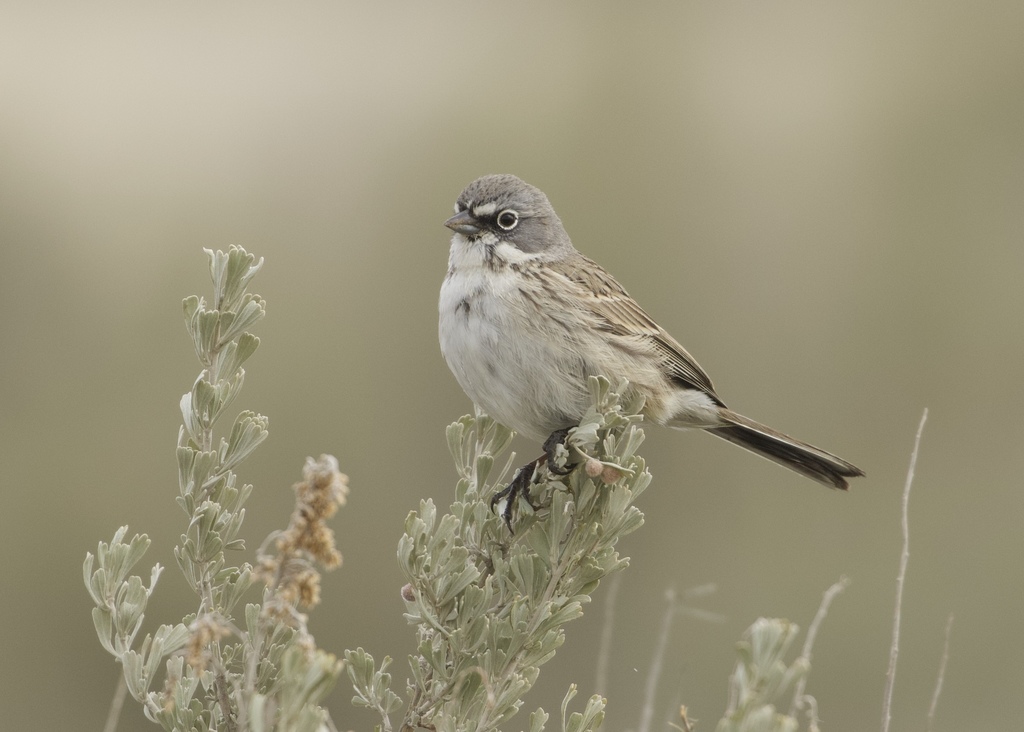
(c) RJ Baltierra, some rights reserved (CC BY) · licence
Family: Passerellidae · Class: Aves · Order: Passeriformes
Artemisiospiza nevadensis (Sagebrush Sparrow) is a California animal in the Passerellidae family.
The Sagebrush Sparrow (Artemisiospiza nevadensis) is a medium-sized passerine measuring 14-16 cm (5.5-6.3 inches) in length with a wingspan of 18-22 cm (7.1-8.7 inches). Adults weigh 17-25 grams. The species exhibits grayish-brown upperparts with dark streaking, pale gray underparts, and a distinctive white eye-ring. The head pattern includes a gray crown with a darker central stripe, white supercilium, and dark moustachial stripe. The tail is relatively long with white outer tail feathers visible in flight. Sexual dimorphism is minimal, though males may show slightly more contrasted plumage during breeding season. Historically, Sagebrush Sparrows ranged throughout the Great Basin region of western North America. In California, the species occurs primarily in the northeastern counties, including Lassen, Modoc, and portions of Mono and Inyo counties. The range extends from the Oregon border south through the eastern Sierra Nevada and into the Mojave Desert region. Population distribution closely follows the extent of sagebrush habitat, with documented breeding locations at elevations from 1,200 to 2,800 meters (3,900-9,200 feet). The species demonstrates strong habitat specificity, requiring intact sagebrush ecosystems dominated by Artemisia tridentata (big sagebrush) and Artemisia arbuscula (low sagebrush). Optimal habitat consists of mature sagebrush stands with 15-25% shrub cover, interspersed with herbaceous openings. The species avoids areas with shrub cover exceeding 40% or below 10%. Suitable habitat requires shrub height of 0.5-2.0 meters with adequate spacing for ground foraging. Nest sites are typically placed in sagebrush shrubs 30-100 cm above ground. Sagebrush Sparrows are primarily ground-foraging granivores, consuming seeds from grasses and forbs during non-breeding periods. During breeding season, diet shifts to include arthropods, particularly lepidopteran larvae and beetles, comprising up to 60% of food items. The species exhibits site fidelity, with adults returning to previous breeding territories. Breeding occurs from April through July, with peak activity in May and June. Females construct open cup nests and typically produce 2-4 broods per season. Clutch size ranges from 2-5 eggs, with an average of 3.2 eggs per clutch. Incubation lasts 11-13 days, and nestlings fledge after 9-11 days. Males establish territories through song and aggressive displays, often perching on prominent shrubs to defend nesting areas. The Sagebrush Sparrow is not federally listed but faces significant conservation challenges. Partners in Flight estimates a 46% population decline since 1970, with current breeding population estimated at 8.7 million individuals. Primary threats include sagebrush habitat loss through agricultural conversion, urban development, and energy development. In California, renewable energy projects and transmission lines pose increasing threats to remaining habitat. Invasive annual grasses, particularly Bromus tectorum (cheatgrass), alter fire regimes and degrade habitat quality. Climate change projections suggest potential range contractions of 30-50% by 2080. The species is considered a priority for sagebrush ecosystem conservation initiatives across its range.
Classification
Class: Aves · Order: Passeriformes · Family: Passerellidae
Frequently asked questions
How is Artemisiospiza nevadensis classified?
Artemisiospiza nevadensis belongs to class Aves, order Passeriformes, family Passerellidae.
What family does Artemisiospiza nevadensis belong to?
Artemisiospiza nevadensis is in the Passerellidae family.
What is Artemisiospiza nevadensis?
The Sagebrush Sparrow (Artemisiospiza nevadensis) is a medium-sized passerine measuring 14-16 cm (5.5-6.3 inches) in length with a wingspan of 18-22 cm (7.1-8.7 inches).
Is Artemisiospiza nevadensis found in California?
Yes. Artemisiospiza nevadensis is recorded in California in The California Species Project's catalogue.
Related species
Other California species in the same genus, family, or bioregion.
Data from The California Species Project — 14,000+ California species with verified data from CNPS, CDFW, USFWS, and more.