Ascalapha odorata
Black Witch
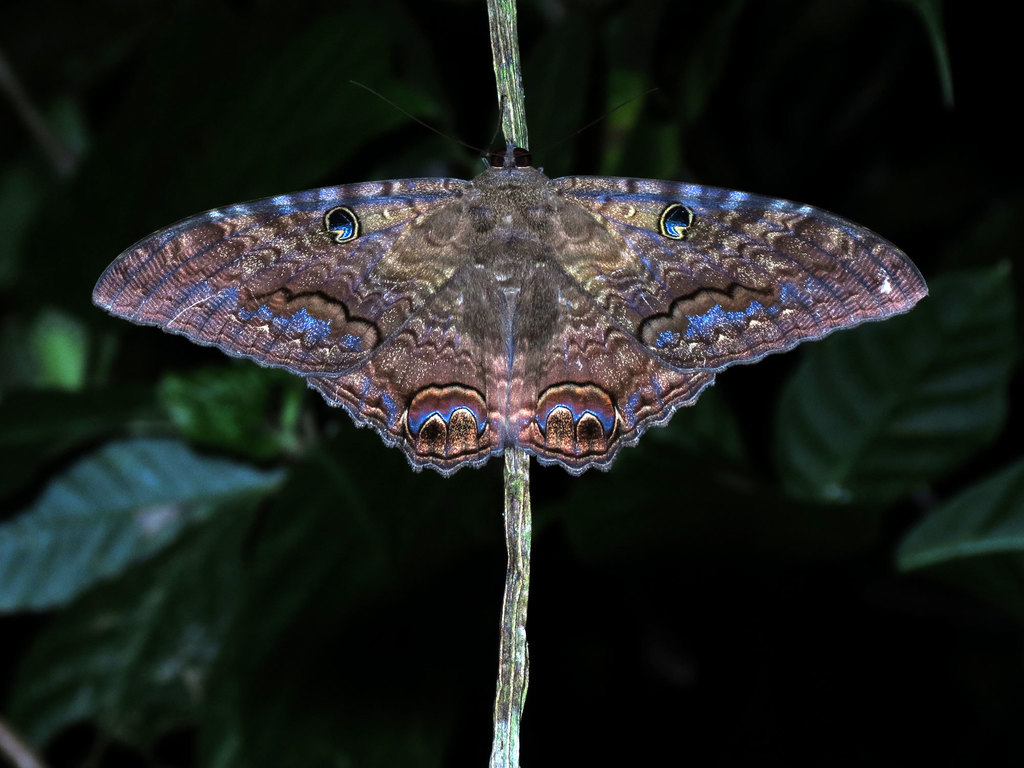
(c) Katja Schulz, some rights reserved (CC BY) · licence
Family: Erebidae · Class: Insecta · Order: Lepidoptera
Ascalapha odorata (Black Witch) is a California animal in the Erebidae family.
The Black Witch is a large moth in the family Erebidae, representing one of North America's largest lepidopteran species. Adults exhibit a wingspan ranging from 120 to 160 mm (4.7 to 6.3 inches), with females typically larger than males (Covell 1984). The forewings are dark brown to black with intricate patterns of lighter brown and gray markings, including distinctive eyespots and wavy transverse lines. Males display a more uniform dark coloration with subtle purple-brown tones, while females show more pronounced mottling and often possess a pale diagonal band across each forewing. The hindwings are similarly dark with lighter marginal areas and small eyespots near the outer edges. The Black Witch maintains a primarily tropical distribution, with established populations present year-round in southern Florida and southern Texas. However, this species demonstrates extensive migratory capabilities, with individuals regularly traveling northward during summer and fall months, typically between July and October. Migration routes extend as far north as Newfoundland and Minnesota, making the Black Witch one of the most widely dispersed tropical moths in North America. These northern movements occur more frequently than those of the closely related Owl Moth (Thysania zenobia), suggesting stronger migratory tendencies in this species. The species inhabits diverse environments ranging from tropical and subtropical forests to urban areas with suitable host plants. Black Witch moths are strongly attracted to artificial lights and frequently appear around residential and commercial lighting systems during migration periods. Adults prefer areas with dense vegetation that provide daytime roosting sites, including tree trunks, building overhangs, and other vertical surfaces where their cryptic coloration provides effective camouflage. Larvae feed exclusively on leguminous plants, with Cassia species and catclaw (Senegalia greggii) serving as primary host plants (Wagner 2005). The caterpillars are large, reaching lengths of 100 to 120 mm when fully developed, and display green coloration with yellow lateral stripes and small black spots (Powell & Opler 2009). Development from egg to adult requires approximately 60 to 90 days under optimal conditions (Janzen & Hallwachs 2009). Adults are nocturnal and primarily active during warm, humid nights. Mating typically occurs during the wet season in tropical regions, with females depositing eggs singly on host plant foliage. The Black Witch holds no federal or state conservation status in the United States, reflecting its widespread distribution and stable populations throughout its native range. Climate change may be influencing migration patterns, with some observations suggesting earlier and more extensive northward movements in recent decades. Urban development and habitat modification in tropical breeding areas could potentially impact local populations, though the species' adaptability to human-modified environments appears to mitigate these concerns. The moth's cultural significance varies across its range, with some regions considering its appearance an omen while others view it neutrally as a common seasonal visitor.
Classification
Class: Insecta · Order: Lepidoptera · Family: Erebidae
Frequently asked questions
How is Ascalapha odorata classified?
Ascalapha odorata belongs to class Insecta, order Lepidoptera, family Erebidae.
What family does Ascalapha odorata belong to?
Ascalapha odorata is in the Erebidae family.
What is Ascalapha odorata?
The Black Witch is a large moth in the family Erebidae, representing one of North America's largest lepidopteran species.
Is Ascalapha odorata found in California?
Yes. Ascalapha odorata is recorded in California in The California Species Project's catalogue.
Related species
Other California species in the same genus, family, or bioregion.
Data from The California Species Project — 14,000+ California species with verified data from CNPS, CDFW, USFWS, and more.