Asio flammeus
Short-eared Owl
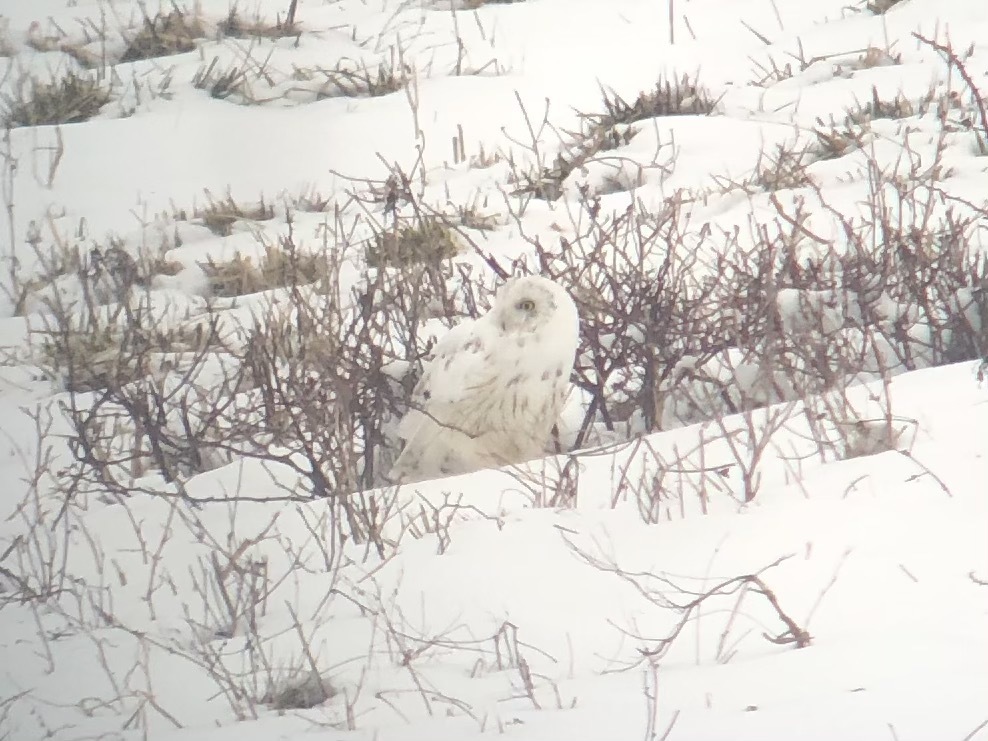
(c) ecovore, some rights reserved (CC BY) · licence
Family: Strigidae · Class: Aves · Order: Strigiformes
Conservation status: G5 S3
Asio flammeus (Short-eared Owl) is a California animal in the Strigidae family.
The Short-eared Owl is a medium-sized raptor measuring 34-42 cm (13-17 inches) in length with a wingspan of 85-103 cm (33-41 inches). Adults weigh between 206-475 grams (7-17 ounces). The species displays mottled brown and buff plumage with streaked underparts and a pale facial disc bordered by dark markings around the eyes. The 'ears' are actually small tufts of feathers that are rarely visible in the field. Males are typically paler than females, with less distinct streaking on the underparts. In flight, the species shows characteristic dark patches at the wrist of each wing and a light-colored trailing edge. Short-eared Owls have one of the most extensive distributions of any bird species globally. In California, the species occurs primarily in the Central Valley, coastal regions, and northeastern counties during winter months. Breeding populations are rare and irregular, with confirmed nesting documented in Modoc, Lassen, and Siskiyou counties in the far northeast. The species is considered a common winter resident from October through March, with peak numbers occurring from December through February. This owl inhabits open grasslands, prairies, agricultural fields, and coastal marshes. The species requires large expanses of short- to medium-height vegetation for hunting, typically avoiding areas with dense tree cover. In California, Short-eared Owls utilize rice fields, alfalfa, cattle pastures, and seasonal wetlands. Breeding habitat consists of extensive grasslands or prairie with scattered low perches and minimal human disturbance. Nests are constructed on the ground in shallow depressions lined with grass and feathers. Short-eared Owls are primarily crepuscular, hunting during dawn and dusk hours, though they may be active during overcast days. The species exhibits a distinctive low, coursing flight pattern over open terrain while searching for prey. Small mammals comprise 95% of the diet, with voles being the primary prey species. Other prey includes mice, shrews, ground squirrels, and occasionally small birds, amphibians, and insects. Breeding occurs from March through July, with females laying 4-7 white eggs in ground nests. Incubation lasts 24-28 days, and young fledge after 24-27 days. The Short-eared Owl is not federally listed but is considered a California Species of Special Concern due to declining populations and habitat loss. According to the North American Breeding Bird Survey, continental populations have declined by approximately 3.9% annually since 1966. In California, breeding populations are extremely limited and irregular. Primary threats include conversion of grassland habitat to agriculture and urban development, pesticide use that reduces prey populations, and disturbance at nest sites. The species' dependence on large blocks of undeveloped grassland makes it particularly vulnerable to habitat fragmentation. Climate change may further impact the species by altering precipitation patterns that affect prey populations and suitable habitat distribution throughout the state.
Classification
Class: Aves · Order: Strigiformes · Family: Strigidae
Conservation status
G5 S3
Frequently asked questions
How is Asio flammeus classified?
Asio flammeus belongs to class Aves, order Strigiformes, family Strigidae.
What family does Asio flammeus belong to?
Asio flammeus is in the Strigidae family.
Is Asio flammeus protected or of conservation concern?
Asio flammeus carries the following status: G5 S3.
What is Asio flammeus?
The Short-eared Owl is a medium-sized raptor measuring 34-42 cm (13-17 inches) in length with a wingspan of 85-103 cm (33-41 inches).
Is Asio flammeus found in California?
Yes. Asio flammeus is recorded in California in The California Species Project's catalogue.
Related species
Other California species in the same genus, family, or bioregion.
Data from The California Species Project — 14,000+ California species with verified data from CNPS, CDFW, USFWS, and more.