Asio flammeus flammeus
Short-eared Owl (subspecies)
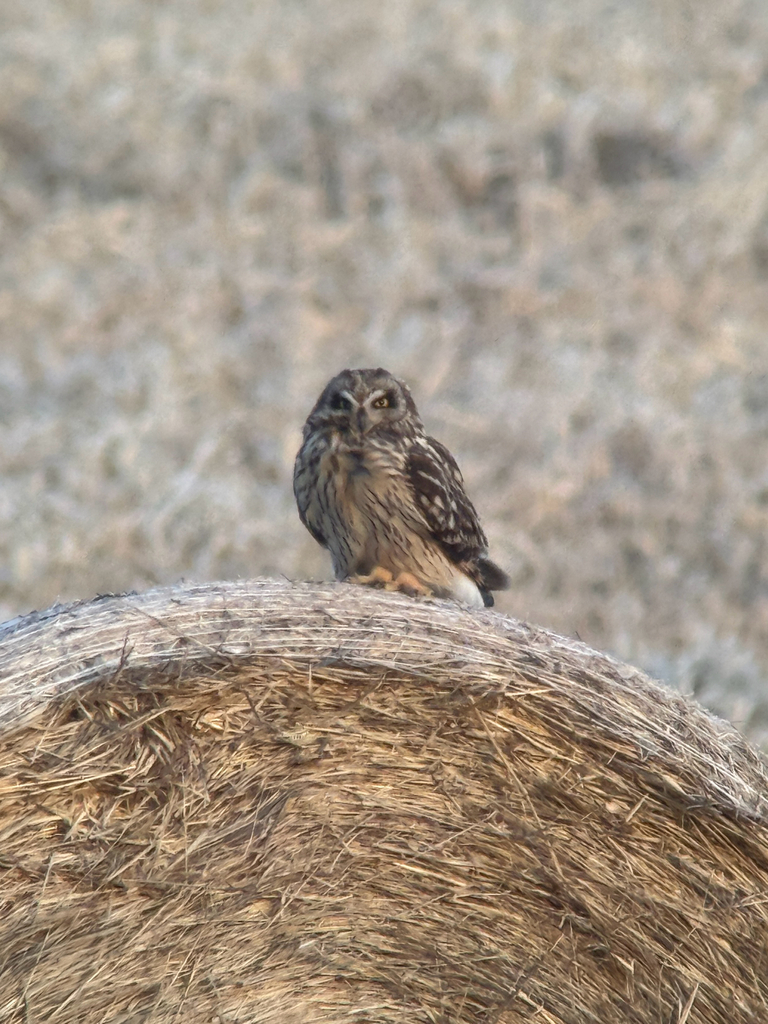
(c) Rajan Rao, some rights reserved (CC BY) · licence
Family: Strigidae · Class: Aves · Order: Strigiformes
Asio flammeus flammeus (Short-eared Owl (subspecies)) is a California animal in the Strigidae family.
The Short-eared Owl (Asio flammeus flammeus) is the nominate subspecies of one of the world's most widely distributed owl species. Adults measure 34-43 cm (13-17 inches) in length with a wingspan of 85-110 cm (33-43 inches), weighing 0.3-0.8 kg (0.7-1.8 pounds), with females slightly larger than males. The plumage displays a mottled pattern of brown, buff, white, and rust colors, with brown and buff patches concentrated on the dorsal surface and lighter coloration below. Key identifying features include a pale gray-white facial disk, distinctive black patches surrounding bright yellow eyes, and small ear tufts that are often inconspicuous. The underwing shows prominent dark patches at the wrist, visible during flight. This subspecies has one of the most extensive distributions among owl taxa, ranging from Iceland, the British Isles, Scandinavia, northern Russia, and northern Siberia south to southern Europe, Afghanistan, northern Mongolia, and Kamchatka (NatureServe 2004). In North America, the breeding range extends from northern Alaska to northern Labrador, south to California, Utah, Colorado, Missouri, Illinois, Ohio, and Virginia. The species is more numerous in western and central North America than in eastern regions. During non-breeding seasons, Short-eared Owls occur primarily in southern Canadian provinces and southward to southern Baja California and southern Mexico. Short-eared Owls inhabit open grasslands, prairies, agricultural areas, marshes, and tundra. They prefer areas with low vegetation that provides adequate small mammal populations while allowing clear sightlines for hunting. The species utilizes savanna, herbaceous wetlands, old fields, cropland with hedgerows, and bog/fen habitats (NatureServe 2004). Breeding territories average 64-74 hectares, with home ranges typically spanning approximately 65 hectares. This subspecies exhibits crepuscular and occasionally diurnal hunting behavior, distinguishing it from most other owl species. Short-eared Owls are opportunistic predators, feeding primarily on small mammals including voles, mice, and shrews, supplemented by small birds and occasionally insects. They hunt by flying low over open terrain in a characteristic coursing flight pattern. Nesting occurs on the ground in shallow depressions lined with grass and feathers, typically concealed within dense vegetation. Females lay 4-9 eggs, with clutch size varying based on prey availability. The nominate subspecies is not federally listed in the United States, maintaining a global conservation status, though specific population trends vary regionally. However, western North American populations have experienced significant declines, with more than 60 percent population reduction over the past four decades according to the Western Asio flammeus Landscape Study (California Department of Fish and Wildlife 2019). Primary threats include habitat loss from agricultural intensification, grassland conversion, and urban development. Climate change and rodenticide exposure represent emerging conservation concerns. The species' dependence on cyclic small mammal populations creates natural fluctuations in breeding success and local abundance.
Classification
Class: Aves · Order: Strigiformes · Family: Strigidae
Frequently asked questions
How is Asio flammeus flammeus classified?
Asio flammeus flammeus belongs to class Aves, order Strigiformes, family Strigidae.
What family does Asio flammeus flammeus belong to?
Asio flammeus flammeus is in the Strigidae family.
What is Asio flammeus flammeus?
The Short-eared Owl (Asio flammeus flammeus) is the nominate subspecies of one of the world's most widely distributed owl species.
Is Asio flammeus flammeus found in California?
Yes. Asio flammeus flammeus is recorded in California in The California Species Project's catalogue.
Related species
Other California species in the same genus, family, or bioregion.
Data from The California Species Project — 14,000+ California species with verified data from CNPS, CDFW, USFWS, and more.