Asio otus
Long-eared Owl
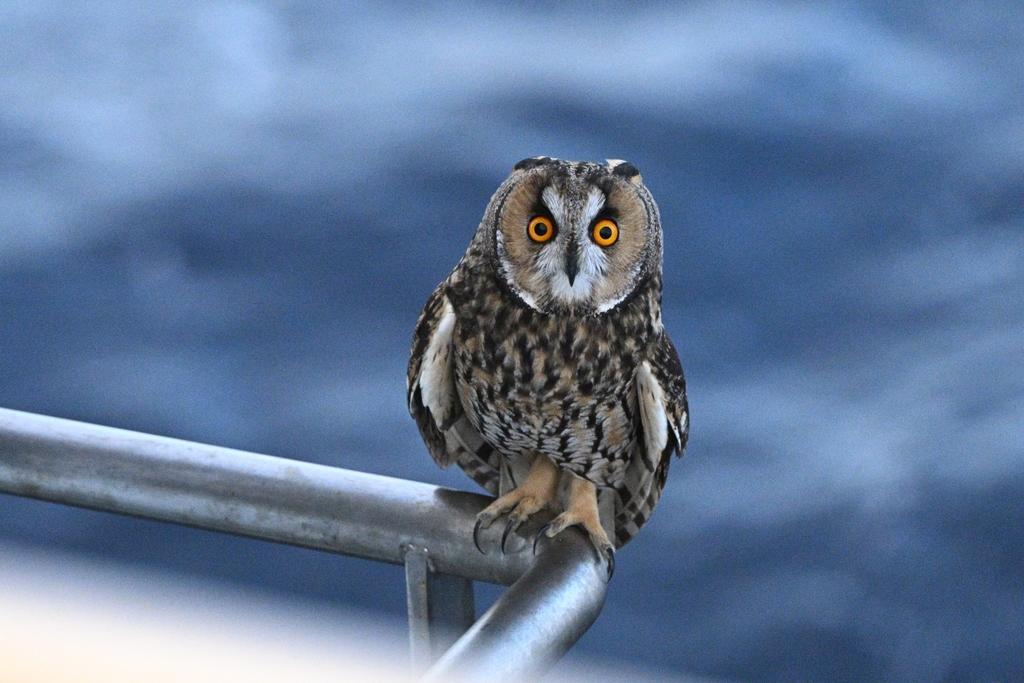
(c) Charlotte Kirchner, some rights reserved (CC BY) · licence
Family: Strigidae · Class: Aves · Order: Strigiformes
Asio otus (Long-eared Owl) is a California animal in the Strigidae family.
The Long-eared Owl (Asio otus) is a medium-sized owl measuring 31-40 cm (12-16 inches) in length with a wingspan of 86-98 cm (34-39 inches). Adults weigh between 220-435 grams (7.8-15.3 ounces). The species displays prominent ear tufts that are positioned closer together than those of the Great Horned Owl. The facial disc is orange-buff to rusty-brown with a dark border, and the eyes are bright orange-yellow. The upperparts are mottled brown, buff, and gray with dark streaking, while the underparts are buff to whitish with bold dark vertical streaking and fine cross-barring. In flight, the wings appear long and narrow with distinct dark patches at the wrist. Long-eared Owls have a widespread but patchy distribution across California. The species breeds throughout much of the state except for the southeastern deserts and high Sierra Nevada peaks. In California, they are found from sea level to approximately 2,100 meters (6,900 feet) elevation. The species occurs year-round in suitable habitat, though northern populations may move south during winter months. Breeding populations are documented in the Central Valley, coastal regions, and montane areas of the Sierra Nevada and Coast Ranges. This species inhabits dense woodlands and forest edges, particularly areas with thick understory vegetation for roosting. Preferred habitats include riparian woodlands dominated by willows and cottonwoods, oak woodlands, mixed coniferous forests, and parks with mature trees. During breeding season, pairs select areas with adjacent open grasslands or agricultural fields for hunting. Roosting sites are typically in dense vegetation 2-4 meters above ground, often in groves of 10-20 trees that provide concealment during daylight hours. Long-eared Owls are nocturnal hunters that feed primarily on small mammals, with voles comprising 60-90% of their diet. Other prey includes mice, shrews, young rabbits, and occasionally small birds and insects. Hunting occurs in open areas such as grasslands, agricultural fields, and meadows. The breeding season extends from March through July in California. Females lay 2-6 white eggs in stick nests abandoned by other species, particularly crows, hawks, or magpies, typically 3-6 meters above ground. Incubation lasts 25-30 days, and young fledge after 21-24 days. During winter, the species may form communal roosts of 6-50 individuals in dense cover. The Long-eared Owl is not federally or state-listed but faces population pressures from habitat loss and fragmentation. Conversion of riparian woodlands and grasslands to urban development and intensive agriculture reduces both nesting and foraging habitat. According to the North American Breeding Bird Survey, populations have shown long-term declines of approximately 1.5% annually across their range. Additional threats include pesticide use in agricultural areas, which reduces prey availability, and collisions with vehicles and power lines. In California, habitat conservation efforts focus on protecting riparian corridors and maintaining connectivity between woodland patches and adjacent open foraging areas through conservation easements and habitat restoration projects.
Classification
Class: Aves · Order: Strigiformes · Family: Strigidae
Frequently asked questions
How is Asio otus classified?
Asio otus belongs to class Aves, order Strigiformes, family Strigidae.
What family does Asio otus belong to?
Asio otus is in the Strigidae family.
What is Asio otus?
The Long-eared Owl (Asio otus) is a medium-sized owl measuring 31-40 cm (12-16 inches) in length with a wingspan of 86-98 cm (34-39 inches).
Is Asio otus found in California?
Yes. Asio otus is recorded in California in The California Species Project's catalogue.
Related species
Other California species in the same genus, family, or bioregion.
Data from The California Species Project — 14,000+ California species with verified data from CNPS, CDFW, USFWS, and more.