Aspidoscelis hyperythra
Orange-throated Whiptail
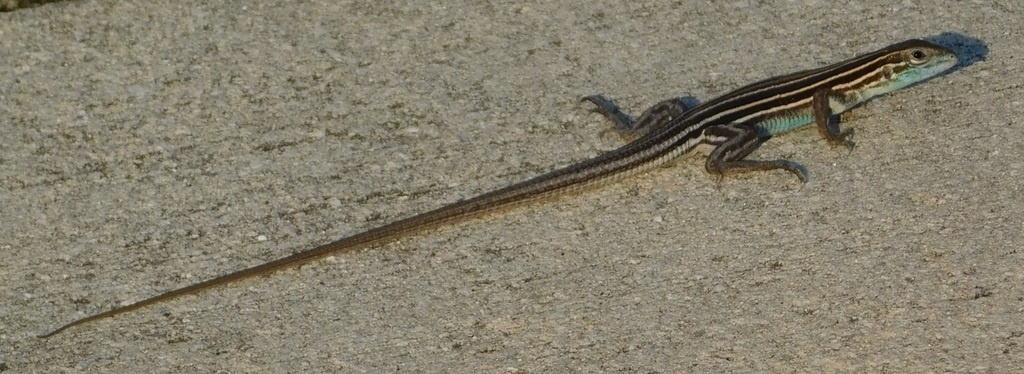
no rights reserved · CC0
Family: Teiidae · Class: Reptilia · Order: Squamata
Conservation status: WL · G5 S2S3
Aspidoscelis hyperythra (Orange-throated Whiptail) is a California animal in the Teiidae family.
The Orange-throated Whiptail is a medium-sized lizard endemic to southern California and Baja California, Mexico. Adults typically measure 203 to 305 mm (8.0 to 12.0 inches) in total length, with males slightly larger than females. The species exhibits distinct sexual dimorphism in coloration. Males display the characteristic orange throat patch that gives the species its common name, along with blue ventral surfaces and bright blue patches on the sides of the belly. The dorsal surface features a brown to grayish-brown base color with six to eight distinct yellowish or cream-colored longitudinal stripes. Females lack the orange throat coloration and blue ventral markings, instead showing a more subdued brown dorsal pattern with similar striping. The tail is typically 1.5 to 2 times the body length and displays alternating light and dark banding. Historically, the Orange-throated Whiptail occurred throughout much of coastal and inland southern California, from Santa Barbara County south to the Mexican border. The current range has contracted significantly and is now fragmented, with populations restricted to scattered locations in Los Angeles, Orange, Riverside, San Bernardino, and San Diego counties. The species has been extirpated from much of its former range in urbanized areas of the Los Angeles Basin and coastal Orange County. Orange-throated Whiptails inhabit a variety of arid and semi-arid environments, including coastal sage scrub, chaparral, desert scrub, and grassland communities. The species occurs from near sea level to elevations of approximately 1,220 meters (4,000 feet). Essential habitat components include areas with loose, sandy or gravelly soils suitable for digging burrows, scattered shrub cover for thermoregulation and predator avoidance, and open areas for foraging. The species demonstrates a preference for south-facing slopes and areas with 25 to 75 percent shrub cover. This diurnal, ground-dwelling lizard is most active during warm mornings and late afternoons when temperatures range from 28 to 35°C (82 to 95°F). Orange-throated Whiptails are primarily insectivorous, consuming beetles, ants, termites, grasshoppers, and other arthropods. They are active foragers, using their keen eyesight and rapid movements to locate prey among leaf litter and low vegetation. The breeding season extends from May through July. Females deposit clutches of one to six eggs, typically three to four, in shallow nests excavated in sandy soil. Incubation requires approximately 60 to 75 days, with hatching occurring from July through September. The Orange-throated Whiptail is designated as a California Watch List species, reflecting concerns about population declines and habitat loss. The species has a global rank of G5 (secure) but a state rank of S2S3 (imperiled to vulnerable) in California. Primary threats include urban development, habitat fragmentation, invasive plant species that alter native plant communities, recreational activities, and fire regime alterations. Coastal populations face particular pressure from development, while inland populations are affected by off-road vehicle use and livestock grazing that degrades soil structure and vegetation.
Classification
Class: Reptilia · Order: Squamata · Family: Teiidae
Conservation status
WL · G5 S2S3
Frequently asked questions
How is Aspidoscelis hyperythra classified?
Aspidoscelis hyperythra belongs to class Reptilia, order Squamata, family Teiidae.
What family does Aspidoscelis hyperythra belong to?
Aspidoscelis hyperythra is in the Teiidae family.
Is Aspidoscelis hyperythra protected or of conservation concern?
Aspidoscelis hyperythra carries the following status: WL · G5 S2S3.
What is Aspidoscelis hyperythra?
The Orange-throated Whiptail is a medium-sized lizard endemic to southern California and Baja California, Mexico.
Is Aspidoscelis hyperythra found in California?
Yes. Aspidoscelis hyperythra is recorded in California in The California Species Project's catalogue.
Related species
Other California species in the same genus, family, or bioregion.
Data from The California Species Project — 14,000+ California species with verified data from CNPS, CDFW, USFWS, and more.