Aspidoscelis tigris stejnegeri
Coastal Whiptail
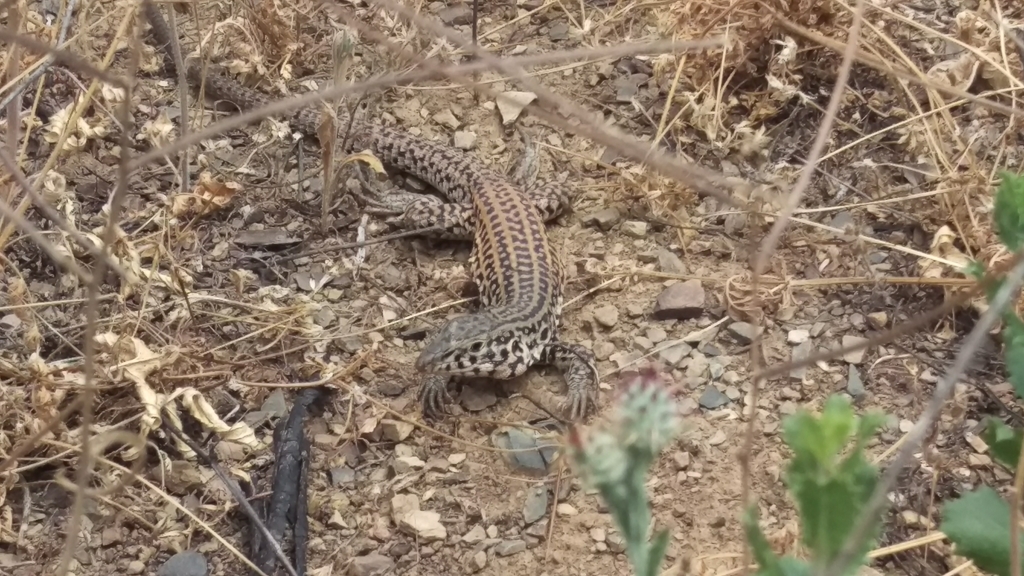
(c) Zachary .Adkins, some rights reserved (CC BY) · licence
Family: Teiidae · Class: Reptilia · Order: Squamata
Conservation status: G5T5 S3
Aspidoscelis tigris stejnegeri (Coastal Whiptail) is a California animal in the Teiidae family.
The coastal whiptail is a medium-sized lizard subspecies of the western whiptail (Aspidoscelis tigris). Adults typically measure 6 to 9 inches (15 to 23 cm) in total length, with approximately two-thirds of this length consisting of the tail. The body is slender and elongated, covered in small granular scales on the dorsal surface and larger rectangular scales arranged in distinct rows on the ventral surface. Coloration consists of a brownish or grayish background with six to eight pale longitudinal stripes extending from the head to the base of the tail. The tail displays alternating light and dark banding, creating a distinctive striped pattern that aids in species identification. The coastal whiptail occurs in coastal Southern California, primarily west of the Peninsular Ranges and south of the Transverse Ranges, extending north into Ventura County (California Herps). The subspecies ranges south into Baja California, Mexico. Within California, there is a zone of intergradation with the California whiptail (A. t. munda) in Ventura County. The distributional range is relatively narrow compared to other whiptail subspecies, reflecting adaptation to specific coastal environmental conditions. This subspecies inhabits a variety of ecosystems characterized by hot, dry conditions and sparse vegetation coverage. Primary habitat types include chaparral, woodland, and riparian areas with open spaces and scattered shrub cover (California Herps). The species shows preference for areas with loose, sandy, or gravelly soils that facilitate burrowing behavior and foraging activities. Elevational range extends from sea level to approximately 2,000 feet (610 m), though the full species complex occurs up to 7,000 feet (2,130 m) in other regions. Coastal whiptails are diurnal, ground-dwelling lizards that exhibit high activity levels during warm periods. They are primarily insectivorous, feeding on a variety of small arthropods including ants, beetles, termites, and spider species. Foraging behavior involves rapid movements and extensive ground searches, using their keen eyesight to locate prey. The species displays territorial behavior, particularly among males during breeding season. Reproduction occurs annually, with mating typically beginning in May. Females deposit eggs in shallow burrows in loose soil or sand, with clutch sizes ranging from 1 to 6 eggs. Eggs hatch from May through August following an incubation period of approximately two months. The coastal whiptail currently holds a Global/State Rank of G5T5 S3, indicating the subspecies is secure globally but vulnerable within California. The California Department of Fish and Wildlife classifies this subspecies as a Species of Special Concern (SSC), reflecting concerns about habitat loss and population pressures in coastal Southern California. Primary threats include urban development, habitat fragmentation, and conversion of natural areas for agricultural and residential use. Climate change may pose additional challenges through altered precipitation patterns and increased fire frequency in chaparral ecosystems. While not federally listed, the subspecies requires ongoing monitoring to assess population trends and habitat quality throughout its limited California range.
Classification
Class: Reptilia · Order: Squamata · Family: Teiidae
Conservation status
G5T5 S3
Frequently asked questions
How is Aspidoscelis tigris stejnegeri classified?
Aspidoscelis tigris stejnegeri belongs to class Reptilia, order Squamata, family Teiidae.
What family does Aspidoscelis tigris stejnegeri belong to?
Aspidoscelis tigris stejnegeri is in the Teiidae family.
Is Aspidoscelis tigris stejnegeri protected or of conservation concern?
Aspidoscelis tigris stejnegeri carries the following status: G5T5 S3.
What is Aspidoscelis tigris stejnegeri?
The coastal whiptail is a medium-sized lizard subspecies of the western whiptail (Aspidoscelis tigris).
Is Aspidoscelis tigris stejnegeri found in California?
Yes. Aspidoscelis tigris stejnegeri is recorded in California in The California Species Project's catalogue.
Related species
Other California species in the same genus, family, or bioregion.
Data from The California Species Project — 14,000+ California species with verified data from CNPS, CDFW, USFWS, and more.