Asterocampa celtis
Hackberry Emperor
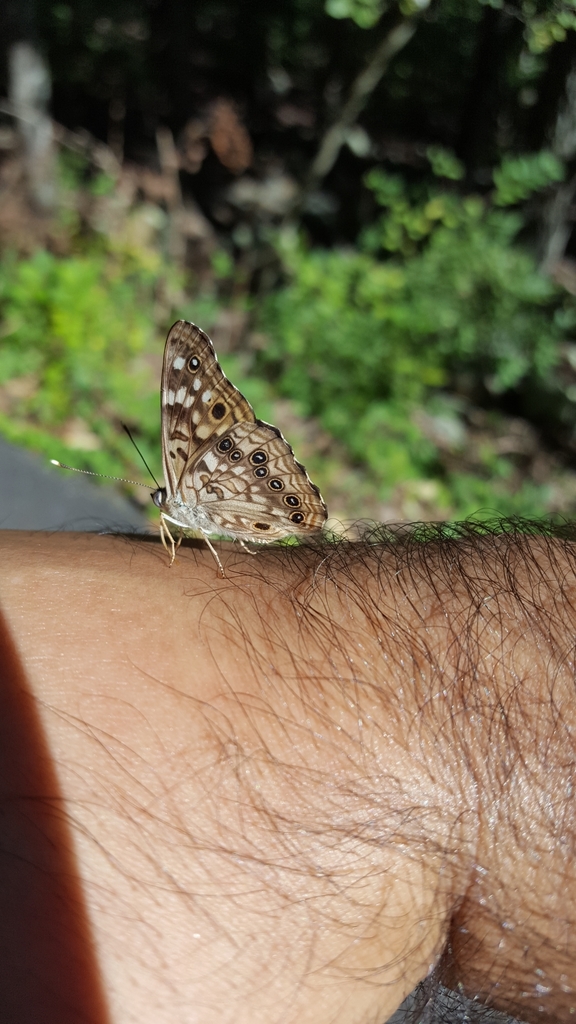
(c) yajapin, some rights reserved (CC BY) · licence
Family: Nymphalidae · Class: Insecta · Order: Lepidoptera
Asterocampa celtis (Hackberry Emperor) is a California animal in the Nymphalidae family.
The Hackberry Emperor (Asterocampa celtis) is a medium-sized butterfly in the family Nymphalidae, subfamily Apaturinae. Adults have a wingspan of 45-70 mm (1.8-2.8 inches), with males typically smaller than females. The dorsal wing surfaces are tawny brown to orange-brown with distinctive dark eyespots. The forewings display one large eyespot near the apex and several smaller spots along the margins. Hindwings feature a row of submarginal eyespots, typically 4-6 in number. The ventral surfaces are paler with prominent white-centered eyespots and intricate patterns of brown, gray, and white markings. Males possess orange patches on the forewings that are absent in females. The Hackberry Emperor is resident in most of the eastern United States, central Plains states, and the southwest mountains, extending into northern Mexico. In California, the species occurs primarily in desert regions and mountain areas where suitable host plants are present. The distribution closely follows that of its host plants, with populations documented in the Sonoran and Mojave Desert regions, as well as foothill and mountain areas up to approximately 1,500 meters (4,900 feet) elevation. This species inhabits areas with hackberry trees, including riparian corridors, desert washes, canyon bottoms, and woodland edges. Adults are commonly found near various hackberries (Celtis species) and sugarberry (Celtis laevigata), which serve as the exclusive larval host plants. The butterflies prefer areas with partial shade and access to moisture, often congregating around seeps, streams, or other water sources in arid regions. Hackberry Emperors are notable for their territorial behavior, with males establishing perching sites on prominent objects such as tree trunks, rocks, or structures. Males engage in rapid, spiraling flights when defending territory or investigating potential mates. Adults feed primarily on tree sap, rotting fruit, carrion, and animal dung rather than flower nectar. The species exhibits strong attraction to fermenting substances and minerals. Females lay eggs singly on hackberry leaves, typically on the undersides. Larvae feed on the host plant leaves and overwinter as partially grown caterpillars. In warmer regions, the species may produce multiple broods per year, with adults active from spring through fall. The Hackberry Emperor has no federal or state conservation listing status and is not considered threatened. Populations appear stable across most of the species' range, though local declines may occur due to habitat modification or host plant removal. In urban and suburban areas, the species can be negatively affected by the removal of hackberry trees, which are sometimes considered weedy. Climate change may affect distribution patterns, particularly at range margins and in desert regions where water availability is critical for host plant survival.
Classification
Class: Insecta · Order: Lepidoptera · Family: Nymphalidae
Frequently asked questions
How is Asterocampa celtis classified?
Asterocampa celtis belongs to class Insecta, order Lepidoptera, family Nymphalidae.
What family does Asterocampa celtis belong to?
Asterocampa celtis is in the Nymphalidae family.
What is Asterocampa celtis?
The Hackberry Emperor (Asterocampa celtis) is a medium-sized butterfly in the family Nymphalidae, subfamily Apaturinae.
Is Asterocampa celtis found in California?
Yes. Asterocampa celtis is recorded in California in The California Species Project's catalogue.
Related species
Other California species in the same genus, family, or bioregion.
Data from The California Species Project — 14,000+ California species with verified data from CNPS, CDFW, USFWS, and more.