Astur cooperii
Cooper's Hawk
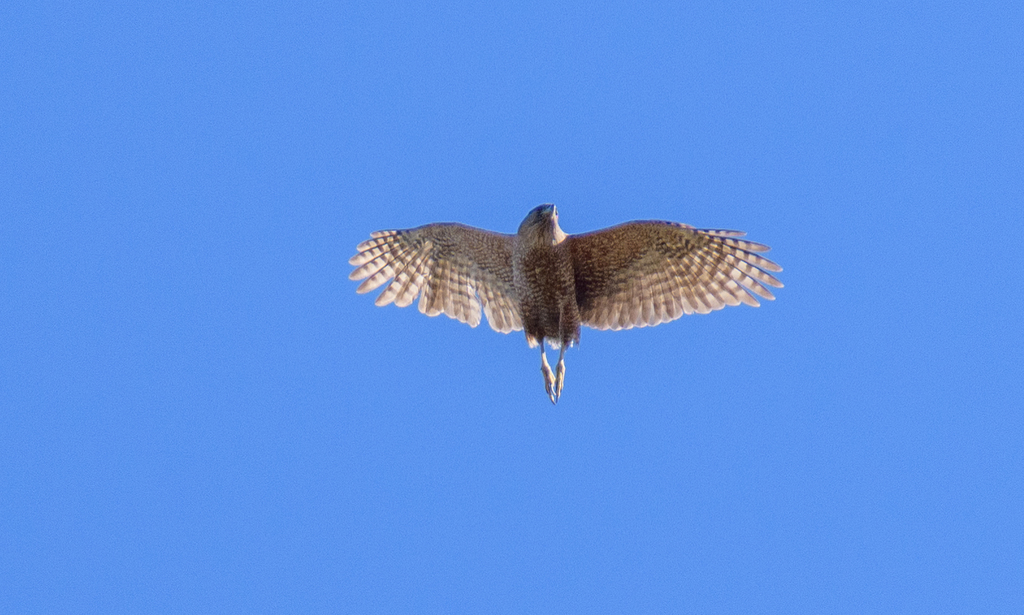
(c) Becky Matsubara, some rights reserved (CC BY) · licence
Family: Accipitridae · Class: Aves · Order: Accipitriformes
Conservation status: WL · G5 S4
Astur cooperii (Cooper's Hawk) is a California animal in the Accipitridae family.
The Cooper's Hawk is a medium-sized raptor with short, rounded wings and a long, rounded tail. Adults measure 35-46 cm (14-18 inches) in length with a wingspan of 62-90 cm (24-35 inches). Males are notably smaller than females, weighing 220-410 grams compared to females at 330-680 grams. Adult birds display bluish-brown to blue-gray upperparts, with females typically showing darker coloration than males. The underparts are white with fine rufous barring across the chest and belly. Juveniles differ markedly, showing brown upperparts with white underparts heavily streaked with brown. The species can be distinguished from the similar Sharp-shinned Hawk by its larger size, more rounded tail tip, and proportionally larger head. Cooper's Hawks breed across extensive forested regions of North America, from southern Canada through most of the contiguous United States. In California, the species maintains a stable breeding population throughout suitable habitat, earning a state rank of S4. The species inhabits deciduous and mixed-deciduous forests, but has successfully adapted to fragmented woodlands, pine plantations, and increasingly to suburban and urban environments with mature trees. They typically avoid dense coniferous forests and completely open habitats. This species demonstrates remarkable habitat flexibility, utilizing woodlots as small as 2-4 hectares for nesting. Cooper's Hawks prefer areas with 50-75% canopy cover and require suitable nest trees, typically selecting mature deciduous trees 15-25 meters tall. In urban settings, they often nest in parks, large residential areas with mature trees, and wooded riparian corridors. Cooper's Hawks are specialist bird hunters, with prey consisting primarily of small to medium-sized songbirds and doves. They employ an ambush hunting strategy, using vegetation cover to surprise prey with short, explosive flights. The species exhibits pronounced sexual dimorphism in hunting behavior, with smaller males typically taking prey weighing 15-50 grams while larger females can capture birds up to 500 grams. Breeding occurs from March through July, with pairs constructing stick nests 6-18 meters high in tree forks. Females lay 3-5 bluish-white eggs, incubated for 32-36 days. Young fledge after 27-34 days but remain dependent on parents for 4-8 additional weeks. Cooper's Hawks are not federally listed but hold Watch List status in California, reflecting ongoing monitoring needs. Historically, populations declined significantly during the DDT era of the 1950s-1970s due to eggshell thinning. Following DDT restrictions, populations have recovered substantially and are now considered stable across most of their range (Birds of the World). Current threats include habitat fragmentation, collisions with vehicles and windows in urban areas, and potential impacts from West Nile Virus. Urban populations face unique challenges including increased mortality from collisions, though cities may provide abundant prey in the form of introduced species and resident bird populations.
Classification
Class: Aves · Order: Accipitriformes · Family: Accipitridae
Conservation status
WL · G5 S4
Frequently asked questions
How is Astur cooperii classified?
Astur cooperii belongs to class Aves, order Accipitriformes, family Accipitridae.
What family does Astur cooperii belong to?
Astur cooperii is in the Accipitridae family.
Is Astur cooperii protected or of conservation concern?
Astur cooperii carries the following status: WL · G5 S4.
What is Astur cooperii?
The Cooper's Hawk is a medium-sized raptor with short, rounded wings and a long, rounded tail.
Is Astur cooperii found in California?
Yes. Astur cooperii is recorded in California in The California Species Project's catalogue.
Related species
Other California species in the same genus, family, or bioregion.
Data from The California Species Project — 14,000+ California species with verified data from CNPS, CDFW, USFWS, and more.