Athene cunicularia
Burrowing owl
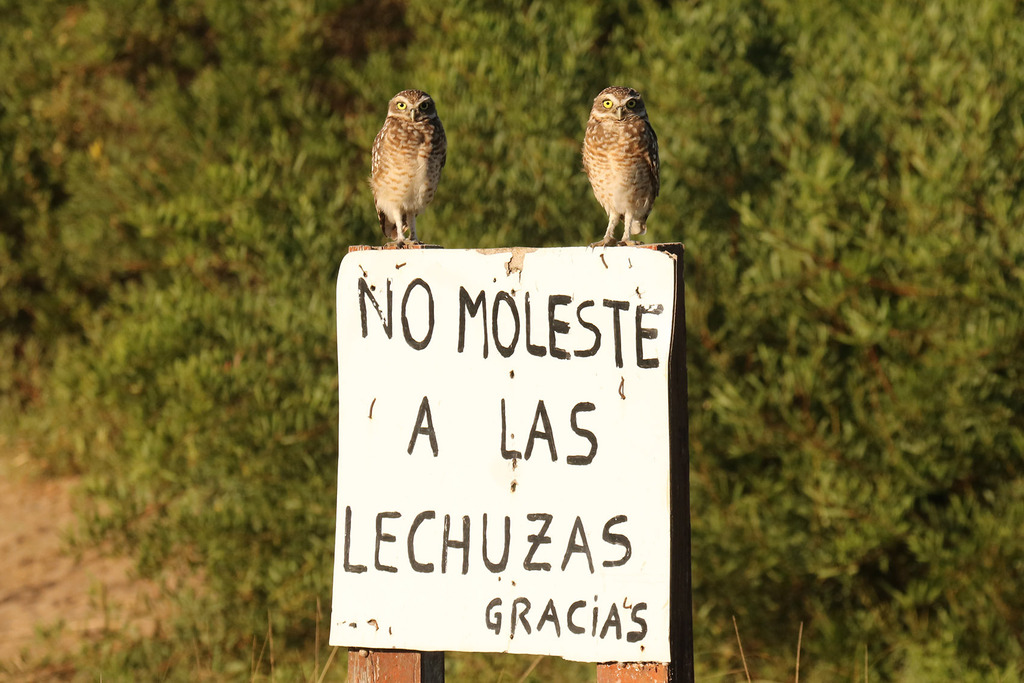
(c) Holger Braun, some rights reserved (CC BY) · licence
Family: Strigidae · Class: Aves · Order: Strigiformes
Conservation status: SC · G4 S3
Athene cunicularia (Burrowing owl) is a California animal in the Strigidae family.
The burrowing owl (Athene cunicularia) is a small, long-legged owl measuring 19 to 25 cm (7.5 to 9.8 inches) in length with a wingspan of 51 to 61 cm (20 to 24 inches). Adults weigh between 120 to 240 grams (4.2 to 8.5 ounces). The species exhibits brown and white barred plumage on the back and wings, with a white to buff-colored breast marked by brown bars. The facial disc is pale brown with white eyebrows, and the eyes are bright yellow. Unlike most owls, burrowing owls have long, featherless legs adapted for terrestrial locomotion. Historically, burrowing owls occurred throughout California's Central Valley, coastal areas, and southeastern deserts. The species remains distributed across suitable habitat in Central Valley counties including Fresno, Kern, Kings, and Tulare, as well as parts of Southern California including Imperial, Riverside, and San Bernardino counties. Populations persist in scattered locations along the coast from Marin County south to San Diego County, though coastal populations have experienced significant reductions. Burrowing owls inhabit open, dry grasslands, prairies, agricultural fields, airports, golf courses, and desert areas with low vegetation. The species requires well-drained soils suitable for excavating burrows or existing underground cavities. Optimal habitat contains scattered perches such as fence posts, power lines, or small shrubs within 3 meters of burrow entrances. Elevation range extends from sea level to approximately 1,500 meters (4,900 feet), though most California populations occur below 500 meters. Unlike other North American owl species, burrowing owls are active during daylight hours and nest underground. The species excavates burrows 1.5 to 3 meters (5 to 10 feet) long or appropriates existing burrows created by ground squirrels, badgers, or other mammals. Breeding occurs from March through August, with females laying 4 to 12 white eggs in underground chambers lined with dried vegetation, feathers, and mammal dung. Males are territorial during breeding season and perform elaborate courtship displays including aerial maneuvers and vocalizations. Diet consists primarily of insects, particularly beetles and grasshoppers, supplemented by small mammals, reptiles, amphibians, and occasionally birds. Prey is typically captured on the ground through short flights from perches. The California Department of Fish and Wildlife designates burrowing owls as a Species of Special Concern due to substantial population declines throughout the state's range. According to the North American Breeding Bird Survey, California populations declined by approximately 60% between 1966 and 2015. Primary threats include habitat conversion for urban and agricultural development, particularly in the Central Valley where over 95% of native grassland habitat has been eliminated. Additional threats include burrow destruction from cultivation practices, vehicle strikes, pesticide use that reduces prey availability, and harassment by domestic animals. The Western Burrowing Owl Conservation Strategy provides management recommendations including burrow protection, habitat preservation, and artificial burrow installation programs implemented by various agencies and organizations.
Classification
Class: Aves · Order: Strigiformes · Family: Strigidae
Conservation status
SC · G4 S3
Frequently asked questions
How is Athene cunicularia classified?
Athene cunicularia belongs to class Aves, order Strigiformes, family Strigidae.
What family does Athene cunicularia belong to?
Athene cunicularia is in the Strigidae family.
Is Athene cunicularia protected or of conservation concern?
Athene cunicularia carries the following status: SC · G4 S3.
What is Athene cunicularia?
The burrowing owl (Athene cunicularia) is a small, long-legged owl measuring 19 to 25 cm (7.5 to 9.8 inches) in length with a wingspan of 51 to 61 cm (20 to 24 inches).
Is Athene cunicularia found in California?
Yes. Athene cunicularia is recorded in California in The California Species Project's catalogue.
Related species
Other California species in the same genus, family, or bioregion.
Data from The California Species Project — 14,000+ California species with verified data from CNPS, CDFW, USFWS, and more.