Athene cunicularia hypugaea
Burrowing Owl (Western)
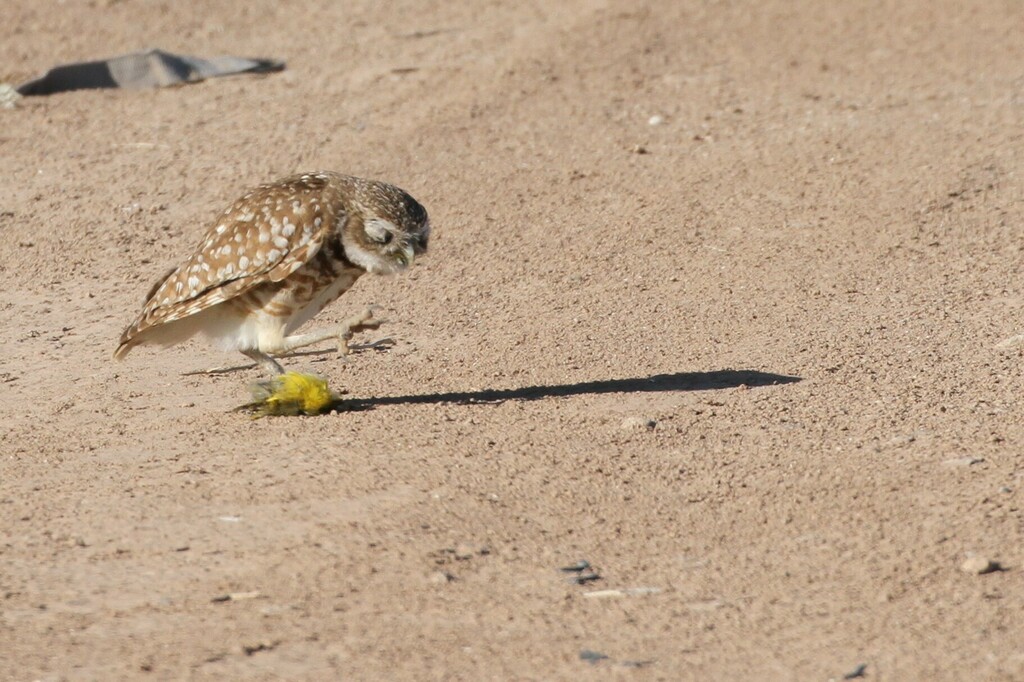
(c) Xochitl Zambrano, some rights reserved (CC BY) · licence
Family: Strigidae · Class: Aves · Order: Strigiformes
Athene cunicularia hypugaea (Burrowing Owl (Western)) is a California animal in the Strigidae family.
The Western Burrowing Owl is a small, ground-dwelling owl measuring 19-25 cm (7.5-10 inches) in length with a wingspan of 51-61 cm (20-24 inches). Adults weigh 120-240 grams (4.2-8.5 ounces). The species displays sandy brown to grayish-brown plumage with white spotting and barring throughout. The facial disc is pale with prominent white eyebrows, and the eyes are bright yellow. Distinguishing features include relatively long legs adapted for terrestrial life, a flattened facial profile, and a white throat patch. Unlike most owls, Burrowing Owls are frequently active during daylight hours. The Western Burrowing Owl subspecies (Athene cunicularia hypugaea) ranges from southern Canada through the western United States into Central America. In California, the species was historically distributed broadly across lowland valley bottoms, flat coastal lowlands, and interior deserts. Current populations are most abundant in the Imperial Valley and parts of the Central Valley, with significant breeding population declines in central and southern coastal areas. This subspecies inhabits flat, open terrain with sparse vegetation, short grass, and bare soil. Preferred habitats include grasslands, prairies, desert shrublands, agricultural areas, and open sagebrush country with low shrub cover. The species requires burrows for nesting and shelter, typically with entrance diameters of at least 10 cm (4 inches). Burrowing Owls depend entirely on fossorial mammals such as ground squirrels, badgers, and prairie dogs to excavate burrows, as they cannot dig their own and can only make limited modifications to existing burrows. Burrowing Owls exhibit both migratory and resident populations within their range. Northern populations migrate south for winter, while southern populations including many in California remain year-round. The species is semi-colonial, with strong site fidelity to breeding areas. Breeding occurs from March through August, with peak activity from April to July. Females lay 6-12 white eggs in underground burrows, with incubation lasting 28-30 days. Chicks emerge from burrows at approximately 14 days old and fledge at 44-53 days, though they remain dependent on parents for several additional weeks. Adults maintain nest territories within 100 meters (328 feet) of burrows and forage within home ranges extending up to 600 meters (1,968 feet). The diet consists primarily of insects, small mammals, reptiles, and amphibians. The Western Burrowing Owl faces significant conservation challenges throughout its range. Primary threats include habitat loss from urban and suburban development, agricultural conversion, ground squirrel population declines, pesticide poisoning, and increased predation. According to the U.S. Fish and Wildlife Service, populations have declined particularly sharply in Florida, the Dakotas, and coastal California. The species is listed as a Species of Special Concern in California, and the California Department of Fish and Wildlife is currently conducting a status review following a 2024 petition to list the subspecies under the California Endangered Species Act. The species is listed as endangered in Canada and receives special protection in Mexico.
Classification
Class: Aves · Order: Strigiformes · Family: Strigidae
Frequently asked questions
How is Athene cunicularia hypugaea classified?
Athene cunicularia hypugaea belongs to class Aves, order Strigiformes, family Strigidae.
What family does Athene cunicularia hypugaea belong to?
Athene cunicularia hypugaea is in the Strigidae family.
What is Athene cunicularia hypugaea?
The Western Burrowing Owl is a small, ground-dwelling owl measuring 19-25 cm (7.5-10 inches) in length with a wingspan of 51-61 cm (20-24 inches).
Is Athene cunicularia hypugaea found in California?
Yes. Athene cunicularia hypugaea is recorded in California in The California Species Project's catalogue.
Related species
Other California species in the same genus, family, or bioregion.
Data from The California Species Project — 14,000+ California species with verified data from CNPS, CDFW, USFWS, and more.