Atherinops affinis
Topsmelt Silverside
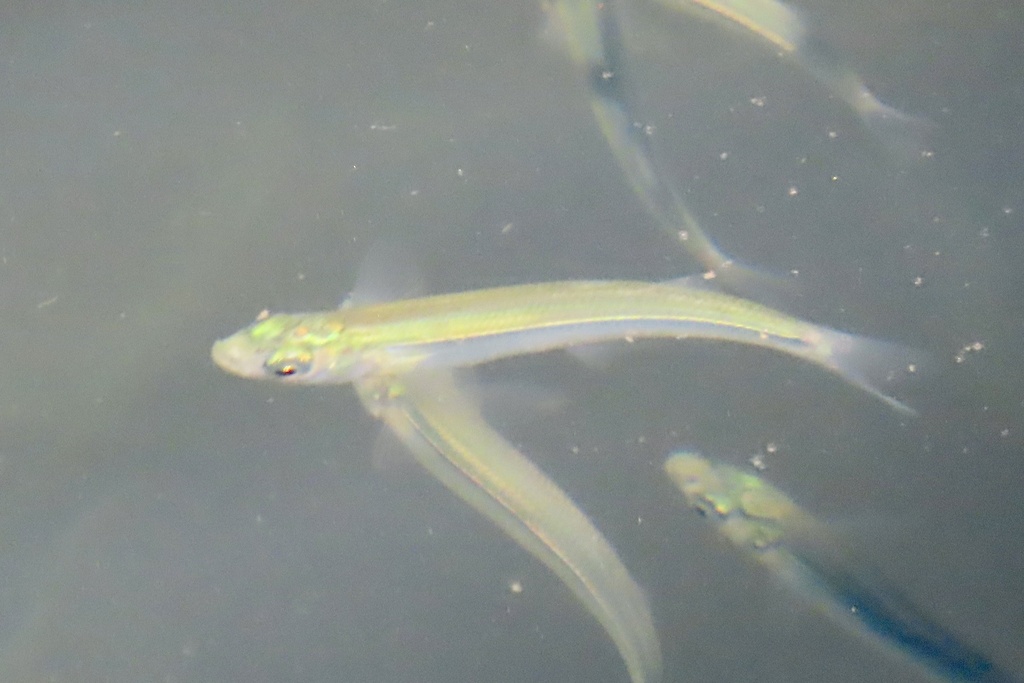
(c) Kat B, some rights reserved (CC BY) · licence
Family: Atherinopsidae · Class: Actinopterygii · Order: Atheriniformes
Atherinops affinis (Topsmelt Silverside) is a California animal in the Atherinopsidae family.
The topsmelt silverside is a slender, elongated marine fish native to the Pacific coast. Adults typically measure 10 to 15 cm (4 to 6 inches) in length, with a streamlined body adapted for surface and near-surface swimming. The species exhibits a translucent to silvery coloration with a distinctive lateral stripe running along the body. The dorsal fin is positioned relatively far back on the body, and the mouth is small and terminal, reflecting its planktivorous feeding habits. Topsmelt range along the Pacific coast from Coos Bay, Oregon, south to Baja California, Mexico. In California, the species occurs in coastal waters, estuaries, bays, and lagoons throughout the state's marine environment. The species is particularly common in southern California waters and has been documented in locations such as Ballona Creek and the Ballona Wetlands Ecological Reserve, where it was identified as the most abundant fish species during baseline surveys. This species inhabits depths from the intertidal zone to 26 meters (85 feet), though it is most commonly found between the surface and the upper 9 meters (30 feet) of the water column. Topsmelt prefer brackish to marine waters and are frequently found in estuarine environments where freshwater and saltwater mix. They utilize tide channels, coastal lagoons, and protected bays as primary habitat. The species demonstrates tolerance for varying salinity levels, making estuarine environments particularly suitable for feeding and reproduction. Topsmelt are planktivorous fish that feed primarily on small crustaceans, including copepods and mysid shrimp, as well as other zooplankton. They form schools and exhibit surface-oriented behavior, often feeding in the upper water column where planktonic prey is concentrated. The species plays an important ecological role as both predator of zooplankton and prey for larger fish, seabirds, and marine mammals. Spawning typically occurs in shallow, protected waters where eggs can be deposited on vegetation or substrate. Topsmelt currently lack formal federal or state conservation listing status, indicating stable population levels across their range. The species appears to be maintaining healthy populations in California waters and continues to be documented as abundant in suitable habitat. In estuarine restoration areas like Ballona Wetlands, topsmelt populations serve as indicators of ecosystem health and function. The species benefits from habitat protection and restoration efforts in coastal wetlands and estuaries. Climate change and coastal development represent potential long-term concerns, though current populations appear stable. The species' adaptability to varying salinity conditions and its presence in multiple habitat types contribute to its resilience in California's coastal marine environment.
Classification
Class: Actinopterygii · Order: Atheriniformes · Family: Atherinopsidae
Frequently asked questions
How is Atherinops affinis classified?
Atherinops affinis belongs to class Actinopterygii, order Atheriniformes, family Atherinopsidae.
What family does Atherinops affinis belong to?
Atherinops affinis is in the Atherinopsidae family.
What is Atherinops affinis?
The topsmelt silverside is a slender, elongated marine fish native to the Pacific coast.
Is Atherinops affinis found in California?
Yes. Atherinops affinis is recorded in California in The California Species Project's catalogue.
Related species
Other California species in the same genus, family, or bioregion.
Data from The California Species Project — 14,000+ California species with verified data from CNPS, CDFW, USFWS, and more.