Atlides halesus
Great Purple Hairstreak
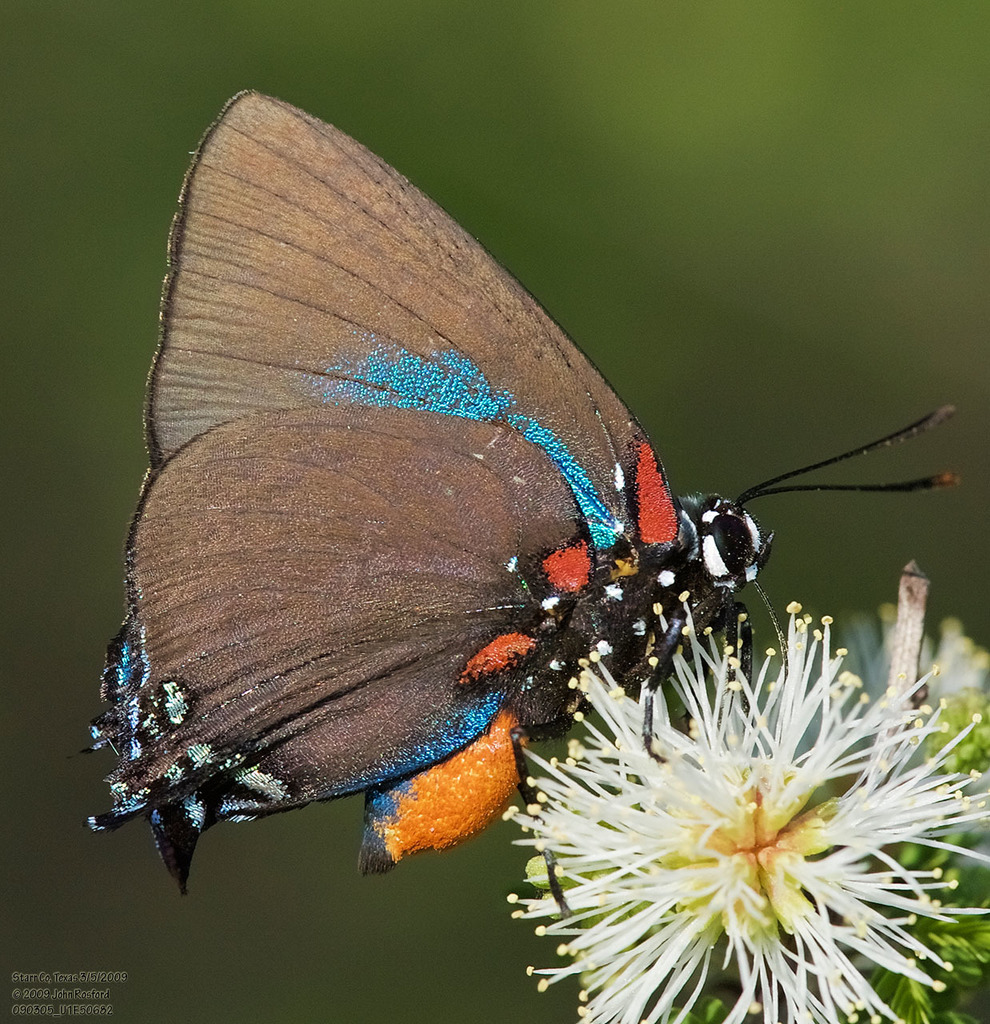
(c) John Rosford, some rights reserved (CC BY) · licence
Family: Lycaenidae · Class: Insecta · Order: Lepidoptera
Atlides halesus (Great Purple Hairstreak) is a California animal in the Lycaenidae family.
The Great Purple Hairstreak is a medium-sized butterfly with a wingspan ranging from 32 to 38 mm (1.3 to 1.5 inches). Males display iridescent blue-purple dorsal wing surfaces with metallic sheen, while the ventral surfaces are grayish-blue with distinctive orange and white spots near the wing margins. Females are typically darker with less pronounced iridescence. Both sexes possess characteristic twin tails on the hindwings and bright orange spots at the wing bases. The thorax and abdomen are metallic blue-green, and the antennae are banded black and white. The Great Purple Hairstreak ranges from Guatemala north to central California, extending eastward through Texas and southern Missouri to Maryland. In California, the species occurs primarily in the Central Valley and coastal ranges, with populations documented in counties including Sacramento, San Joaquin, Fresno, Kern, Los Angeles, and Orange. The northern range limit in California appears to be in the Sacramento Valley, while southern populations extend into Baja California. This species inhabits areas where its obligate host plant, mistletoe (Phoradendron species), grows on various tree species. Preferred habitat includes riparian woodlands, oak savannas, and urban areas with mature trees supporting mistletoe infestations. Host trees commonly include valley oak (Quercus lobata), coast live oak (Q. agrifolia), cottonwoods (Populus species), and various introduced ornamental trees. The butterfly typically occurs at elevations from sea level to approximately 1,500 meters (4,900 feet). Great Purple Hairstreaks are closely tied to their mistletoe host plants throughout their life cycle. Adults feed on nectar from various flowers, showing preferences for California buckeye, ceanothus, and composite flowers. Females deposit single eggs on mistletoe branches, where larvae develop by feeding exclusively on mistletoe leaves and stems. The species is multivoltine in warmer areas, producing two to three generations annually, with continuous breeding possible in southern California. Peak flight periods typically occur from March through October, with activity patterns varying by local climate conditions. Larvae are tended by ants, particularly species in the genera Crematogaster and Formica, in a mutualistic relationship where ants receive honeydew secretions in exchange for protection from predators and parasitoids. Pupation occurs in leaf litter beneath host trees, with the chrysalis stage lasting approximately two weeks during warmer months. The Great Purple Hairstreak is not federally or state-listed and appears to maintain stable populations throughout most of its range. However, local populations may face pressure from urban development, removal of host trees, and mistletoe control programs. The species' dependence on mistletoe, often considered a pest plant, creates unique conservation challenges. Climate change may affect distribution patterns by altering host plant phenology and expanding suitable habitat northward. Population monitoring is limited, but citizen science observations suggest the species remains locally common where suitable habitat exists, particularly in California's Central Valley and southern regions.
Classification
Class: Insecta · Order: Lepidoptera · Family: Lycaenidae
Frequently asked questions
How is Atlides halesus classified?
Atlides halesus belongs to class Insecta, order Lepidoptera, family Lycaenidae.
What family does Atlides halesus belong to?
Atlides halesus is in the Lycaenidae family.
What is Atlides halesus?
The Great Purple Hairstreak is a medium-sized butterfly with a wingspan ranging from 32 to 38 mm (1.3 to 1.5 inches).
Is Atlides halesus found in California?
Yes. Atlides halesus is recorded in California in The California Species Project's catalogue.
Related species
Other California species in the same genus, family, or bioregion.
Data from The California Species Project — 14,000+ California species with verified data from CNPS, CDFW, USFWS, and more.