Auriparus flaviceps
Verdin
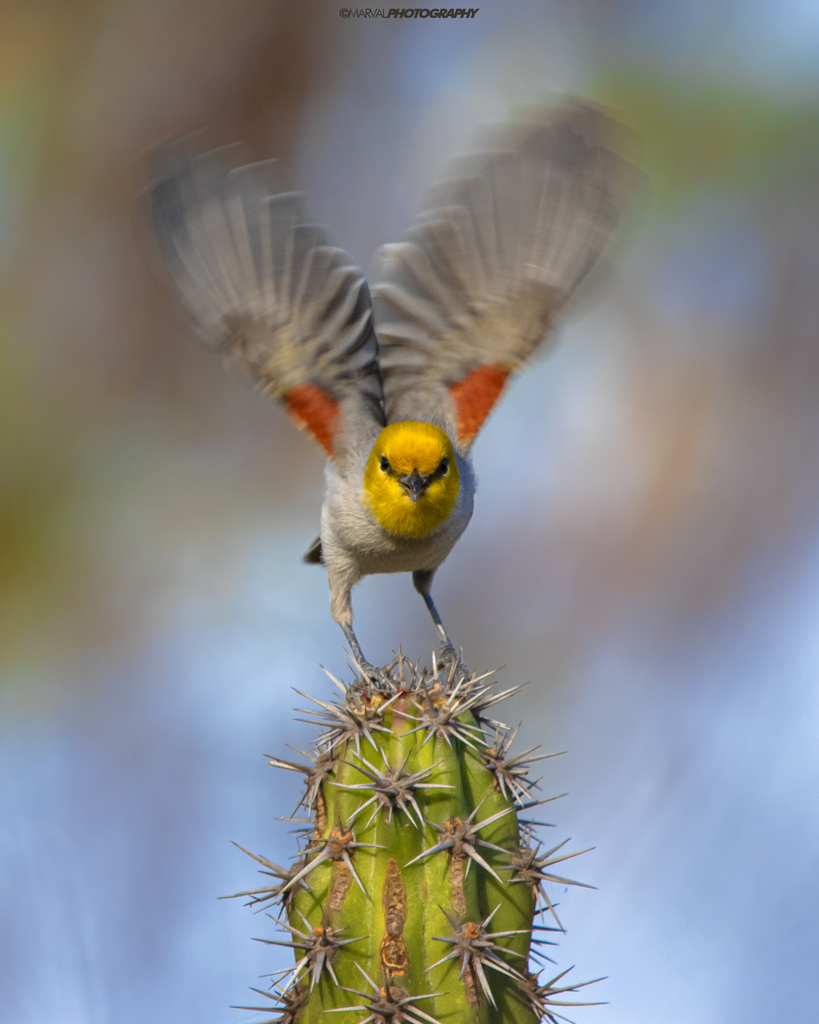
(c) MarvalPhotography19, some rights reserved (CC BY) · licence
Family: Remizidae · Class: Aves · Order: Passeriformes
Auriparus flaviceps (Verdin) is a California animal in the Remizidae family.
The Verdin (Auriparus flaviceps) is a small passerine bird belonging to the family Remizidae, the penduline tits. Adults measure 8 to 10 cm (3.1 to 3.9 inches) in length with a wingspan of 16 to 18 cm (6.3 to 7.1 inches) and weigh 5.5 to 7.5 grams. Males display a distinctive yellow head and throat, with chestnut shoulder patches (lesser coverts) that are particularly prominent during breeding season. Females and juveniles show more subdued coloration, with pale yellow on the head and less pronounced shoulder markings. The body is gray above and whitish below, with a relatively short, pointed bill adapted for gleaning insects. In California, Verdins occur primarily in the southeastern desert regions, including the Colorado and Mojave deserts. Their range extends through Imperial, Riverside, San Bernardino, and Inyo counties, with scattered populations in Kern County. The species reaches its northwestern range limit in California's Death Valley region. Outside California, Verdins range throughout the southwestern United States into Mexico, occupying parts of Arizona, Nevada, New Mexico, Texas, and Baja California. Verdins inhabit arid and semi-arid shrublands, typically below 1,200 meters (3,940 feet) elevation. They show strong association with thorny desert scrub vegetation, particularly areas dominated by mesquite (Prosopis species), palo verde (Parkinsonia florida), catclaw acacia (Senegalia greggii), and creosote bush (Larrea tridentata). The species also utilizes riparian woodland edges and desert washes where shrub density is higher. Verdins require areas with sufficient woody plant diversity to support their specialized nesting requirements. Verdins are primarily insectivorous, foraging actively through shrub foliage for small arthropods including aphids, scale insects, caterpillars, and spiders. They supplement their diet with nectar from desert flowers and occasionally consume small berries. The species is notable for constructing multiple spherical nests throughout the year, serving both reproductive and roosting functions. Breeding occurs from March through September, with peak activity in April and May. Females lay 3 to 5 pale blue eggs with brown spotting, incubated for 13 to 15 days. Young fledge after 17 to 21 days. Verdins are generally monogamous during a breeding season but may change partners between years. The Verdin is not federally listed and maintains stable populations throughout most of its range. According to the North American Bird Conservation Initiative, the species shows a slight population increase over the past several decades. However, localized habitat loss due to urban development, agriculture, and renewable energy projects poses ongoing threats in California. Climate change may affect the species through altered precipitation patterns and increased temperatures in desert regions. The Verdin's specialized habitat requirements and limited dispersal ability make populations vulnerable to habitat fragmentation. Conservation efforts focus on maintaining connectivity between suitable habitat patches and protecting key roosting and nesting areas within the species' restricted California range.
Classification
Class: Aves · Order: Passeriformes · Family: Remizidae
Frequently asked questions
How is Auriparus flaviceps classified?
Auriparus flaviceps belongs to class Aves, order Passeriformes, family Remizidae.
What family does Auriparus flaviceps belong to?
Auriparus flaviceps is in the Remizidae family.
What is Auriparus flaviceps?
The Verdin (Auriparus flaviceps) is a small passerine bird belonging to the family Remizidae, the penduline tits.
Is Auriparus flaviceps found in California?
Yes. Auriparus flaviceps is recorded in California in The California Species Project's catalogue.
Related species
Other California species in the same genus, family, or bioregion.
Data from The California Species Project — 14,000+ California species with verified data from CNPS, CDFW, USFWS, and more.