Auriparus flaviceps acaciarum
Verdin (Southwest subspecies)
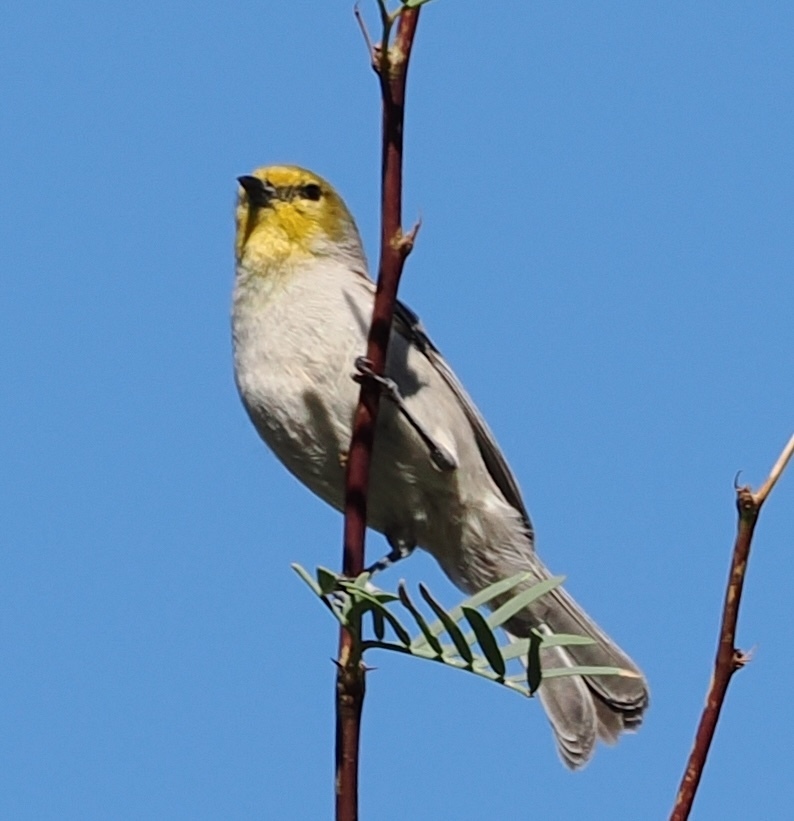
(c) desertnaturalist, some rights reserved (CC BY) · licence
Family: Remizidae · Class: Aves · Order: Passeriformes
Auriparus flaviceps acaciarum (Verdin (Southwest subspecies)) is a California animal in the Remizidae family.
The Verdin (Southwest subspecies) is among the smallest North American songbirds, measuring 8-11 cm (3.1-4.3 inches) in length and weighing 5.5-7 grams. Adults display a distinctive bright yellow head and throat, contrasting with gray upperparts and whitish underparts. Males possess a conspicuous chestnut shoulder patch that is absent or greatly reduced in females and juveniles. The bill is short, thin, and slightly curved, adapted for gleaning small arthropods from vegetation. The Southwest subspecies (Auriparus flaviceps acaciarum) occurs in desert regions of the southwestern United States and northwestern Mexico. In California, this subspecies is found primarily in the Colorado Desert of southeastern counties, including Imperial, Riverside, and San Bernardino. The range extends eastward through Arizona, southern Nevada, and into Sonora, Mexico. This subspecies is distinguished from other Verdin subspecies by subtle differences in size and coloration. Verdins inhabit thorny desert scrub vegetation, particularly areas dominated by mesquite, palo verde, ironwood, and acacia. They occur from sea level to approximately 1,200 meters (4,000 feet) elevation in the Sonoran Desert ecosystem. The species shows strong preference for riparian areas and desert washes where vegetation is denser, but also occupies upland desert scrub with scattered shrubs and trees. Urban areas with appropriate desert landscaping can support resident populations. Verdins are highly active, insectivorous birds that forage almost continuously by gleaning live foliage and flowers for spiders, small insects, and occasionally nectar. They construct distinctive spherical nests 15-25 cm in diameter from thorny twigs, grasses, leaves, and feathers (Birds of the World). These enclosed structures feature a side entrance approximately 3 cm wide with a small platform of twigs. The species builds multiple nest types: breeding nests used from March through September, and smaller roosting nests constructed year-round for shelter. Females typically lay 3-6 pale blue eggs with brown spotting, with incubation lasting 10-11 days. Verdins maintain pair bonds and defend territories year-round, producing 1-3 broods annually. The Southwest subspecies is designated as a Bird of Conservation Concern by the U.S. Fish and Wildlife Service (BCC 2021), reflecting population declines attributed to habitat loss and degradation. Primary threats include urban development, agricultural conversion of desert habitats, water diversions affecting riparian areas, and invasive plant species that alter native vegetation structure. Climate change poses additional challenges through increased temperatures and altered precipitation patterns in desert ecosystems. The subspecies is not federally listed under the Endangered Species Act but requires continued monitoring and habitat conservation efforts to maintain stable populations across its range.
Classification
Class: Aves · Order: Passeriformes · Family: Remizidae
Frequently asked questions
How is Auriparus flaviceps acaciarum classified?
Auriparus flaviceps acaciarum belongs to class Aves, order Passeriformes, family Remizidae.
What family does Auriparus flaviceps acaciarum belong to?
Auriparus flaviceps acaciarum is in the Remizidae family.
What is Auriparus flaviceps acaciarum?
The Verdin (Southwest subspecies) is among the smallest North American songbirds, measuring 8-11 cm (3.1-4.3 inches) in length and weighing 5.5-7 grams.
Is Auriparus flaviceps acaciarum found in California?
Yes. Auriparus flaviceps acaciarum is recorded in California in The California Species Project's catalogue.
Related species
Other California species in the same genus, family, or bioregion.
Data from The California Species Project — 14,000+ California species with verified data from CNPS, CDFW, USFWS, and more.