Austraeolis stearnsi
Stearns' Aeolid
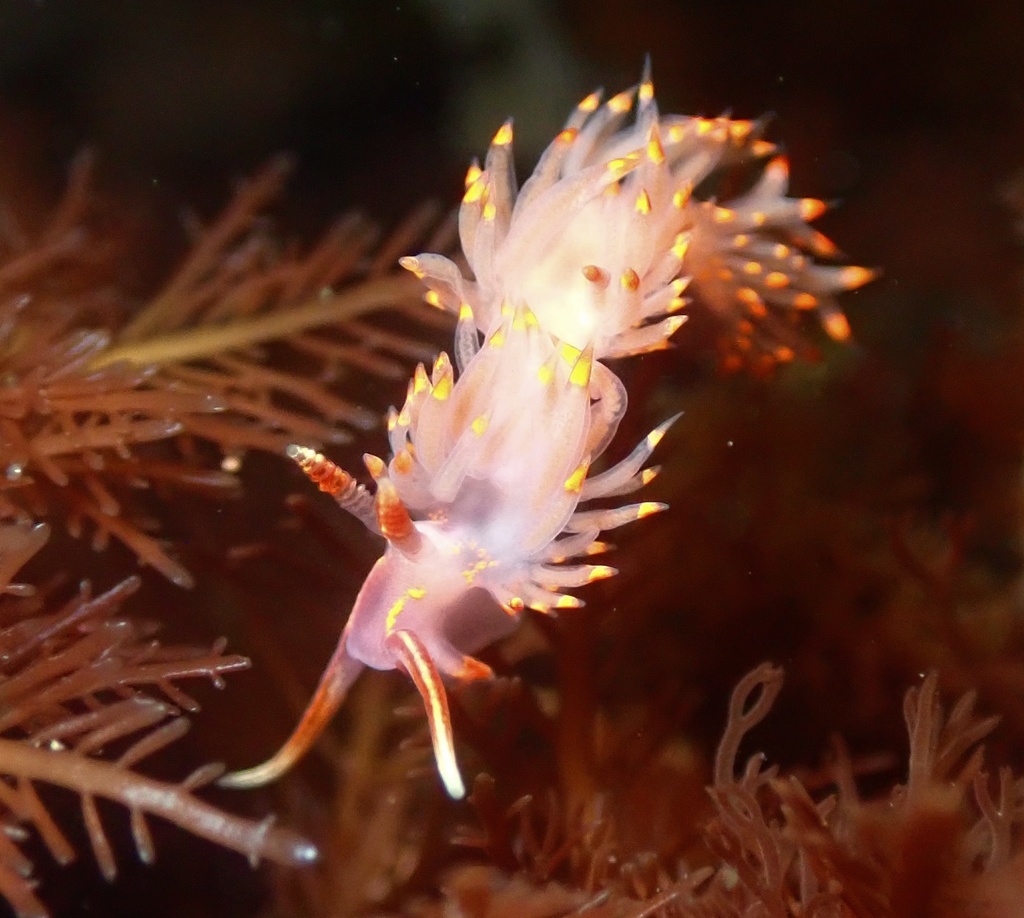
(c) Cricket Raspet, some rights reserved (CC BY) · licence
Family: Facelinidae · Class: Gastropoda · Order: Nudibranchia
Austraeolis stearnsi (Stearns' Aeolid) is a California animal in the Facelinidae family.
Austraeolis stearnsi, commonly known as Stearns' aeolid, is a marine nudibranch gastropod belonging to the family Facelinidae. This sea slug exhibits the characteristic cerata (finger-like projections) along its dorsal surface that are typical of aeolid nudibranchs. The cerata contain extensions of the digestive system and often display the coloration of the organism's prey. The body is typically translucent to semi-transparent, allowing internal structures to be visible through the integument. Stearns' aeolid is found along the California coast, with documented occurrences in the Channel Islands region. The species has been observed at Anacapa Island, where it inhabits marine protected areas including the Anacapa Island State Marine Conservation Area. The exact extent of its range along the California coast requires further documentation, though it appears to be associated with rocky intertidal and subtidal environments. This nudibranch inhabits rocky marine environments, typically in intertidal and shallow subtidal zones. The species is found on hard substrates where it can locate its cnidarian prey. Depth ranges appear to extend from the intertidal zone to moderate depths, though specific depth preferences have not been thoroughly documented. The rocky habitat provides both hunting grounds for prey organisms and suitable surfaces for egg deposition. Like other aeolid nudibranchs, Austraeolis stearnsi is a specialized predator that feeds on cnidarians, likely including hydroids and small anemones. The species obtains nematocysts (stinging cells) from its prey, which are then incorporated into specialized structures called cnidosacs located at the tips of the cerata. These recycled stinging cells provide defense against potential predators. Reproduction involves the deposition of spiral egg masses, typically attached to hard substrates. As hermaphroditic organisms, individuals possess both male and female reproductive organs, though cross-fertilization between individuals is the norm. The conservation status of Stearns' aeolid has not been formally assessed by state or federal agencies. The species lacks federal or state listing under endangered species legislation. Population trends and abundance estimates are not available, reflecting the general lack of comprehensive surveys for marine invertebrates. The species' occurrence within marine protected areas at Anacapa Island may provide some protection from human disturbances, though the effectiveness of this protection for nudibranch populations has not been evaluated. Primary potential threats include habitat degradation from coastal development, water quality impacts, and climate change effects on marine ecosystems. The limited distributional data and lack of population monitoring highlight the need for additional research to understand the species' conservation requirements and population status. Scientific documentation for Stearns' aeolid remains limited compared to more widely studied marine species. Additional research is needed to clarify distributional patterns, ecological relationships, and population dynamics. Field surveys and taxonomic work would contribute valuable information for understanding this species' role in California's marine ecosystems.
Classification
Class: Gastropoda · Order: Nudibranchia · Family: Facelinidae
Frequently asked questions
How is Austraeolis stearnsi classified?
Austraeolis stearnsi belongs to class Gastropoda, order Nudibranchia, family Facelinidae.
What family does Austraeolis stearnsi belong to?
Austraeolis stearnsi is in the Facelinidae family.
What is Austraeolis stearnsi?
Austraeolis stearnsi, commonly known as Stearns' aeolid, is a marine nudibranch gastropod belonging to the family Facelinidae.
Is Austraeolis stearnsi found in California?
Yes. Austraeolis stearnsi is recorded in California in The California Species Project's catalogue.
Related species
Other California species in the same genus, family, or bioregion.
Data from The California Species Project — 14,000+ California species with verified data from CNPS, CDFW, USFWS, and more.