Autographa californica
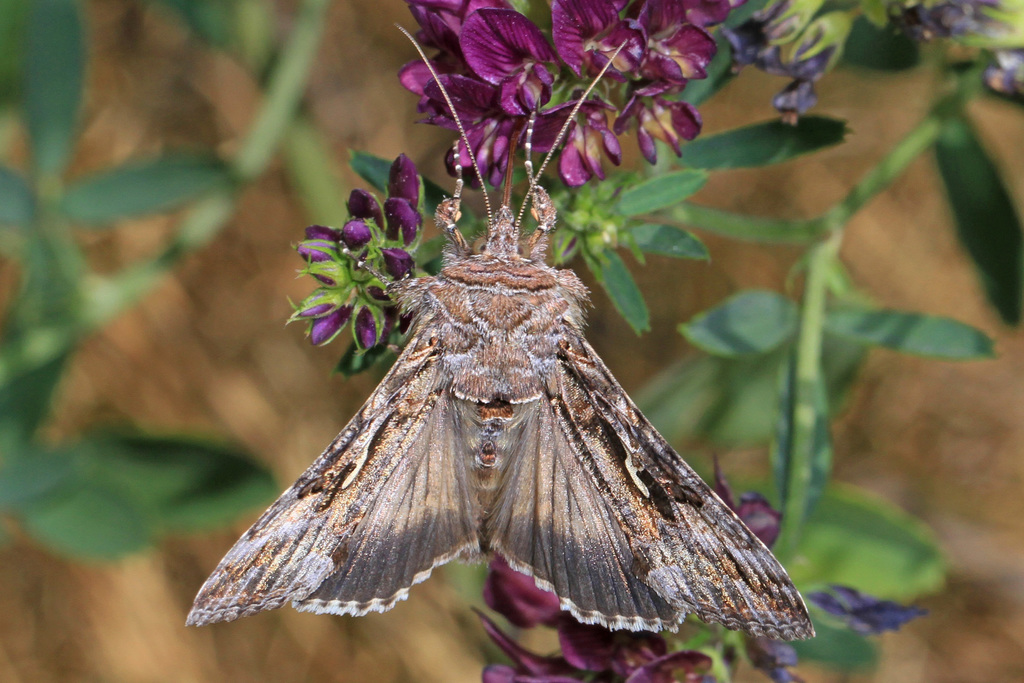
(c) Judy Gallagher, some rights reserved (CC BY-SA) · licence
Family: Noctuidae · Class: Insecta · Order: Lepidoptera
Autographa californica is a California animal in the Noctuidae family.
The Alfalfa Looper (Autographa californica) is a moth in the family Noctuidae, subfamily Plusiinae. This noctuid moth is characterized by the typical looping locomotion of its caterpillar stage, from which it derives its common name. Adult moths display the characteristic wing patterns common to many Autographa species, though specific morphological details require further documentation in the scientific literature. Autographa californica has an extensive North American range, occurring from southern British Columbia south to Baja California, and eastward to Manitoba, South Dakota, Colorado, and New Mexico (iNaturalist). Within California, the species is distributed throughout suitable habitat areas, though specific county-level distribution data has not been comprehensively documented. The broad latitudinal range suggests considerable ecological adaptability across diverse climatic conditions. Habitat preferences for this species encompass a variety of open and semi-open environments where host plants are abundant. The moth utilizes agricultural areas, particularly those containing leguminous crops, as well as natural grasslands, meadows, and disturbed areas where suitable larval food sources occur. Elevation ranges and specific microhabitat requirements have not been well documented in the available literature. The larval stage of Autographa californica feeds on various plants, with a particular association with alfalfa (Medicago sativa), which contributes to its common name. Additional host plants likely include other legumes and herbaceous species, though comprehensive host plant documentation remains limited. The caterpillars exhibit the characteristic looping movement pattern typical of geometrid moths and some noctuids, arching their bodies as they move across surfaces. Adult flight periods and specific reproductive biology require further research documentation. As a semi-looping caterpillar, this species can occasionally reach economically significant population levels in agricultural settings, particularly alfalfa fields. However, it generally does not constitute a major agricultural pest. The species appears to maintain stable populations across its range, with no current conservation concerns identified. Natural population regulation likely occurs through predation, parasitism, and environmental factors typical of moth species with broad ecological niches. Like many noctuid moths, Autographa californica probably exhibits seasonal activity patterns synchronized with host plant availability and favorable weather conditions. Adults are presumably nocturnal, following the typical behavior patterns of the family Noctuidae. The species likely undergoes multiple generations per year in warmer portions of its range, though specific voltinism data has not been well documented. Scientific documentation for this species remains limited compared to more economically significant agricultural pest species. The information presented here is based on available sources including taxonomic databases and citizen science observations. If you have additional verified information about this species' biology, distribution, or ecology, please contact us to help improve this species account.
Classification
Class: Insecta · Order: Lepidoptera · Family: Noctuidae
Frequently asked questions
How is Autographa californica classified?
Autographa californica belongs to class Insecta, order Lepidoptera, family Noctuidae.
What family does Autographa californica belong to?
Autographa californica is in the Noctuidae family.
What is Autographa californica?
The Alfalfa Looper (Autographa californica) is a moth in the family Noctuidae, subfamily Plusiinae.
Is Autographa californica found in California?
Yes. Autographa californica is recorded in California in The California Species Project's catalogue.
Related species
Other California species in the same genus, family, or bioregion.
Data from The California Species Project — 14,000+ California species with verified data from CNPS, CDFW, USFWS, and more.