Autographa corusca
Dark-spotted Looper
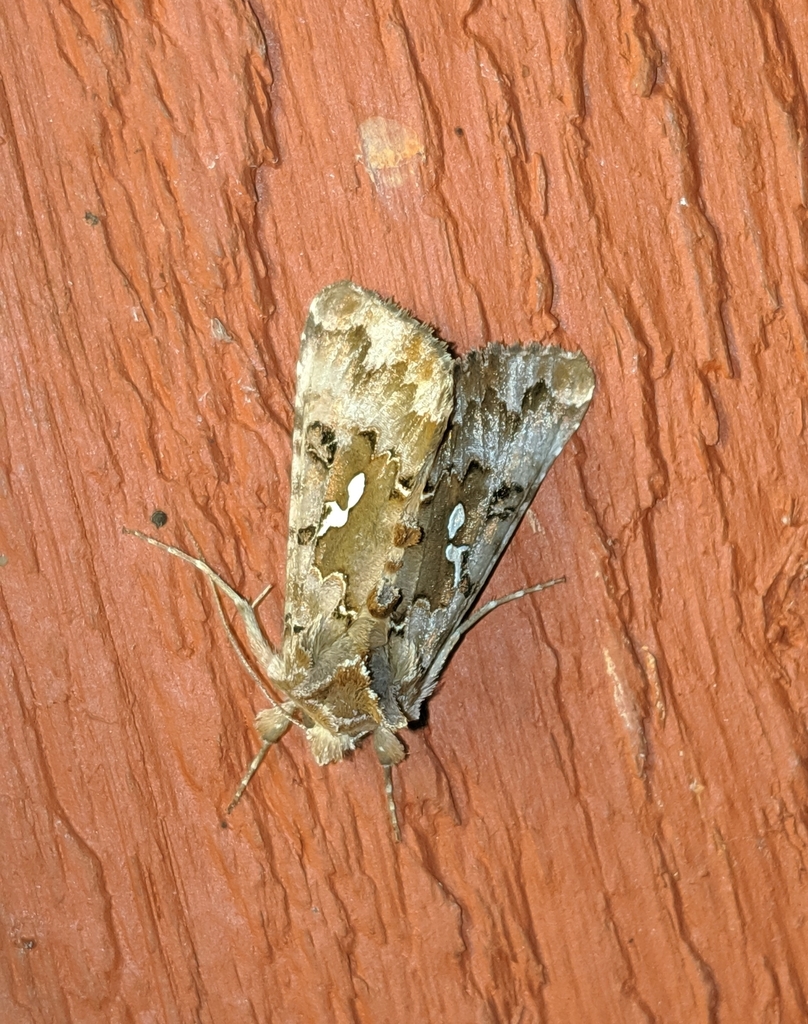
no rights reserved · CC0
Family: Noctuidae · Class: Insecta · Order: Lepidoptera
Autographa corusca (Dark-spotted Looper) is a California animal in the Noctuidae family.
The Dark-spotted Looper (Autographa corusca) is a medium-sized moth in the family Noctuidae, subfamily Plusiinae. Adults display the characteristic metallic markings typical of Autographa species, with forewings featuring silvery or golden patches that create a distinctive looped pattern when at rest. The species exhibits sexual dimorphism, with males typically smaller and more brightly marked than females. Autographa corusca is endemic to the wet coastal forests of the Pacific Northwest, with its range extending from northern California through Oregon, Washington, and British Columbia to southern Alaska (LaFontaine and Poole 1991). The species occurs primarily in coastal areas, demonstrating a strong association with maritime climate conditions and the specific forest communities found in this biogeographic region. The species inhabits mature coniferous forests dominated by Sitka spruce, western hemlock, and Douglas fir, along with associated understory vegetation. These wet coastal forests provide the humid microclimate conditions required for the species' development. Larvae feed on various herbaceous plants in the forest understory, including Adenocaulon bicolor (pathfinder) in the Asteraceae family, which serves as a documented host plant. The species shows a preference for shaded forest environments with high moisture retention and minimal disturbance. Adult Dark-spotted Loopers are active during summer months, with flight periods typically occurring from June through August. As nocturnal insects, adults are attracted to artificial lights and can be collected using standard moth trapping techniques. The species exhibits typical geometer-like behavior, with larvae moving in a characteristic looping motion that gives the group its common name. Caterpillars feed on the foliage of their host plants, pupating in leaf litter or shallow soil during late summer. The species likely has a single generation per year, consistent with the cooler climate conditions of its coastal range. Population monitoring data for Autographa corusca remains limited, reflecting the general challenges in documenting Pacific Northwest forest moths. The species' dependence on mature coastal forest ecosystems makes it potentially vulnerable to habitat loss from logging, urban development, and climate change impacts on coastal forest communities. Habitat fragmentation and changes in forest composition could affect population connectivity and local abundance. Recent observations include documentation of adults visiting flowers of Phalaris dilatata, indicating the species may serve as a pollinator for certain plant species within its forest habitat. The species' endemic status to Pacific Northwest coastal forests highlights the importance of maintaining large, intact forest landscapes for the conservation of regional biodiversity. While not currently listed under federal or state conservation programs, the species represents part of the specialized fauna associated with these unique coastal forest ecosystems.
Classification
Class: Insecta · Order: Lepidoptera · Family: Noctuidae
Frequently asked questions
How is Autographa corusca classified?
Autographa corusca belongs to class Insecta, order Lepidoptera, family Noctuidae.
What family does Autographa corusca belong to?
Autographa corusca is in the Noctuidae family.
What is Autographa corusca?
The Dark-spotted Looper (Autographa corusca) is a medium-sized moth in the family Noctuidae, subfamily Plusiinae.
Is Autographa corusca found in California?
Yes. Autographa corusca is recorded in California in The California Species Project's catalogue.
Related species
Other California species in the same genus, family, or bioregion.
Data from The California Species Project — 14,000+ California species with verified data from CNPS, CDFW, USFWS, and more.