Autographa pseudogamma
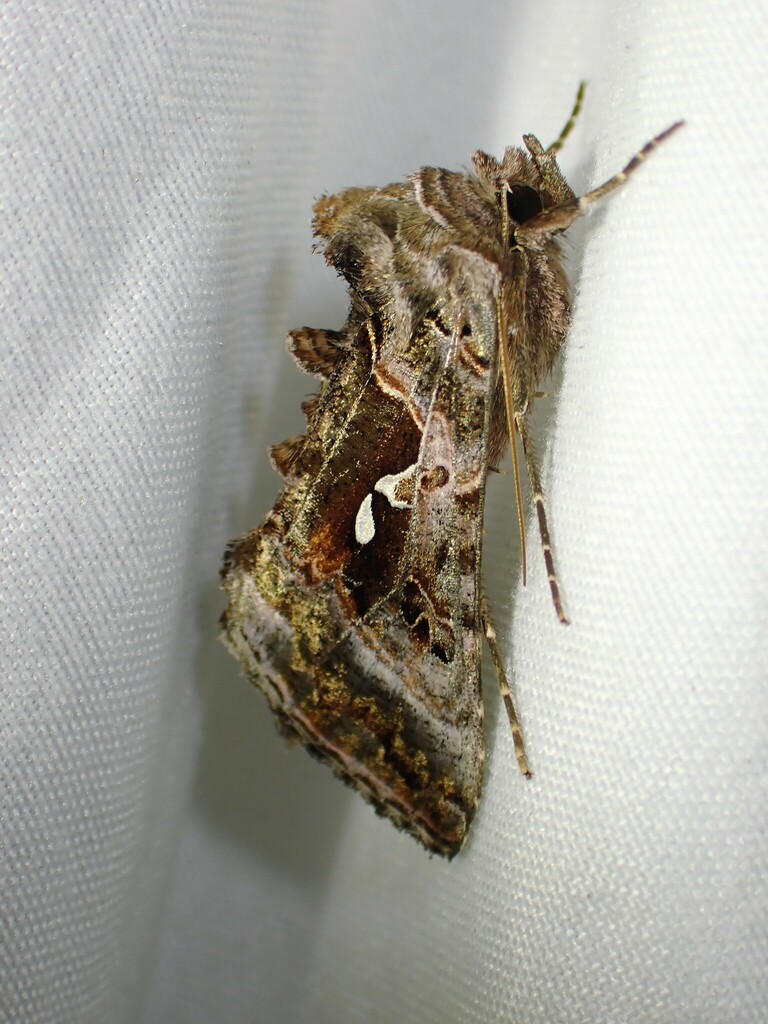
(c) Louis Imbeau, some rights reserved (CC BY) · licence
Family: Noctuidae · Class: Insecta · Order: Lepidoptera
Autographa pseudogamma is a California animal in the Noctuidae family.
Autographa pseudogamma is a medium-sized noctuid moth in the subfamily Plusiinae, commonly known as the Delphinium Looper or False Gamma Moth. Adults have a wingspan of 30 to 40 mm (1.2 to 1.6 inches), with forewings displaying a distinctive silver-white gamma-shaped mark on a mottled brown and gray background. The hindwings are pale gray with darker marginal bands. The forewings show a complex pattern of brown, gray, and reddish-brown scales with darker cross-lines and a prominent reniform spot. This species exhibits a transcontinental distribution across North America. In the north and east, it ranges from Nova Scotia to British Columbia, extending north to Alaska and south to Maine, Michigan, South Dakota, Montana, and Wyoming. In western North America, the range extends into the central Sierra Nevada mountains of California, northeastern Nevada, Arizona, and New Mexico. The species occupies diverse elevational zones from sea level to montane regions, with populations documented at elevations exceeding 2,400 meters (7,900 feet) in mountainous areas. Autographa pseudogamma inhabits a wide range of habitats including deciduous and mixed forests, woodland edges, meadows, gardens, and agricultural areas. Adults are frequently found in areas with abundant flowering plants that provide nectar sources. The species shows particular association with habitats containing legumes, composites, and other herbaceous flowering plants. In California, populations occur in montane meadows and forest clearings within the Sierra Nevada. Larvae are generalist feeders on herbaceous plants, with documented host plants including species in the families Fabaceae, Asteraceae, Plantaginaceae, and Ranunculaceae. Common hosts include clover, alfalfa, plantain, delphinium, and various wildflowers. The caterpillars are semi-loopers, moving with a characteristic arching motion due to reduced prolegs. Development typically requires 30 to 45 days from egg to adult, with multiple generations per year in warmer regions. Adults are nocturnal and strongly attracted to artificial lights. Flight period extends from May through October, with peak abundance occurring in mid-summer. The species produces two to three broods annually in most of its range, with northern populations completing fewer generations. Females deposit pale yellow eggs singly on host plant foliage. Larvae undergo five instars, reaching lengths of 25 to 30 mm when fully developed. Pupation occurs in soil or leaf litter within a silk-lined earthen cell. Autographa pseudogamma is not federally listed and appears to maintain stable populations throughout most of its range. The species benefits from its broad host plant tolerance and ability to utilize both natural and disturbed habitats. In agricultural areas, it is occasionally considered a minor pest of legume crops, though economic damage is typically minimal. Climate change may affect the species' elevational distribution, particularly in mountainous regions where warming temperatures could shift suitable habitat to higher elevations.
Classification
Class: Insecta · Order: Lepidoptera · Family: Noctuidae
Frequently asked questions
How is Autographa pseudogamma classified?
Autographa pseudogamma belongs to class Insecta, order Lepidoptera, family Noctuidae.
What family does Autographa pseudogamma belong to?
Autographa pseudogamma is in the Noctuidae family.
What is Autographa pseudogamma?
Autographa pseudogamma is a medium-sized noctuid moth in the subfamily Plusiinae, commonly known as the Delphinium Looper or False Gamma Moth.
Is Autographa pseudogamma found in California?
Yes. Autographa pseudogamma is recorded in California in The California Species Project's catalogue.
Related species
Other California species in the same genus, family, or bioregion.
Data from The California Species Project — 14,000+ California species with verified data from CNPS, CDFW, USFWS, and more.