Aythya affinis
Lesser Scaup
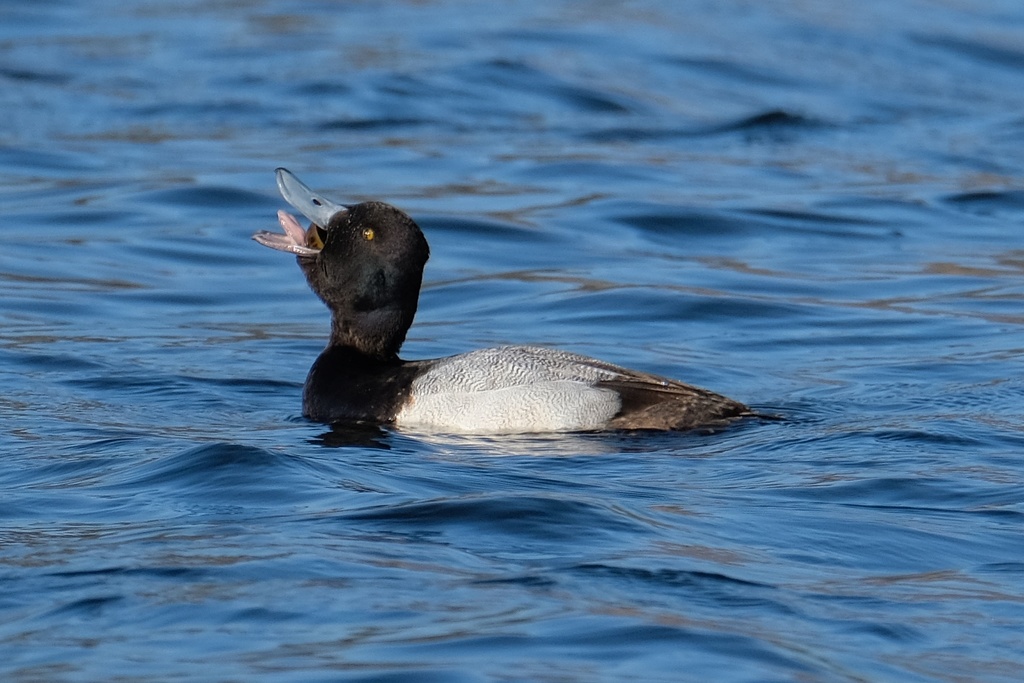
(c) Madeleine Claire, some rights reserved (CC BY) · licence
Family: Anatidae · Class: Aves · Order: Anseriformes
Aythya affinis (Lesser Scaup) is a California animal in the Anatidae family.
The Lesser Scaup is a medium-sized diving duck measuring 39-46 cm (15-18 inches) in length with a wingspan of 68-78 cm (27-31 inches). Adult males in breeding plumage display an iridescent black head with purple and green sheens, a white back with fine black barring, and a black breast and rump. The sides and flanks are white, creating a distinctive white-sided appearance when viewed from a distance. Females and non-breeding males are brownish overall with a darker brown head and back, lighter brown sides, and a distinctive white patch at the base of the bill. Both sexes have yellow eyes and blue-gray bills with black tips. In flight, Lesser Scaup show a white stripe extending along the secondaries and inner primaries. Lesser Scaup breed across much of Alaska, western and central Canada, and the northern United States, including portions of the northern Great Plains. In California, they occur primarily as migrants and winter residents from October through April. The species is found throughout California's Central Valley, coastal regions, and many inland areas. Major wintering areas include San Francisco Bay, the Sacramento-San Joaquin Delta, Salton Sea, and numerous smaller wetlands and reservoirs throughout the state. Some individuals may remain through summer at higher elevation lakes, though breeding in California is uncommon. During winter and migration, Lesser Scaup inhabit large, deep freshwater and brackish water bodies including lakes, reservoirs, large ponds, estuaries, and protected coastal bays. They prefer open water areas typically deeper than 1-3 meters where they can dive for food. The species shows strong site fidelity to traditional wintering areas and roost sites. On breeding grounds, they utilize prairie potholes, shallow lakes, and wetlands with emergent vegetation for nesting cover. Lesser Scaup are diving ducks that feed primarily by diving underwater to depths of 1-7 meters. Their diet consists mainly of aquatic invertebrates including chironomid larvae, amphipods, mollusks, and aquatic worms. During winter, they also consume aquatic vegetation, seeds, and small fish. The species is highly gregarious outside the breeding season, often forming large rafts of hundreds or thousands of individuals on suitable water bodies. Breeding occurs from May through July, with females constructing nests in dense vegetation near water. Clutch size ranges from 6-14 eggs, with an average of 9 eggs. Incubation lasts 24-28 days, and ducklings fledge after approximately 45-50 days. The Lesser Scaup is not federally or state listed but has experienced significant population declines. North American Breeding Bird Survey data indicates a 48% population decline from 1966-2019. The species is included on the U.S. Fish and Wildlife Service's Birds of Conservation Concern list. Primary threats include habitat loss and degradation on breeding grounds, particularly prairie pothole destruction and wetland drainage. Water level management, pollution, and climate change impacts on wetland hydrology also pose concerns. Conservation efforts focus on wetland protection and restoration through programs such as the North American Waterfowl Management Plan.
Classification
Class: Aves · Order: Anseriformes · Family: Anatidae
Frequently asked questions
How is Aythya affinis classified?
Aythya affinis belongs to class Aves, order Anseriformes, family Anatidae.
What family does Aythya affinis belong to?
Aythya affinis is in the Anatidae family.
What is Aythya affinis?
The Lesser Scaup is a medium-sized diving duck measuring 39-46 cm (15-18 inches) in length with a wingspan of 68-78 cm (27-31 inches).
Is Aythya affinis found in California?
Yes. Aythya affinis is recorded in California in The California Species Project's catalogue.
Related species
Other California species in the same genus, family, or bioregion.
Data from The California Species Project — 14,000+ California species with verified data from CNPS, CDFW, USFWS, and more.