Aythya collaris
Ring-necked Duck
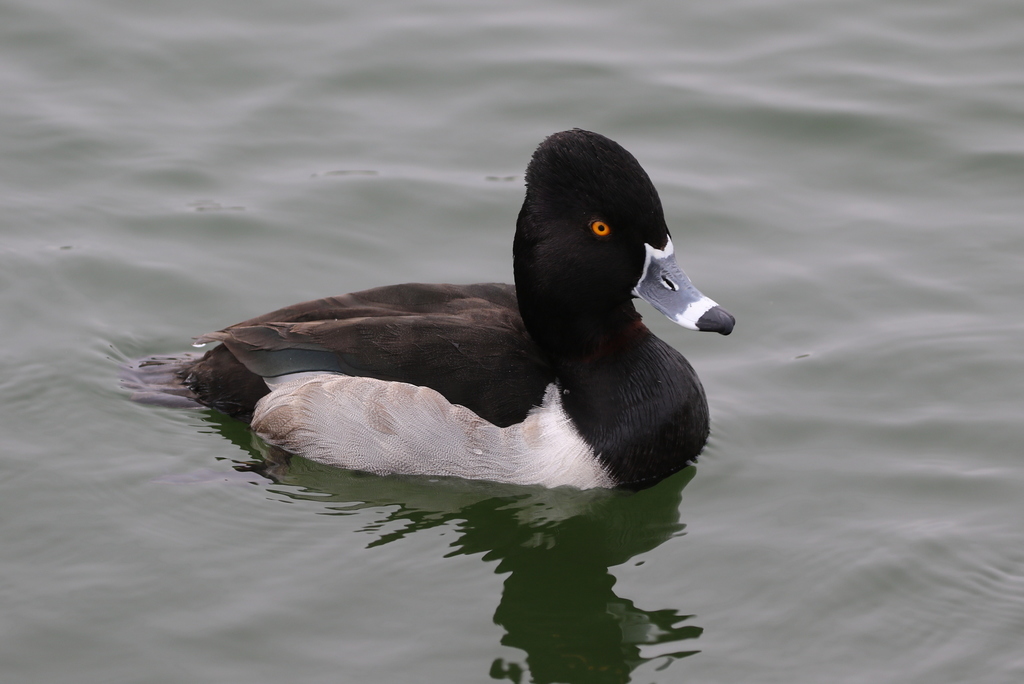
no rights reserved · CC0
Family: Anatidae · Class: Aves · Order: Anseriformes
Aythya collaris (Ring-necked Duck) is a California animal in the Anatidae family.
The Ring-necked Duck (Aythya collaris) is a medium-sized diving duck measuring 39-46 cm (15-18 inches) in length with a wingspan of 62-63 cm (24-25 inches). Adult males in breeding plumage display a black head, neck, breast, and back with an iridescent purple sheen on the head. The sides are gray with a distinctive white vertical stripe separating the gray flanks from the black breast. Males exhibit a white ring around the bill base and a faint chestnut collar around the neck, though this collar is often difficult to observe in the field and gives the species its common name. Females are predominantly brown with lighter brown flanks and a white eye-ring. Both sexes show white wing stripes visible in flight and have blue-gray bills with white bands. Ring-necked Ducks breed primarily in the northern United States and southern Canada, from British Columbia east to the Maritime provinces and south to Colorado, Nebraska, and Pennsylvania. In California, they are primarily winter residents and migrants, arriving from September through November. The species winters throughout much of the United States and into Mexico, with California hosting significant wintering populations in the Central Valley, coastal regions, and suitable inland waters. Spring migration occurs from February through April. The species inhabits shallow freshwater wetlands including marshes, ponds, small lakes, and slow-moving rivers with emergent vegetation. During breeding season, they prefer water bodies 0.5-3 meters (1.6-10 feet) deep with dense stands of cattails, bulrushes, and sedges. Wintering birds utilize similar habitats but also frequent flooded agricultural fields, sewage treatment ponds, and urban park lakes. They typically avoid large, open water bodies, preferring smaller wetlands with vegetated margins. Ring-necked Ducks are omnivorous, feeding both by diving and dabbling. Their diet consists of aquatic invertebrates including midges, mayflies, and snails during breeding season, shifting to seeds, tubers, and other plant matter during migration and winter. Females consume more animal protein than males. Breeding occurs from May through July, with females constructing nests in dense emergent vegetation over water or on floating mats. Clutch size averages 8-10 eggs, with incubation lasting 25-29 days. Ducklings fledge after 49-56 days. The Ring-necked Duck is not federally or state listed as threatened or endangered. The species is classified as Least Concern by the International Union for Conservation of Nature. North American populations have remained relatively stable, with breeding population estimates of approximately 1.2 million birds according to the North American Waterfowl Management Plan. However, the species faces ongoing threats from wetland loss and degradation, particularly in prairie breeding areas. Climate change may affect breeding habitat availability and shift wintering ranges. Conservation efforts focus on wetland protection and restoration through programs such as the North American Waterfowl Management Plan and the Conservation Reserve Program.
Classification
Class: Aves · Order: Anseriformes · Family: Anatidae
Frequently asked questions
How is Aythya collaris classified?
Aythya collaris belongs to class Aves, order Anseriformes, family Anatidae.
What family does Aythya collaris belong to?
Aythya collaris is in the Anatidae family.
What is Aythya collaris?
The Ring-necked Duck (Aythya collaris) is a medium-sized diving duck measuring 39-46 cm (15-18 inches) in length with a wingspan of 62-63 cm (24-25 inches).
Is Aythya collaris found in California?
Yes. Aythya collaris is recorded in California in The California Species Project's catalogue.
Related species
Other California species in the same genus, family, or bioregion.
Data from The California Species Project — 14,000+ California species with verified data from CNPS, CDFW, USFWS, and more.