Aythya fuligula
Tufted Duck
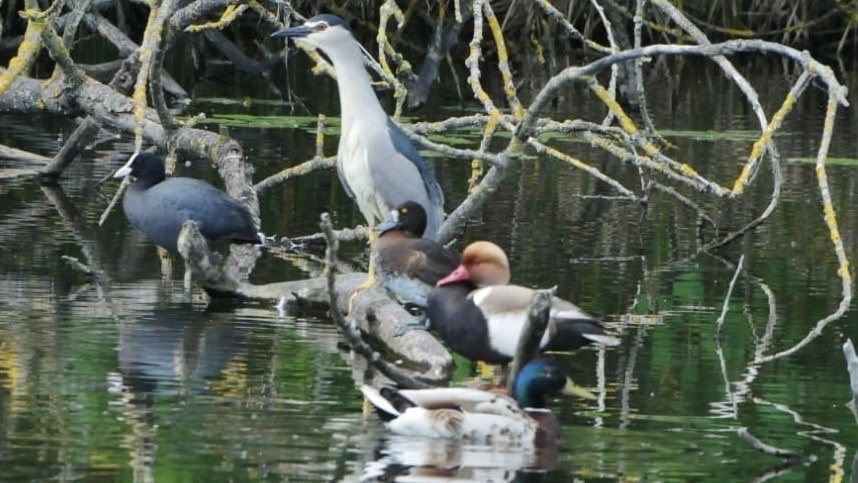
(c) Adi Peter, some rights reserved (CC BY) · licence
Family: Anatidae · Class: Aves · Order: Anseriformes
Aythya fuligula (Tufted Duck) is a California animal in the Anatidae family.
The Tufted Duck (Aythya fuligula) is a medium-sized diving duck native to Eurasia that occurs as a vagrant in North America, including rare sightings in California. Adult males measure 40-47 cm (15.7-18.5 inches) in length with a wingspan of 65-72 cm (25.6-28.3 inches) and weigh 550-900 grams (1.2-2.0 pounds). Males in breeding plumage display distinctive black and white coloration, with a glossy black head, neck, breast, and back contrasting sharply with bright white flanks and belly. A prominent tuft of elongated feathers extends from the back of the head, giving the species its common name. The bill is blue-gray with a black tip, and the eyes are bright yellow. Females are smaller and predominantly brown with paler flanks, lacking the male's distinctive crest and showing a less pronounced head tuft. The Tufted Duck's native range spans across northern Eurasia from Iceland and the British Isles east through Scandinavia, Russia, and central Asia to the Pacific coast. The species breeds primarily in northern temperate and subarctic regions and winters in more southern areas including southern Europe, the Mediterranean, and southern Asia. In North America, Tufted Ducks occur as rare but regular vagrants, with most records from Alaska and the Pacific Northwest. California sightings are exceptionally rare, with fewer than 20 documented records since the 1960s, primarily from coastal areas and large inland water bodies. Tufted Ducks inhabit freshwater lakes, reservoirs, and large ponds with abundant aquatic vegetation during the breeding season. They prefer water bodies 1-4 meters deep with muddy or sandy bottoms rich in invertebrates. During winter and migration, the species also utilizes brackish coastal lagoons, estuaries, and protected marine bays. Breeding habitat requires emergent vegetation for nesting cover and open water areas for foraging. As diving ducks, Tufted Ducks feed primarily underwater, diving to depths of 1-4 meters to forage on benthic invertebrates, small fish, and aquatic plant material. Their diet consists mainly of mollusks, crustaceans, insect larvae, and seeds of aquatic plants. Breeding occurs from May through July, with females constructing nests in dense vegetation near water. Clutch size ranges from 6-14 eggs, with an incubation period of 25-26 days. Ducklings fledge after 45-50 days but may remain with the female for several additional weeks. The Tufted Duck is not federally listed in the United States, as it is not a native breeding species. The IUCN Red List classifies the species as Least Concern globally, with a stable population estimated at 3.4-4.2 million individuals. Climate change may affect the species' northern breeding range, potentially leading to shifts in migration patterns and wintering areas. In California, the species' vagrant status makes population monitoring challenging, though citizen science databases continue to document rare occurrences throughout the state.
Classification
Class: Aves · Order: Anseriformes · Family: Anatidae
Frequently asked questions
How is Aythya fuligula classified?
Aythya fuligula belongs to class Aves, order Anseriformes, family Anatidae.
What family does Aythya fuligula belong to?
Aythya fuligula is in the Anatidae family.
What is Aythya fuligula?
The Tufted Duck (Aythya fuligula) is a medium-sized diving duck native to Eurasia that occurs as a vagrant in North America, including rare sightings in California.
Is Aythya fuligula found in California?
Yes. Aythya fuligula is recorded in California in The California Species Project's catalogue.
Related species
Other California species in the same genus, family, or bioregion.
Data from The California Species Project — 14,000+ California species with verified data from CNPS, CDFW, USFWS, and more.