Baeolophus inornatus
Oak Titmouse
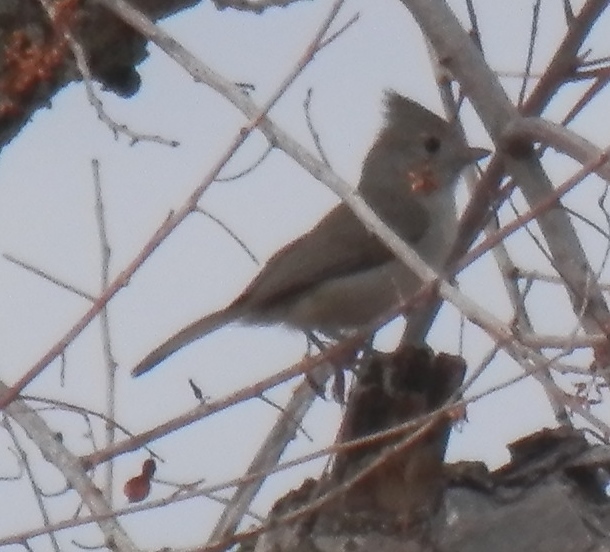
(c) Justin Johnsen, some rights reserved (CC BY) · licence
Family: Paridae · Class: Aves · Order: Passeriformes
Conservation status: G4 S4
Baeolophus inornatus (Oak Titmouse) is a California animal in the Paridae family.
The Oak Titmouse is a small, gray songbird endemic to the oak woodlands of California and Baja California. Adults measure 13-14 cm (5.1-5.5 inches) in length with a wingspan of approximately 20 cm (7.9 inches) and weigh 16-20 grams. The species displays uniform grayish-brown plumage above and paler gray-buff coloration below, with no distinctive markings or sexual dimorphism. A small pointed crest distinguishes this species from other small songbirds in its range, though the crest is often held flat against the head when the bird is relaxed. Oak Titmouse range extends throughout California's oak-dominated regions, from Shasta County in the north to San Diego County in the south, and into Baja California, Mexico. The species occurs primarily west of the Sierra Nevada crest and is absent from the Central Valley floor and high-elevation coniferous forests. Populations are found in the Coast Ranges, Sierra Nevada foothills, and Peninsular Ranges, with elevational distribution typically between 150-2,100 meters (500-6,900 feet). The species inhabits oak woodlands and mixed oak-conifer forests, showing strong association with several oak species including coast live oak (Quercus agrifolia), interior live oak (Q. wislizeni), blue oak (Q. douglasii), and valley oak (Q. lobata). Oak Titmouse also occurs in riparian woodlands with oak components and oak-pine associations. The species requires mature trees with natural cavities or suitable substrates for excavating nest sites, typically selecting trees with diameter at breast height exceeding 30 cm. Oak Titmouse feeds primarily on insects during breeding season, including caterpillars, beetles, and aphids, switching to a diet dominated by acorns and other seeds in fall and winter. The species employs various foraging techniques, gleaning insects from bark crevices, foliage, and occasionally catching prey in flight. Breeding occurs from March through July, with pairs excavating nest cavities in soft, decaying wood of oaks, sycamores, or other deciduous trees. Females lay 4-8 white eggs with reddish-brown spots, incubating for 14-16 days. Nestlings fledge after 16-21 days, with pairs typically producing one brood per year. The species exhibits year-round residency throughout its range, maintaining small territories of 1-2 hectares during breeding season and forming loose flocks outside breeding periods. Oak Titmouse pairs often remain together across multiple breeding seasons, with both sexes participating in territory defense and nest site selection. Oak Titmouse populations are considered stable across much of their range, reflected in the species' G4 S4 ranking indicating apparently secure global and state status. However, localized population declines have occurred due to oak woodland conversion for urban development and agriculture. According to North American Breeding Bird Survey data, California populations showed a non-significant decline of 0.7% annually from 1966-2019. Primary conservation concerns include continued loss of mature oak habitat, particularly in rapidly developing regions of Southern California and the Central Valley margins. Fire suppression practices that reduce oak woodland regeneration and climate change effects on oak distribution represent additional long-term threats to habitat availability.
Classification
Class: Aves · Order: Passeriformes · Family: Paridae
Conservation status
G4 S4
Frequently asked questions
How is Baeolophus inornatus classified?
Baeolophus inornatus belongs to class Aves, order Passeriformes, family Paridae.
What family does Baeolophus inornatus belong to?
Baeolophus inornatus is in the Paridae family.
Is Baeolophus inornatus protected or of conservation concern?
Baeolophus inornatus carries the following status: G4 S4.
What is Baeolophus inornatus?
The Oak Titmouse is a small, gray songbird endemic to the oak woodlands of California and Baja California.
Is Baeolophus inornatus found in California?
Yes. Baeolophus inornatus is recorded in California in The California Species Project's catalogue.
Related species
Other California species in the same genus, family, or bioregion.
Data from The California Species Project — 14,000+ California species with verified data from CNPS, CDFW, USFWS, and more.