Baeolophus ridgwayi
Juniper Titmouse
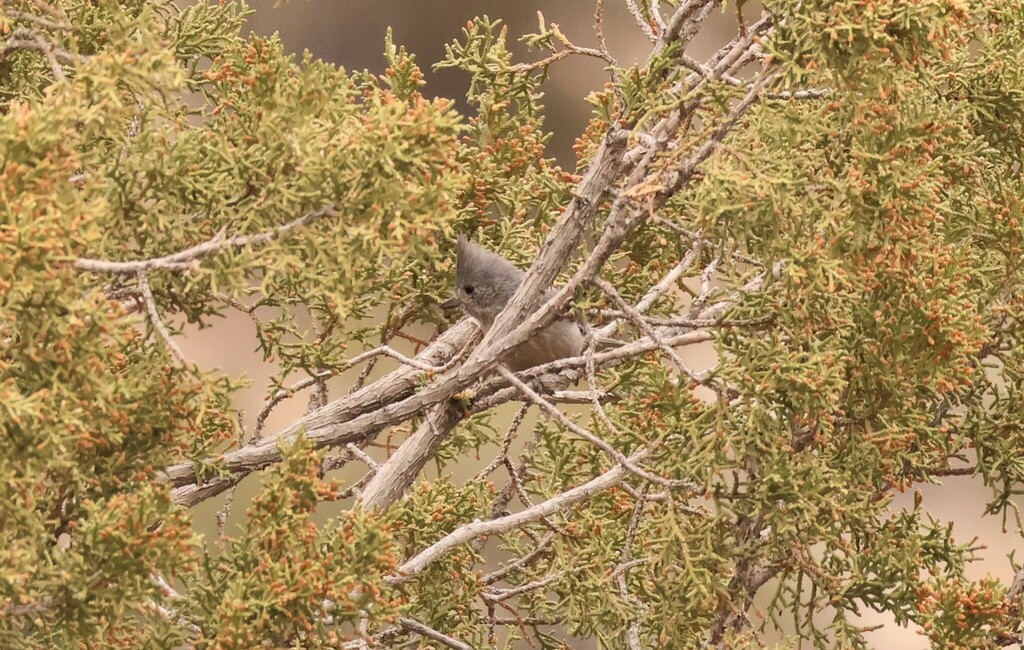
(c) Millie Basden, some rights reserved (CC BY) · licence
Family: Paridae · Class: Aves · Order: Passeriformes
Baeolophus ridgwayi (Juniper Titmouse) is a California animal in the Paridae family.
The Juniper Titmouse is a small, compact songbird measuring 13 to 14 cm (5.1 to 5.5 inches) in length with a wingspan of approximately 20 cm (7.9 inches). Adults weigh between 16 to 21 grams (0.56 to 0.74 ounces). The species displays uniform gray plumage across its body, with slightly darker wings and tail. A distinctive pointed crest adorns the head, which can be raised or lowered depending on the bird's alertness level. The bill is short, black, and pointed, adapted for extracting seeds and small insects. Both sexes appear identical, with juveniles showing similar coloration but with a less pronounced crest and slightly browner tones. The Juniper Titmouse occurs primarily in the Great Basin and intermountain regions of western North America. In California, the species is found along the eastern slopes of the Sierra Nevada, in the Modoc Plateau, and throughout the desert mountain ranges of the southeastern portion of the state, including the White Mountains, Inyo Mountains, and Panamint Range. The range extends into Nevada, Utah, Arizona, and small portions of Idaho and Colorado. California populations represent the westernmost extent of the species' distribution. This species inhabits pinyon-juniper woodlands, typically at elevations ranging from 1,200 to 2,400 meters (3,900 to 7,900 feet). The primary habitat consists of areas dominated by Utah juniper (Juniperus osteosperma), single-leaf pinyon pine (Pinus monophylla), and occasionally big sagebrush (Artemisia tridentata). Juniper Titmouse shows strong fidelity to mature stands with dense canopy cover and established understory vegetation. The species avoids pure sagebrush habitats and requires trees for nesting and roosting. Juniper Titmouse feeds primarily on pine nuts from pinyon pines and juniper berries, supplemented by insects during the breeding season. The diet includes beetles, caterpillars, aphids, and scale insects, which provide essential protein for nestlings. Foraging behavior involves methodical searching of bark crevices and foliage. The species caches seeds and nuts for winter consumption, storing food items in bark furrows and rock crevices within their territory. Breeding occurs from March through July, with pairs typically producing one clutch per year. Females construct nests in natural tree cavities or old woodpecker holes, laying 3 to 7 white eggs spotted with reddish-brown markings. Incubation lasts 14 to 16 days, performed solely by the female. The Juniper Titmouse is not federally listed and maintains stable populations across most of its range according to the North American Breeding Bird Survey. However, habitat conversion and fragmentation of pinyon-juniper woodlands pose localized threats. Climate change may affect the species through shifts in suitable habitat elevation and changes in seed production cycles of primary food sources. Fire suppression practices that alter woodland structure and periodic drought events that reduce seed availability represent additional conservation concerns.
Classification
Class: Aves · Order: Passeriformes · Family: Paridae
Frequently asked questions
How is Baeolophus ridgwayi classified?
Baeolophus ridgwayi belongs to class Aves, order Passeriformes, family Paridae.
What family does Baeolophus ridgwayi belong to?
Baeolophus ridgwayi is in the Paridae family.
What is Baeolophus ridgwayi?
The Juniper Titmouse is a small, compact songbird measuring 13 to 14 cm (5.1 to 5.5 inches) in length with a wingspan of approximately 20 cm (7.9 inches).
Is Baeolophus ridgwayi found in California?
Yes. Baeolophus ridgwayi is recorded in California in The California Species Project's catalogue.
Related species
Other California species in the same genus, family, or bioregion.
Data from The California Species Project — 14,000+ California species with verified data from CNPS, CDFW, USFWS, and more.