Balaenoptera musculus
Blue whale
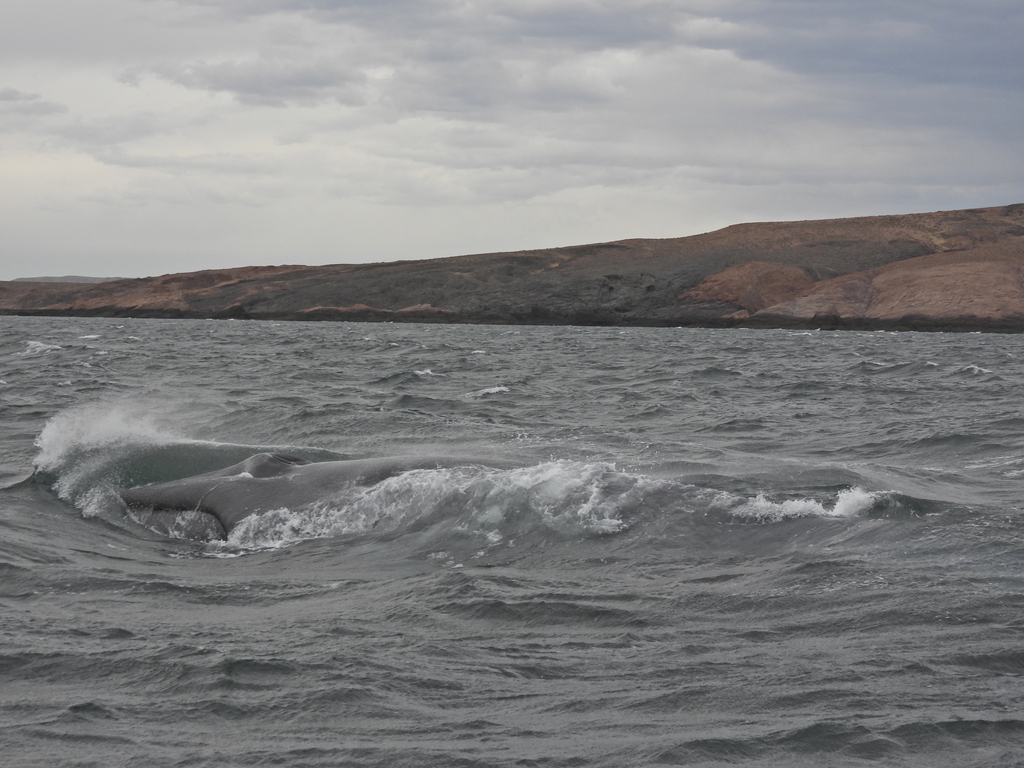
(c) Tomás Tamagno, some rights reserved (CC BY) · licence
Family: Balaenopteridae · Class: Mammalia · Order: Artiodactyla
Conservation status: Endangered
Balaenoptera musculus (Blue whale) is a California animal in the Balaenopteridae family.
The blue whale is the largest animal species known to have existed on Earth. Adults typically measure 24 to 27 meters (79 to 89 feet) in length, with females slightly larger than males. Maximum recorded lengths reach 33 meters (108 feet). Adults weigh between 100 and 200 metric tons, with some individuals exceeding 200 tons. The body is long and streamlined, with a broad, flat head comprising approximately 25% of total body length. The dorsal surface is blue-gray with lighter mottling, while the ventral surface displays yellow coloration from diatom accumulation. The dorsal fin is small and positioned far back on the body. Between 55 and 88 ventral pleats extend from the lower jaw to the navel. Blue whales inhabit global oceans, including waters off California and Hawaii. In California waters, the species occurs year-round but shows seasonal distribution patterns. During summer months, blue whales concentrate in productive upwelling areas along the continental shelf from central California to British Columbia. The Eastern North Pacific population migrates south to breeding areas off Mexico and Central America during winter months. Historical populations were distributed throughout all major ocean basins before commercial whaling reduced numbers significantly. Blue whales prefer deep oceanic waters but frequently feed in areas where upwelling brings nutrients to surface waters. In California, the species is commonly observed over the continental shelf and slope at depths exceeding 200 meters. During feeding periods, blue whales concentrate in areas of high krill density, particularly where Euphausia pacifica and Thysanoessa spinifera aggregate. The species shows strong site fidelity to productive feeding areas. Blue whales are baleen whales that feed almost exclusively on krill through lunge feeding behavior. During feeding, individuals engulf massive volumes of water and krill, then expel water through baleen plates while retaining prey. Daily consumption can reach 3,600 kilograms of krill during peak feeding periods. Breeding occurs during winter months in warm waters, with gestation lasting 10 to 12 months. Females give birth to single calves measuring 6 to 7 meters at birth. Sexual maturity occurs between 8 and 10 years of age. Blue whales produce low-frequency calls below 100 Hz that can travel hundreds of kilometers underwater. The blue whale is listed as endangered under the Endangered Species Act throughout its range. Commercial whaling from 1900 to 1970 reduced global populations from an estimated 350,000 individuals to fewer than 5,000. Current threats include ship strikes, entanglement in fishing gear, noise pollution, and climate change impacts on prey distribution. The Eastern North Pacific population, which includes California waters, has shown recovery with current estimates of approximately 2,500 individuals according to NOAA Fisheries. This represents the largest blue whale population globally. Recovery efforts focus on reducing ship strike mortality, minimizing acoustic disturbance, and monitoring population trends through photo-identification studies and acoustic monitoring programs.
Classification
Class: Mammalia · Order: Artiodactyla · Family: Balaenopteridae
Conservation status
Endangered
Frequently asked questions
How is Balaenoptera musculus classified?
Balaenoptera musculus belongs to class Mammalia, order Artiodactyla, family Balaenopteridae.
What family does Balaenoptera musculus belong to?
Balaenoptera musculus is in the Balaenopteridae family.
Is Balaenoptera musculus protected or of conservation concern?
Balaenoptera musculus carries the following status: Endangered.
What is Balaenoptera musculus?
The blue whale is the largest animal species known to have existed on Earth.
Is Balaenoptera musculus found in California?
Yes. Balaenoptera musculus is recorded in California in The California Species Project's catalogue.
Related species
Other California species in the same genus, family, or bioregion.
Data from The California Species Project — 14,000+ California species with verified data from CNPS, CDFW, USFWS, and more.