Bassaniana utahensis
Utah Crab Spider
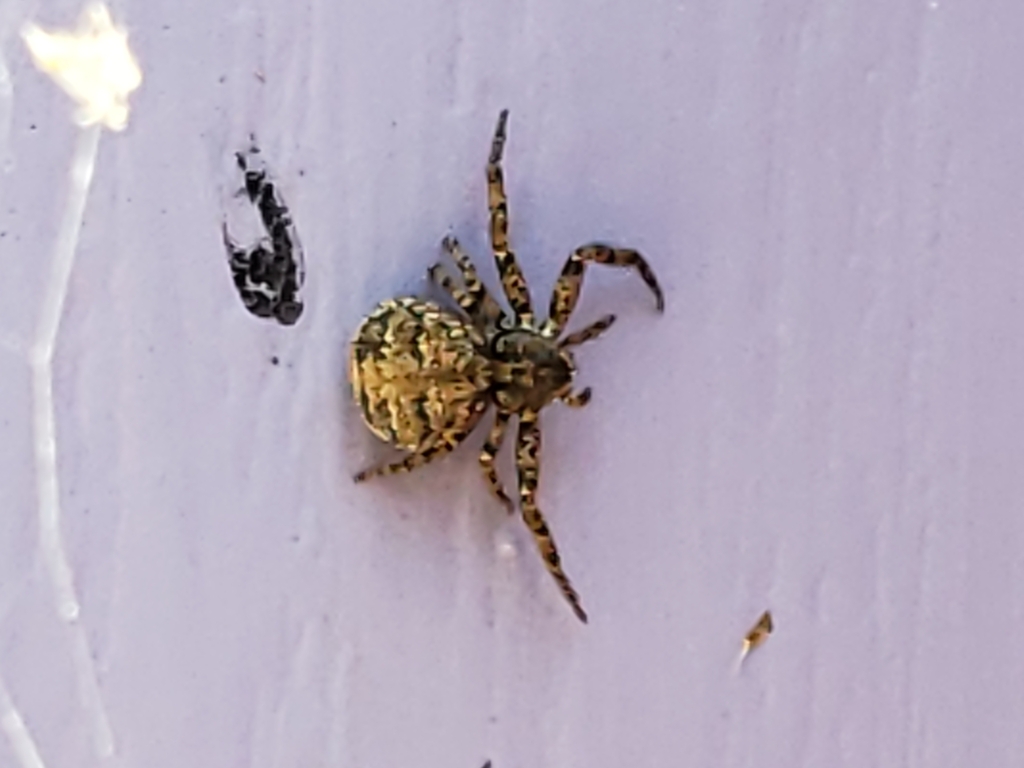
(c) Gavin Slater, some rights reserved (CC BY) · licence
Family: Thomisidae · Class: Arachnida · Order: Araneae
Bassaniana utahensis (Utah Crab Spider) is a California animal in the Thomisidae family.
Bassaniana utahensis, commonly known as the Utah Crab Spider, is a member of the crab spider family Thomisidae. Adult females reach approximately 7 mm in body length (BugGuide.Net). Like other members of the genus Bassaniana, this species is characterized by blunted hairs on the carapace, which distinguishes it from other crab spider genera. The species exhibits the typical crab spider body form with a flattened cephalothorax and the ability to hold their front legs laterally. Despite its common name suggesting a Utah origin, B. utahensis has a broader distribution across western North America. The species occurs from Alberta, Canada southward through the western United States. In Alberta, this is the only Bassaniana species present according to the Checklist of the spiders of Canada and Alaska (BugGuide.Net). The species' presence in California is indicated by its inclusion in taxonomic databases, though specific county-level distribution data within the state remains undocumented. Habitat preferences for B. utahensis appear to be quite general, as documented observations include specimens found on human-made structures such as lawn furniture (BugGuide.Net). This suggests the species may be relatively adaptable to various microhabitats. Like other bark crab spiders in the genus Bassaniana, this species likely occupies bark surfaces, vegetation, and other substrates where they can ambush prey. As an ambush predator typical of the Thomisidae family, B. utahensis likely feeds on small flying insects that come within striking distance. Crab spiders do not build webs for prey capture but instead rely on camouflage and rapid strikes to capture prey with their powerful front legs. Specific prey preferences, hunting behavior, and reproductive biology for this species have not been well documented in the scientific literature. B. utahensis does not appear on federal or state endangered species lists, and no specific conservation concerns have been identified for this species. The lack of detailed ecological studies makes it difficult to assess population trends or specific threats. Like many arthropod species, habitat modification and pesticide use could potentially impact local populations, but no targeted research has documented such effects for this species. Scientific documentation for this species remains extremely limited despite thorough literature searches. The information presented here is based on available sources including BugGuide.Net community observations and basic taxonomic references. Detailed studies of this species' ecology, distribution patterns within California, seasonal activity, and specific habitat requirements are lacking. We welcome contributions of verified scientific data, photographs, or field observations to enhance this species account. Please contact Species List Pro to share additional information about B. utahensis occurrence, behavior, or ecology.
Classification
Class: Arachnida · Order: Araneae · Family: Thomisidae
Frequently asked questions
How is Bassaniana utahensis classified?
Bassaniana utahensis belongs to class Arachnida, order Araneae, family Thomisidae.
What family does Bassaniana utahensis belong to?
Bassaniana utahensis is in the Thomisidae family.
What is Bassaniana utahensis?
Bassaniana utahensis, commonly known as the Utah Crab Spider, is a member of the crab spider family Thomisidae.
Is Bassaniana utahensis found in California?
Yes. Bassaniana utahensis is recorded in California in The California Species Project's catalogue.
Related species
Other California species in the same genus, family, or bioregion.
Data from The California Species Project — 14,000+ California species with verified data from CNPS, CDFW, USFWS, and more.