Batillaria attramentaria
Japanese False Cerith
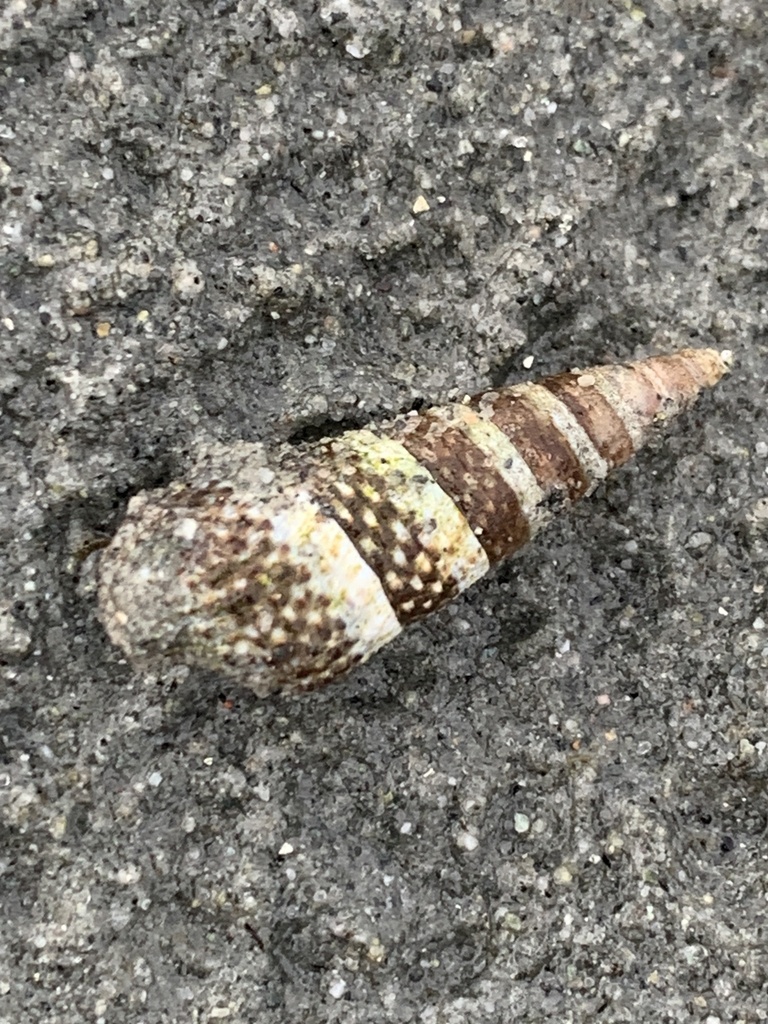
(c) Corvi Zeman, some rights reserved (CC BY) · licence
Family: Batillariidae · Class: Gastropoda · Order: Caenogastropoda
Batillaria attramentaria (Japanese False Cerith) is a California animal in the Batillariidae family.
Batillaria attramentaria, commonly known as the Japanese false cerith or Japanese mud snail, is a marine gastropod mollusk in the family Batillariidae. This intertidal snail is native to coastal waters of Japan and Korea but has become established as an invasive species along the Pacific coast of North America. The species is characterized by its elongated, conical shell with a pointed spire and distinctive spiral ridges. Adults typically measure 20-35 mm in length, with a dark brown to black shell coloration that may show lighter banding patterns. In its native range, B. attramentaria occurs throughout coastal Japan and Korea in intertidal mudflats and estuarine environments. Following introduction to North America, likely through ballast water or shipping activities, the species has established populations along the Pacific coast from British Columbia to California. In California, populations are documented in San Francisco Bay, Tomales Bay, and other estuarine systems along the central and northern coastline. The Japanese false cerith inhabits intertidal mudflats, salt marshes, and estuarine environments with soft sediment substrates. The species demonstrates high tolerance for salinity fluctuations and can survive in both brackish and fully marine conditions. It is typically found in the mid to high intertidal zone, where it can withstand periodic exposure during low tides. The snail shows preference for areas with organic-rich sediments and moderate water flow. Batillaria attramentaria is a deposit feeder that grazes on organic matter, detritus, and microorganisms within sediment and on substrate surfaces. The species exhibits dioecious reproduction, with separate male and female individuals. Reproduction occurs during warmer months, with females depositing egg masses on hard surfaces such as shells, rocks, or other snails. The larval stage includes a planktonic veliger phase that facilitates dispersal. Adults can reach high population densities, particularly in suitable mudflat habitats where they may number in the thousands per square meter. As a non-native species in North American waters, B. attramentaria is considered invasive and poses ecological concerns for native intertidal communities. According to the Global Invasive Species Database, since its arrival in North America, the species has reduced native biodiversity and is known to have decreased populations of native species through competition for space and food resources (IUCN GISD). The snail's high reproductive capacity and tolerance for environmental fluctuations have enabled successful establishment in multiple estuarine systems. Research conducted by the Smithsonian Environmental Research Center indicates that the species' convenient size, high abundance, and localized intertidal distribution have made it a subject of particular conservation concern and ecological research focus. Management efforts focus on monitoring population spread and preventing further introductions to uncolonized estuaries. The species serves as an example of successful marine invasion and highlights the ongoing challenges of managing non-native species in coastal ecosystems.
Classification
Class: Gastropoda · Order: Caenogastropoda · Family: Batillariidae
Frequently asked questions
How is Batillaria attramentaria classified?
Batillaria attramentaria belongs to class Gastropoda, order Caenogastropoda, family Batillariidae.
What family does Batillaria attramentaria belong to?
Batillaria attramentaria is in the Batillariidae family.
What is Batillaria attramentaria?
Batillaria attramentaria, commonly known as the Japanese false cerith or Japanese mud snail, is a marine gastropod mollusk in the family Batillariidae.
Is Batillaria attramentaria found in California?
Yes. Batillaria attramentaria is recorded in California in The California Species Project's catalogue.
More California species
This species has no close relatives in our California data — here are other species to explore.
Data from The California Species Project — 14,000+ California species with verified data from CNPS, CDFW, USFWS, and more.