Batrachoseps altasierrae
Greenhorn Mountains Slender Salamander
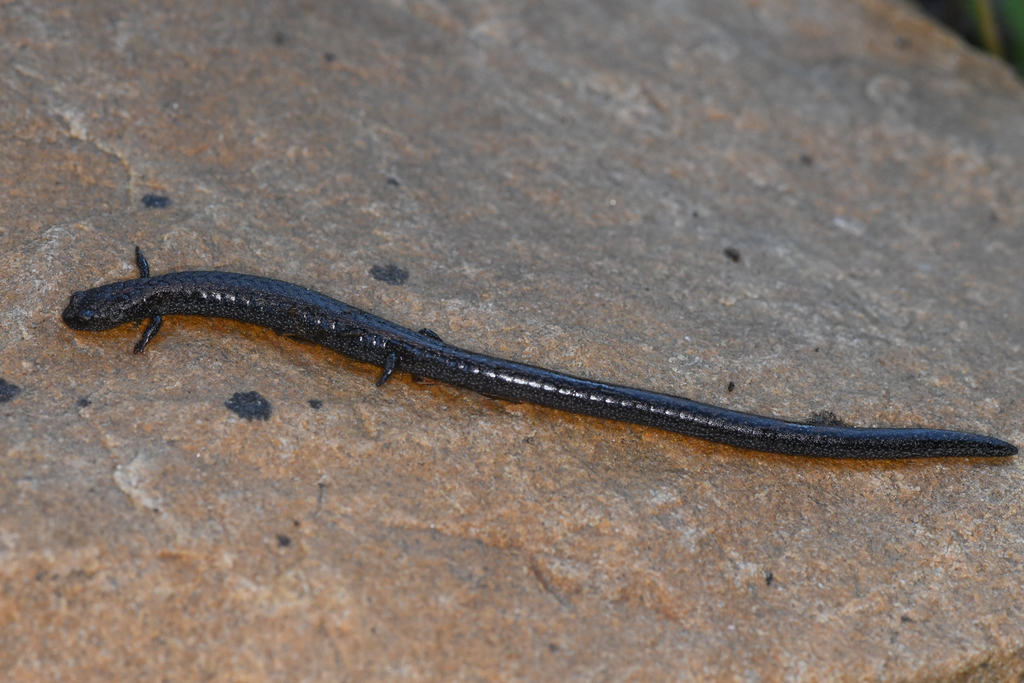
(c) Trevor Van Loon, some rights reserved (CC BY) · licence
Family: Plethodontidae · Class: Amphibia · Order: Caudata
Conservation status: G2 S2
Batrachoseps altasierrae (Greenhorn Mountains Slender Salamander) is a California animal in the Plethodontidae family.
The Greenhorn Mountains Slender Salamander (Batrachoseps altasierrae) is a small terrestrial amphibian endemic to the southern Sierra Nevada of California. This lungless salamander belongs to the family Plethodontidae and represents one of the most geographically restricted salamander species in North America. Adults typically measure 38 to 64 mm (1.5 to 2.5 inches) in total length, with approximately half of this length comprising the tail. The body is characteristically slender with a narrow head and relatively short limbs. Coloration consists of a dark brown to black dorsal surface with lighter bronze or reddish-brown lateral striping. The ventral surface is typically lighter, ranging from gray to pale brown. The species has an extremely limited range, occurring only in the Greenhorn Mountains of Kern County, California. This range represents one of the smallest known distributions for any North American salamander species, encompassing approximately 28 square kilometers (11 square miles) of montane habitat. The species was first described in 2001 from specimens collected near the Greenhorn Summit area. Current known populations occur at elevations between 1,980 and 2,440 meters (6,500 to 8,000 feet) in the Sequoia National Forest. Greenhorn Mountains Slender Salamanders inhabit mixed coniferous forests dominated by white fir (Abies concolor), Jeffrey pine (Pinus jeffreyi), and sugar pine (Pinus lambertiana). The species requires moist microhabitats and is typically found under logs, rocks, bark, and leaf litter in areas with permanent soil moisture. Suitable habitat includes north-facing slopes and areas near seasonal streams or springs where humidity levels remain elevated throughout the dry summer months. The species appears to be associated with specific soil conditions and organic matter accumulation that maintain adequate moisture levels. As a member of the Plethodontidae family, this salamander lacks lungs and conducts gas exchange entirely through its skin and oral cavity. Adults are presumed to feed on small invertebrates including mites, springtails, small beetles, and other arthropods found in the forest floor environment. Reproduction follows the direct development pattern typical of plethodontid salamanders, with females depositing eggs in moist terrestrial locations. Eggs undergo complete development without an aquatic larval stage, hatching as miniature adults. Seasonal activity patterns are likely influenced by moisture availability, with peak surface activity occurring during spring snowmelt and autumn precipitation periods. The Greenhorn Mountains Slender Salamander is classified as G2 S2 under the NatureServe ranking system, indicating it is imperiled both globally and within California. The extremely restricted range makes the species particularly vulnerable to habitat alteration, climate change, and stochastic events. Primary threats include timber management activities, recreational impacts, altered fire regimes, and climate-induced changes in precipitation patterns and snowpack duration. The species' dependence on specific moisture and temperature conditions within its limited montane habitat makes it especially susceptible to warming temperatures and extended drought periods. Conservation efforts focus on habitat protection within the Sequoia National Forest and monitoring of known populations to assess long-term population trends.
Classification
Class: Amphibia · Order: Caudata · Family: Plethodontidae
Conservation status
G2 S2
Frequently asked questions
How is Batrachoseps altasierrae classified?
Batrachoseps altasierrae belongs to class Amphibia, order Caudata, family Plethodontidae.
What family does Batrachoseps altasierrae belong to?
Batrachoseps altasierrae is in the Plethodontidae family.
Is Batrachoseps altasierrae protected or of conservation concern?
Batrachoseps altasierrae carries the following status: G2 S2.
What is Batrachoseps altasierrae?
The Greenhorn Mountains Slender Salamander (Batrachoseps altasierrae) is a small terrestrial amphibian endemic to the southern Sierra Nevada of California.
Is Batrachoseps altasierrae found in California?
Yes. Batrachoseps altasierrae is recorded in California in The California Species Project's catalogue.
Related species
Other California species in the same genus, family, or bioregion.
Data from The California Species Project — 14,000+ California species with verified data from CNPS, CDFW, USFWS, and more.