Batrachoseps attenuatus
California Slender Salamander
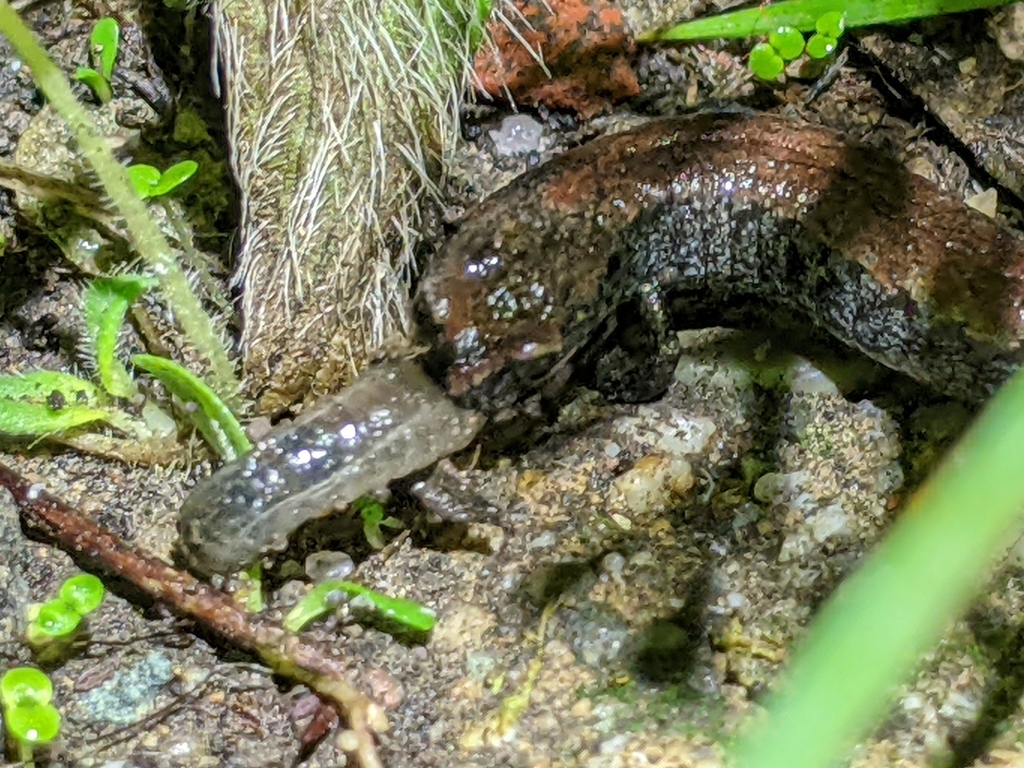
(c) Ken-ichi Ueda, some rights reserved (CC BY) · licence
Family: Plethodontidae · Class: Amphibia · Order: Caudata
Batrachoseps attenuatus (California Slender Salamander) is a California animal in the Plethodontidae family.
The California slender salamander (Batrachoseps attenuatus) is a small, elongate terrestrial salamander endemic to California. Adults typically measure 32-57 mm (1.3-2.2 inches) in snout-vent length, with a total length including tail reaching 75-140 mm (3.0-5.5 inches). The body is extremely slender with a narrow head and relatively short limbs. Coloration varies from dark brown to black dorsally, often with a reddish-brown, yellow, or tan dorsal stripe extending from the head to the tail tip. The ventral surface is typically lighter, ranging from gray to black with white flecking. Adults possess 18-21 trunk vertebrae and typically 4 toes on the hind feet, distinguishing them from other Batrachoseps species. This species is endemic to California, with a distribution extending from Humboldt County in the north to Monterey County in the south. The range includes the Coast Ranges and western slopes of the Sierra Nevada foothills, primarily west of the Central Valley. Populations occur from sea level to approximately 1,220 meters (4,000 feet) elevation. Historical records indicate the species was once more widely distributed, but current populations are fragmented due to habitat loss and urbanization. California slender salamanders inhabit a variety of woodland and forest environments, including oak woodlands, mixed evergreen forests, and redwood forests. They require moist microhabitats and are typically found under logs, rocks, bark, leaf litter, and in talus slopes. The species shows a preference for areas with moderate canopy cover that maintain soil moisture. They are also found in human-modified habitats including gardens and parks where suitable cover objects and moisture are present. As lungless salamanders (family Plethodontidae), California slender salamanders respire entirely through their skin and must maintain moisture to prevent desiccation. They are primarily nocturnal and surface active during cool, moist conditions, particularly during fall and winter rains. The species feeds on small arthropods including mites, springtails, small spiders, and insect larvae. Reproduction is terrestrial, with females depositing 4-21 eggs in moist locations such as under logs or in rock crevices during late fall and winter. Eggs undergo direct development without an aquatic larval stage, hatching as miniature adults after 3-4 months. Sexual maturity is reached at 2-3 years of age. Currently, the California slender salamander has no federal or state listing status, though populations face ongoing threats from habitat loss due to urban development, agriculture, and timber harvesting. Climate change poses additional risks through altered precipitation patterns and increased temperatures that could reduce suitable habitat. The species' limited dispersal ability and specific moisture requirements make populations vulnerable to habitat fragmentation. Some populations occur within protected areas including state parks and preserves, but comprehensive population monitoring is limited. Conservation efforts focus on habitat protection and maintaining connectivity between fragmented populations.
Classification
Class: Amphibia · Order: Caudata · Family: Plethodontidae
Frequently asked questions
How is Batrachoseps attenuatus classified?
Batrachoseps attenuatus belongs to class Amphibia, order Caudata, family Plethodontidae.
What family does Batrachoseps attenuatus belong to?
Batrachoseps attenuatus is in the Plethodontidae family.
What is Batrachoseps attenuatus?
The California slender salamander (Batrachoseps attenuatus) is a small, elongate terrestrial salamander endemic to California.
Is Batrachoseps attenuatus found in California?
Yes. Batrachoseps attenuatus is recorded in California in The California Species Project's catalogue.
Related species
Other California species in the same genus, family, or bioregion.
Data from The California Species Project — 14,000+ California species with verified data from CNPS, CDFW, USFWS, and more.