Batrachoseps bramei
Fairview Slender Salamander
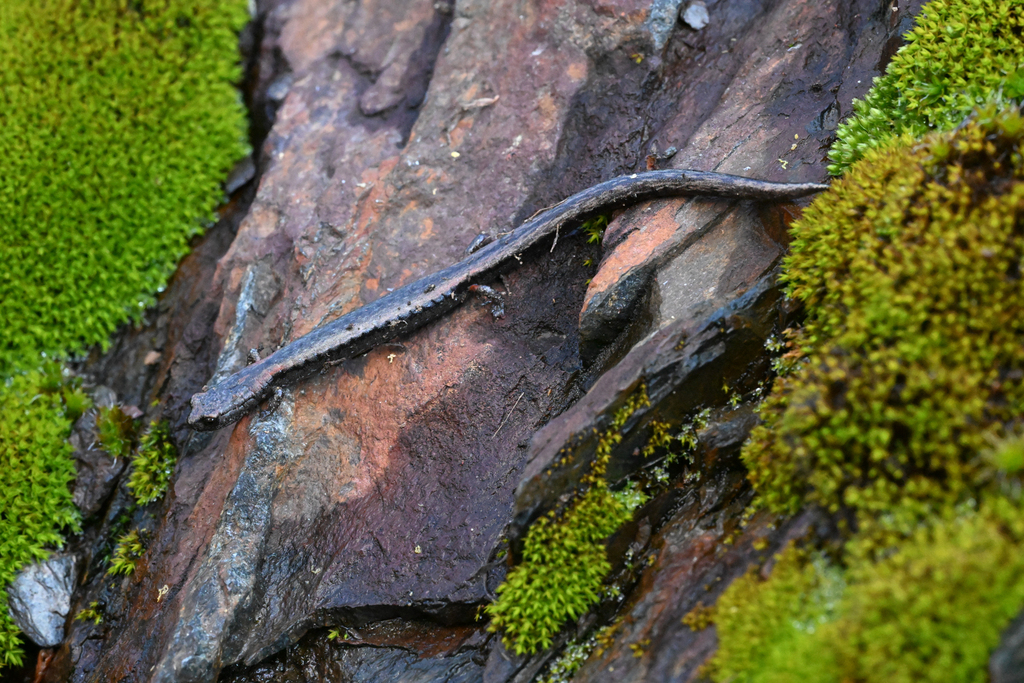
(c) Trevor Van Loon, some rights reserved (CC BY) · licence
Family: Plethodontidae · Class: Amphibia · Order: Caudata
Conservation status: G3 S3
Batrachoseps bramei (Fairview Slender Salamander) is a California animal in the Plethodontidae family.
The Fairview slender salamander (Batrachoseps bramei) is a small terrestrial amphibian endemic to a limited area of southern California. Adults typically measure 35 to 50 mm (1.4 to 2.0 inches) in snout-vent length, with a total length including tail reaching 85 to 110 mm (3.3 to 4.3 inches). The species exhibits the characteristic elongated body form of the genus Batrachoseps, with a narrow head, reduced limbs, and cylindrical tail that comprises approximately 60% of total body length. The dorsal surface displays bronze to reddish-brown coloration with a darker dorsal stripe, while the ventral surface is lighter gray to tan. Males can be distinguished from females by their mental glands and nasolabial protuberances during breeding season. This species has an extremely restricted range, occurring only in the Santa Monica Mountains of Los Angeles and Ventura counties. The type locality is from the Fairview area near the boundary of Topanga State Park. Current distribution is limited to approximately 15 square kilometers in coastal mountain terrain, representing one of the smallest ranges of any North American salamander species. Historical records suggest the species may have had a slightly broader distribution within the Santa Monica Mountains prior to urban development. Fairview slender salamanders inhabit oak woodland and chaparral communities at elevations ranging from 150 to 600 meters (490 to 1,970 feet). The species requires specific microhabitat conditions, typically occurring under rocks, logs, and leaf litter in areas with adequate moisture retention. Suitable habitat is characterized by north-facing slopes with dense canopy cover, particularly areas dominated by coast live oak (Quercus agrifolia) and California bay laurel (Umbellularia californica). The species shows strong association with talus slopes and areas with decomposing organic matter. As a lungless salamander, Batrachoseps bramei respires entirely through its skin and requires consistently moist conditions. The species is primarily nocturnal and exhibits peak surface activity during cool, humid nights, particularly following precipitation events. Reproduction is terrestrial, with females depositing 8 to 15 eggs in underground chambers or beneath rocks during winter months. Eggs undergo direct development without an aquatic larval stage, hatching as miniature adults after approximately 6 months. The diet consists primarily of small arthropods including springtails, mites, and small beetles. The species is assigned a conservation rank of G3 S3, indicating it is vulnerable both globally and within California. Primary threats include habitat loss and fragmentation due to urban development, altered fire regimes, and climate change effects including increased drought frequency and temperature extremes. The limited range makes the species particularly vulnerable to stochastic events and habitat degradation. Conservation efforts focus on protecting existing habitat within public lands and monitoring population trends to detect potential declines.
Classification
Class: Amphibia · Order: Caudata · Family: Plethodontidae
Conservation status
G3 S3
Frequently asked questions
How is Batrachoseps bramei classified?
Batrachoseps bramei belongs to class Amphibia, order Caudata, family Plethodontidae.
What family does Batrachoseps bramei belong to?
Batrachoseps bramei is in the Plethodontidae family.
Is Batrachoseps bramei protected or of conservation concern?
Batrachoseps bramei carries the following status: G3 S3.
What is Batrachoseps bramei?
The Fairview slender salamander (Batrachoseps bramei) is a small terrestrial amphibian endemic to a limited area of southern California.
Is Batrachoseps bramei found in California?
Yes. Batrachoseps bramei is recorded in California in The California Species Project's catalogue.
Related species
Other California species in the same genus, family, or bioregion.
Data from The California Species Project — 14,000+ California species with verified data from CNPS, CDFW, USFWS, and more.