Batrachoseps campi
Inyo Mountains Slender Salamander
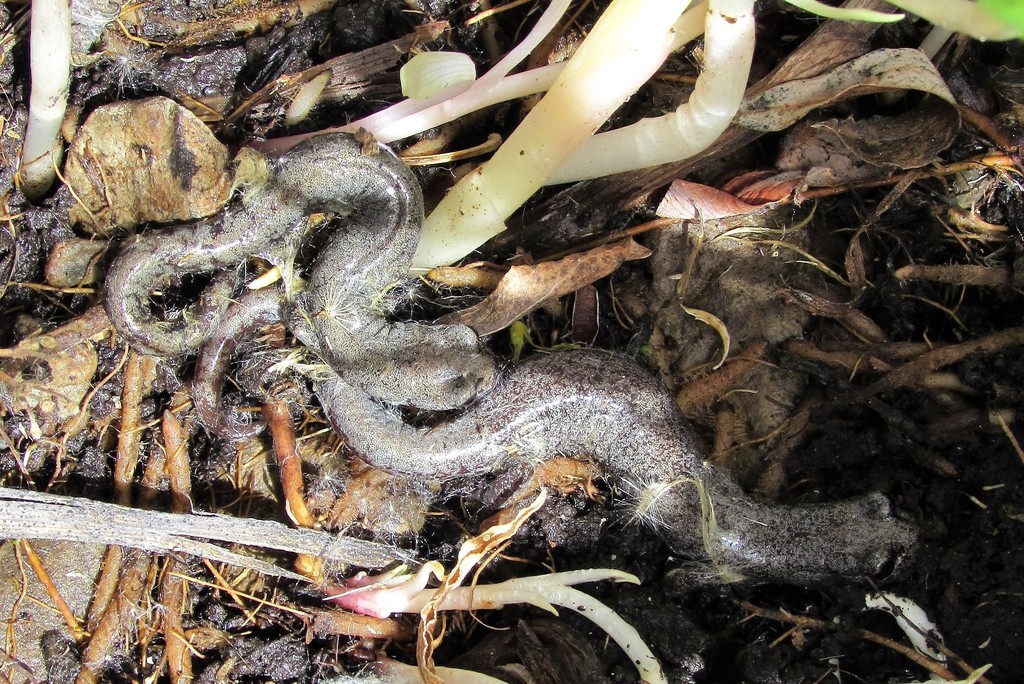
(c) Matt D'Agrosa, some rights reserved (CC BY) · licence
Family: Plethodontidae · Class: Amphibia · Order: Caudata
Conservation status: G3 S3
Batrachoseps campi (Inyo Mountains Slender Salamander) is a California animal in the Plethodontidae family.
The Inyo Mountains slender salamander is a small, terrestrial amphibian endemic to the eastern Sierra Nevada of California. Adults typically measure 35 to 50 mm (1.4 to 2.0 inches) in snout-vent length, with a total length including tail of 85 to 120 mm (3.3 to 4.7 inches). The body is elongate and cylindrical with relatively short legs and a long, slender tail that comprises approximately 60% of total body length. Coloration consists of a dark brown to black dorsal surface with a distinctive reddish-brown or bronze dorsal stripe running from head to tail tip. The ventral surface is lighter, ranging from gray to pale brown with small dark flecks. This species is restricted to the Inyo Mountains of eastern California, specifically occurring in Inyo County. The range extends along the eastern escarpment of the Sierra Nevada, with documented populations in rocky talus slopes and canyon systems between approximately 1,200 and 2,400 meters (3,900 to 7,900 feet) elevation. Known localities include areas near Independence and Lone Pine, though the species' distribution within suitable habitat appears patchy and discontinuous. Inyo Mountains slender salamanders inhabit rocky environments characterized by granite talus fields, boulder piles, and rocky outcrops with sufficient moisture retention. The species requires areas with permanent or semi-permanent moisture, typically found beneath rocks and in crevices where humidity levels remain elevated. Preferred microhabitats include spaces between large boulders and under rock slabs where temperature remains relatively stable and desiccation risk is minimized. Vegetation in occupied areas is typically sparse, consisting of drought-adapted shrubs and scattered pinyon pine. Like other plethodontid salamanders, this species exhibits direct development without an aquatic larval stage. Females deposit small clutches of eggs in underground retreats during late spring or early summer. The eggs develop directly into miniature adults without metamorphosis. Adults are active primarily during cooler, moist periods and retreat deep into rock crevices during dry conditions or extreme temperatures. The species feeds on small arthropods including springtails, mites, small beetles, and other invertebrates found in the rocky substrate. Individuals may remain inactive for extended periods during unfavorable environmental conditions. The Inyo Mountains slender salamander is considered a species of conservation concern due to its extremely limited range and specialized habitat requirements. The Global and State ranks of G3 S3 indicate the species is vulnerable to extirpation, with populations facing potential threats from climate change, habitat alteration, and water availability changes in the arid eastern Sierra region. The species' dependence on specific moisture and temperature regimes within rocky habitats makes it particularly susceptible to environmental changes. Long-term monitoring is needed to assess population trends and habitat stability, as many slender salamander populations in California have experienced declines due to environmental stressors and habitat fragmentation.
Classification
Class: Amphibia · Order: Caudata · Family: Plethodontidae
Conservation status
G3 S3
Frequently asked questions
How is Batrachoseps campi classified?
Batrachoseps campi belongs to class Amphibia, order Caudata, family Plethodontidae.
What family does Batrachoseps campi belong to?
Batrachoseps campi is in the Plethodontidae family.
Is Batrachoseps campi protected or of conservation concern?
Batrachoseps campi carries the following status: G3 S3.
What is Batrachoseps campi?
The Inyo Mountains slender salamander is a small, terrestrial amphibian endemic to the eastern Sierra Nevada of California.
Is Batrachoseps campi found in California?
Yes. Batrachoseps campi is recorded in California in The California Species Project's catalogue.
Related species
Other California species in the same genus, family, or bioregion.
Data from The California Species Project — 14,000+ California species with verified data from CNPS, CDFW, USFWS, and more.