Batrachoseps diabolicus
Hell Hollow Slender Salamander
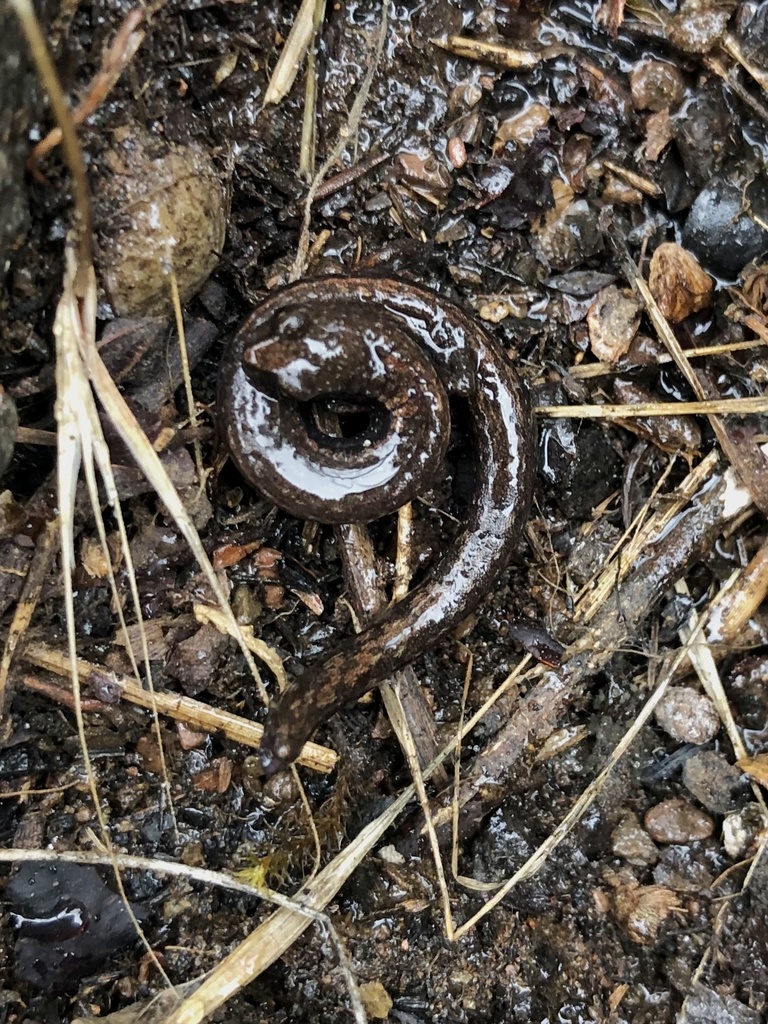
(c) Matt D'Agrosa, some rights reserved (CC BY) · licence
Family: Plethodontidae · Class: Amphibia · Order: Caudata
Conservation status: G3 S3
Batrachoseps diabolicus (Hell Hollow Slender Salamander) is a California animal in the Plethodontidae family.
The Hell Hollow slender salamander (Batrachoseps diabolicus) is a small terrestrial amphibian endemic to California's North Coast Range. Adults typically measure 35-45 mm (1.4-1.8 inches) in snout-vent length, with a total length including tail reaching 70-90 mm (2.8-3.5 inches). The species exhibits the characteristic slender body form of the genus Batrachoseps, with relatively short limbs and a long, cylindrical tail. Dorsal coloration ranges from dark brown to nearly black, often with a reddish-brown stripe running along the back. The ventral surface is typically lighter, displaying gray to brownish tones with darker flecking. This species has an extremely restricted range, known only from the Hell Hollow area in Lake County, California, within the Mayacamas Mountains. The type locality encompasses steep, north-facing slopes at elevations between 600-900 meters (1,970-2,950 feet). The distribution appears to be limited to a few square kilometers, making it one of California's most geographically restricted salamander species. Hell Hollow slender salamanders inhabit mixed evergreen forest dominated by Douglas fir (Pseudotsuga menziesii), canyon live oak (Quercus chrysolepis), and madrone (Arbutus menziesii). The species requires moist microhabitats with abundant surface cover, including fallen logs, bark, leaf litter, and rock crevices. These salamanders are typically found under decaying organic matter on steep slopes where moisture levels remain relatively constant throughout the dry season. The forest canopy provides critical protection from desiccation during California's Mediterranean climate dry period. As a lungless salamander, Batrachoseps diabolicus breathes entirely through its skin and must maintain moisture to survive. The species is most active during the wet season from October through April, when individuals can be found foraging on the surface at night. During dry periods, salamanders retreat deep into talus slopes, root channels, and other subsurface refugia. Their diet consists primarily of small invertebrates including springtails, mites, small beetles, and other arthropods found in the leaf litter and soil layers. Reproduction occurs during winter months, with females depositing small clusters of eggs in moist underground sites. Development is direct, with young hatching as miniature adults without an aquatic larval stage. The species carries a Global and State conservation rank of G3/S3, indicating it is vulnerable to extinction. The extremely limited range makes Hell Hollow slender salamanders particularly susceptible to habitat destruction, climate change, and stochastic events. Primary threats include logging activities, residential development pressure, altered fire regimes, and prolonged drought conditions that could eliminate critical moisture refugia. Forest management practices that remove canopy cover or disturb soil layers pose significant risks to population persistence. Climate change projections suggest increasing temperatures and reduced summer fog penetration could further restrict suitable habitat. Conservation efforts focus on habitat protection within the known range and monitoring of population trends to detect early warning signs of decline.
Classification
Class: Amphibia · Order: Caudata · Family: Plethodontidae
Conservation status
G3 S3
Frequently asked questions
How is Batrachoseps diabolicus classified?
Batrachoseps diabolicus belongs to class Amphibia, order Caudata, family Plethodontidae.
What family does Batrachoseps diabolicus belong to?
Batrachoseps diabolicus is in the Plethodontidae family.
Is Batrachoseps diabolicus protected or of conservation concern?
Batrachoseps diabolicus carries the following status: G3 S3.
What is Batrachoseps diabolicus?
The Hell Hollow slender salamander (Batrachoseps diabolicus) is a small terrestrial amphibian endemic to California's North Coast Range.
Is Batrachoseps diabolicus found in California?
Yes. Batrachoseps diabolicus is recorded in California in The California Species Project's catalogue.
Related species
Other California species in the same genus, family, or bioregion.
Data from The California Species Project — 14,000+ California species with verified data from CNPS, CDFW, USFWS, and more.