Batrachoseps gregarius
Gregarious Slender Salamander
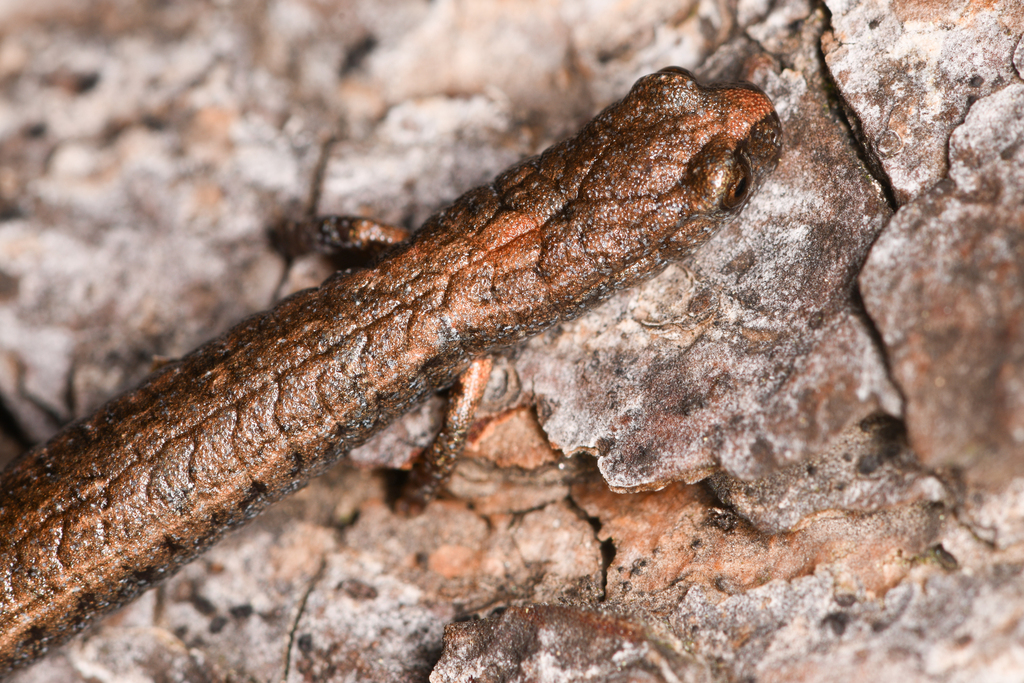
(c) Trevor Van Loon, some rights reserved (CC BY) · licence
Family: Plethodontidae · Class: Amphibia · Order: Caudata
Batrachoseps gregarius (Gregarious Slender Salamander) is a California animal in the Plethodontidae family.
The gregarious slender salamander (Batrachoseps gregarius) is a small terrestrial amphibian endemic to California. Adults typically measure 35 to 55 mm (1.4 to 2.2 inches) in snout-vent length, with a total length including tail of 70 to 110 mm (2.8 to 4.3 inches). The body is elongate and slender with short legs and a relatively long tail. Dorsal coloration ranges from dark brown to black with a prominent reddish-brown dorsal stripe extending from the head to the tail base. The ventral surface is typically dark gray to black with fine white speckling. The species has 18 to 20 trunk vertebrae and four toes on both front and hind feet, distinguishing it from five-toed salamander species. This species is endemic to the Santa Lucia Mountains of central California, with a distribution restricted to Monterey and San Luis Obispo counties. The range extends from the Carmel River drainage south to the vicinity of Cambria, occurring primarily on the western slopes of the Santa Lucia Range. Elevational distribution ranges from near sea level to approximately 1,220 meters (4,000 feet), with most populations occurring between 150 and 900 meters (500 to 3,000 feet) elevation. Gregarious slender salamanders inhabit coastal redwood forests, mixed evergreen forests, and oak woodlands. The species shows strong association with areas containing coast redwood (Sequoia sempervirens), Douglas fir (Pseudotsuga menziesii), and tanoak (Notholithocarpus densiflorus). Microhabitat requirements include moist soil, leaf litter, rotting logs, and rock crevices that provide shelter and maintain adequate moisture levels. The species is surface-active during periods of high humidity and rainfall, typically from October through April. Like other plethodontid salamanders, this species lacks lungs and relies entirely on cutaneous respiration through the skin. Reproduction is terrestrial, with females depositing small clutches of eggs in moist underground chambers during late fall and winter months. Eggs undergo direct development without an aquatic larval stage, hatching as miniature adults after approximately 4 to 6 months. The species feeds primarily on small arthropods including mites, springtails, small beetles, and other invertebrates found in leaf litter and soil. The gregarious slender salamander faces several conservation challenges. Habitat loss and fragmentation due to residential development, logging, and land conversion represent primary threats, particularly in coastal areas experiencing development pressure. The species' limited range and specific habitat requirements make populations vulnerable to localized disturbances. Climate change poses additional concerns through altered precipitation patterns and increased frequency of drought conditions, which could reduce suitable moisture levels in breeding and foraging habitats. Fire management practices that remove understory vegetation and alter forest structure may also impact habitat quality. Currently, the species lacks federal or state listing status, though continued monitoring is warranted given its restricted distribution and habitat specificity.
Classification
Class: Amphibia · Order: Caudata · Family: Plethodontidae
Frequently asked questions
How is Batrachoseps gregarius classified?
Batrachoseps gregarius belongs to class Amphibia, order Caudata, family Plethodontidae.
What family does Batrachoseps gregarius belong to?
Batrachoseps gregarius is in the Plethodontidae family.
What is Batrachoseps gregarius?
The gregarious slender salamander (Batrachoseps gregarius) is a small terrestrial amphibian endemic to California.
Is Batrachoseps gregarius found in California?
Yes. Batrachoseps gregarius is recorded in California in The California Species Project's catalogue.
Related species
Other California species in the same genus, family, or bioregion.
Data from The California Species Project — 14,000+ California species with verified data from CNPS, CDFW, USFWS, and more.