Batrachoseps incognitus
San Simeon Slender Salamander
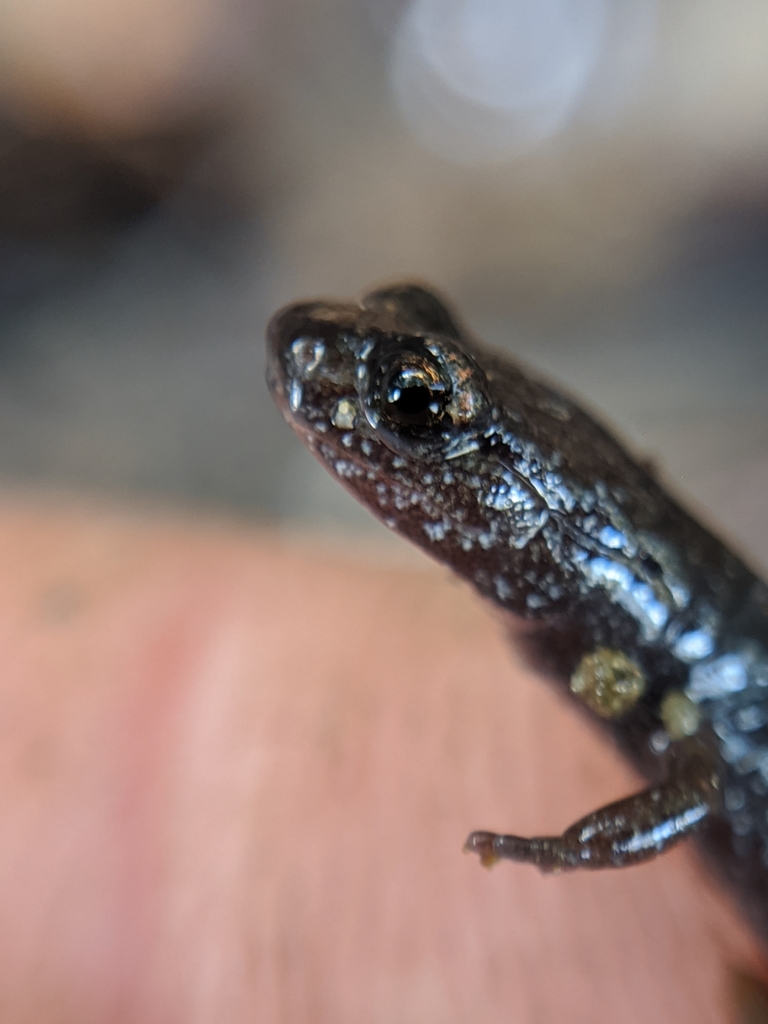
no rights reserved · CC0
Family: Plethodontidae · Class: Amphibia · Order: Caudata
Conservation status: G2 S2
Batrachoseps incognitus (San Simeon Slender Salamander) is a California animal in the Plethodontidae family.
The San Simeon slender salamander (Batrachoseps incognitus) is a small terrestrial amphibian endemic to a limited area along California's central coast. Adults typically measure 35-50 mm (1.4-2.0 inches) in snout-vent length, with a total length including tail of 75-95 mm (3.0-3.7 inches). The species exhibits the characteristic body plan of slender salamanders, with an elongated, narrow body, short legs, and a long tail that comprises approximately 60% of total body length. The dorsal coloration ranges from dark brown to reddish-brown with a distinctive lighter dorsal stripe running from head to tail tip. The ventral surface is typically lighter, appearing gray to pale brown. Males can be distinguished from females during breeding season by enlarged mental glands and a more swollen cloacal region. Batrachoseus incognitus occurs in an extremely restricted range along the central California coast near San Simeon in San Luis Obispo County. The species' distribution encompasses approximately 25 square kilometers of coastal hills and marine terraces. This limited range represents one of the smallest distributions of any North American salamander species. Historical records suggest the species may have occurred slightly further inland, but current populations are confined to areas within 8 kilometers of the Pacific Ocean. The species inhabits coastal scrub and oak woodland communities at elevations ranging from sea level to approximately 300 meters (980 feet). San Simeon slender salamanders require specific microhabitat conditions, typically found beneath rocks, logs, and leaf litter in areas with moderate to high soil moisture. The species shows strong associations with north-facing slopes and canyon bottoms where fog penetration maintains higher humidity levels. Suitable habitat includes areas with scattered coast live oak (Quercus agrifolia), California sagebrush (Artemisia californica), and coyote brush (Baccharis pilularis). The salamanders require refugia that remain moist throughout the dry summer months. San Simeon slender salamanders are lungless, breathing entirely through their skin and mouth lining, which necessitates maintaining constant skin moisture. The species is primarily nocturnal and exhibits surface activity during cool, humid nights, particularly following rain events. Diet consists of small invertebrates including springtails, mites, small beetles, and fly larvae. Reproduction is terrestrial, with females depositing 4-12 eggs in underground chambers during late fall and early winter. Eggs undergo direct development without an aquatic larval stage, hatching as miniature adults after approximately 4-6 months. Sexual maturity is reached at 2-3 years of age. The San Simeon slender salamander is assigned a global rank of G2 (imperiled) and state rank of S2 (imperiled in California), reflecting its extremely limited distribution and small population size. Primary threats include habitat loss from coastal development, livestock grazing, and invasive plant species. Climate change poses additional risks through altered precipitation patterns and increased temperatures that could reduce suitable microhabitat. Fire suppression has led to increased vegetation density in some areas, potentially degrading habitat quality. The species' restricted range makes it particularly vulnerable to stochastic events and local extinctions.
Classification
Class: Amphibia · Order: Caudata · Family: Plethodontidae
Conservation status
G2 S2
Frequently asked questions
How is Batrachoseps incognitus classified?
Batrachoseps incognitus belongs to class Amphibia, order Caudata, family Plethodontidae.
What family does Batrachoseps incognitus belong to?
Batrachoseps incognitus is in the Plethodontidae family.
Is Batrachoseps incognitus protected or of conservation concern?
Batrachoseps incognitus carries the following status: G2 S2.
What is Batrachoseps incognitus?
The San Simeon slender salamander (Batrachoseps incognitus) is a small terrestrial amphibian endemic to a limited area along California's central coast.
Is Batrachoseps incognitus found in California?
Yes. Batrachoseps incognitus is recorded in California in The California Species Project's catalogue.
Related species
Other California species in the same genus, family, or bioregion.
Data from The California Species Project — 14,000+ California species with verified data from CNPS, CDFW, USFWS, and more.